Peak Season is moving upstream
Black Friday lands on 27 November, followed by Cyber Monday on 30 November. Yet peak season is no longer confined to late November. Commercial activity now begins earlier in the autumn, spreads across more channels and builds through several distinct promotional waves before reaching December, when delivery cut-offs and product availability take over.
The calendar is expanding
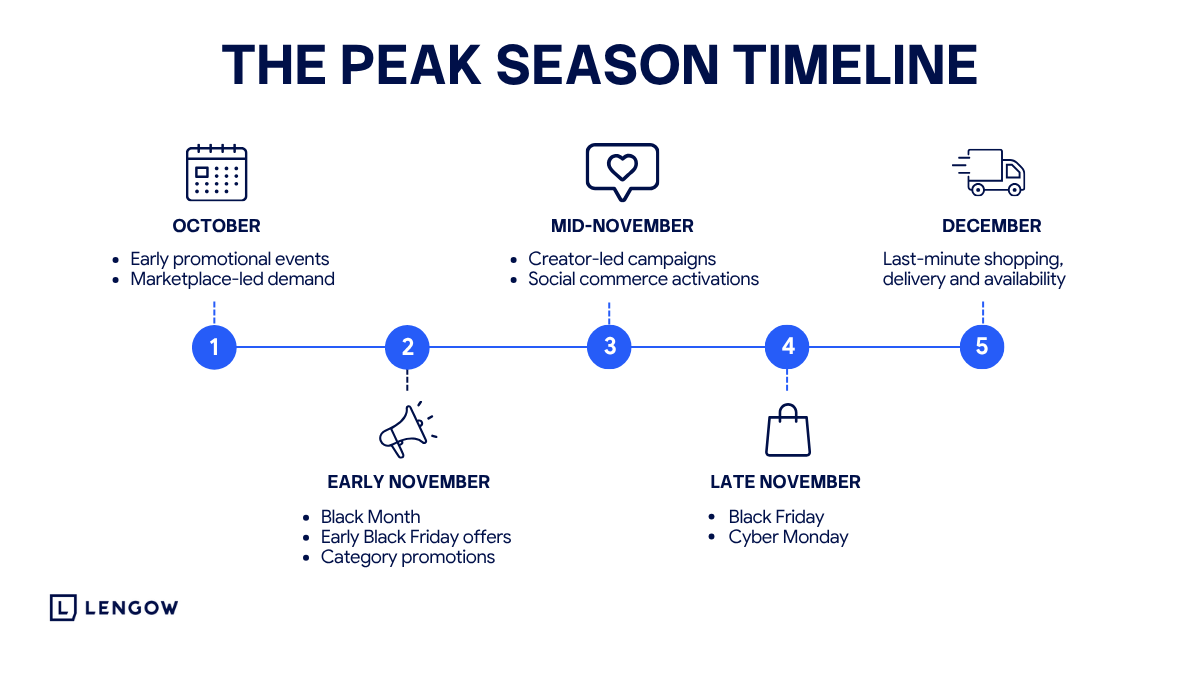
Several other events add momentum to the wider season, including Singles’ Day, Early Access, Cyber Week and Christmas cut-off dates. Their commercial weight varies by market, category and merchant model: not every retailer needs to activate every date, and products rarely benefit from the same promotional window.
These moments shape different stages of the shopping journey. Some shoppers research and compare offers early, while others wait for the strongest promotions around Black Friday. Peak Season is therefore becoming a longer and more uneven journey from discovery to purchase.
Why shoppers are starting earlier
The earlier start is driven by a combination of tighter value expectations and changing discovery habits:
- Value makes shoppers more deliberate: Bain expects 2026 holiday sales to grow by 3.5% in the UK, 2.5% in France and 2% in Germany. It also notes that inflation accounts for a significant share of this growth, rather than a comparable increase in sales volume. In a volume-flat market, shoppers compare prices more methodically and wait for genuine discounts rather than buying on impulse.
- Research starts before Black Friday: in a study of 10,240 consumers across ten markets, including seven in Europe, BCG found that nearly 60% begin researching deals in October or early November. Yet 77% deliberately postpone purchases to capitalise on Black Friday pricing, while 28% keep looking for late opportunities.
- Discovery is spreading across channels: Bain’s survey of 3,113 consumers in the UK, France and Germany shows that Amazon remains a major starting point for product searches. At the same time, generative AI is reshaping early research among younger demographics, with nearly half of Gen Z respondents initiating product queries on AI platforms.
The result is a longer shopping journey with different types of intent at different points in the season. A shopper browsing in October may track items, compare options during Black Friday week, and return in mid-December for final essentials based strictly on shipping reliability.
What major retailers and platforms are doing
Major platforms are reshaping the peak season calendar. They launch their own promotional events, extend the period of active offers and bring product discovery closer to purchase. In doing so, they influence both when shoppers start looking and when retailers need to be ready.
Amazon: turning October into an early peak
Amazon Prime Big Deal Days took place on 6 and 7 October 2026, anchoring October as the first major promotional surge of the season. During the two-day event, Adobe Analytics recorded $9.86 billion in online sales across US retailers, up 8.5% year on year, according to Digital Commerce 360.
Crucially, this growth reflects spend across the wider retail market, not just on Amazon itself. The event creates a halo effect: it prompts competing retailers to bring campaigns forward, forcing brands to align inventory, feeds and promotional budgets well before November begins.
Cdiscount: extending Black Friday into Black Month
Cdiscount formalised this calendar stretch with its 2026 Black Month, launched on 2 November. The campaign spans high-demand categories including consumer electronics, home appliances, toys, fashion, groceries and travel.
Rather than concentrating promotional volume on a single weekend, Cdiscount treats Black Friday as a month-long sequence. This approach allows different categories to lead at different points in November, helping manage warehouse throughput while keeping shoppers engaged over several weeks.
TikTok Shop: combining discovery and conversion
On TikTok, holiday discovery can begin before shoppers have a specific product in mind. The platform reported a 263% month-on-month increase in #holidayshopping content in September, reflecting growing interest in holiday ideas and inspiration.
TikTok Shop shortens the distance between inspiration and checkout. By rolling out activations ahead of Black Friday weekend, the platform uses creator content, native search and live video to shape consideration and drive immediate purchases in a single interface.
With over 100,000 businesses now active on TikTok Shop across European markets, content-led commerce is becoming an established component of the European peak season mix.
These platforms illustrate three distinct shifts: Amazon pulls the initial demand peak forward into October, Cdiscount stretches the promotional window across November, and TikTok collapses discovery and purchase into a continuous feed.
How retailers can take advantage of the earlier Peak Season
A successful Black Friday e-commerce strategy requires operational flexibility. Merchants need mechanisms to adapt as commercial conditions evolve between October and late December.
Align with relevant marketplace events
Each marketplace event calls for its own product selection and listing strategy. Prime Big Deal Days, Cdiscount’s Black Month and TikTok Shop’s Black Friday campaign attract different shoppers and follow different commercial requirements.
Retailers can use these differences to decide which product ranges to prioritise for each channel, adjusting category mappings, attributes, titles, pricing and promotional badges accordingly. Not every product needs to appear everywhere, and the master catalogue should not have to change every time a marketplace campaign starts.
Lengow supports this segmentation through NetMarkets, allowing brands and retailers to adapt catalogue data, custom attributes and product selections for each marketplace from a central platform.
Keep product advertising aligned with live catalogue conditions
During peak season, advertising feeds can become misaligned within hours as prices, promotional badges and stock levels fluctuate. Continuing to spend media budget on items that are out of stock, no longer discounted or delivering negative margins directly erodes profitability.
Automated feed rules help teams maintain alignment without manual intervention:
- Pausing visibility on out-of-stock, low-margin or underperforming products
- Boosting products with high stock availability, proven conversion rates or strong promotional margins
- Applying channel-specific criteria across campaigns without modifying source inventory data
Lengow’s NetAmplify enables this approach with context-aware feeds, dynamic assortment filtering and automated exclusion rules that react when commercial conditions change.
Use category and performance data to guide decisions
Early shopping events show where demand is accelerating. During Prime Big Deal Days, online sales rose by 85% for electronics, 158% for toys and 90% for video games compared with September levels, according to Digital Commerce 360 and Adobe Analytics.
Prime Big Deal Days shows where demand accelerated in those categories. The next question is whether the same products combine strong demand with healthy margins, sufficient stock and solid conversion for a given retailer. These signals can then guide decisions about product visibility, marketplace selection and campaign timing.
Monitor and adjust throughout the season
Product priorities inevitably shift across the season. An item driving high volume in October may face margin erosion or inventory constraints by late November, while December demand hinges primarily on delivery cut-offs and guaranteed arrival dates.
Retailers should review channel performance at each transition point, refining product exclusions, feed rules and bidding thresholds. This requires agile product data and feed management that adjust as shopper demand and stock availability shift.
Managing an extended peak season comes down to continuous operational alignment rather than a single promotional push. Retailers that perform reliably across the quarter maintain flexibility throughout: tracking product and campaign performance as market conditions shift, updating catalogue rules to protect margins, and adapting visibility to match changing shopper priorities from early discovery to the final delivery cut-offs.

Adrien Lemaire
Adrien Lemaire is a freelance content manager covering technology and digital topics, including e-commerce, AI/data and social platforms.