

.png?width=48&height=48&name=Adrian%20(1).png)
The Advancements in E-commerce Enablement
In recent years, e-commerce has experienced significant growth and transformation, driven by technological advancements that have made it easier than ever for businesses to reach new customers and expand their revenue streams. Consider these numbers: In 2022, global e-commerce sales amounted to $5.7 trillion, and
by 2025, that figure is projected to exceed at least $6.38 trillion. Companies of all sizes have embraced online sales as a means of tapping into this lucrative market. E-commerce platforms have become more user-friendly and sophisticated, offering features such as personalized product recommendations, real-time inventory updates, and one-click checkout. For example,
Amazon's recommendation algorithm is estimated to drive as much as 35% of the company's total sales. These developments have made online shopping more convenient and seamless for consumers, resulting in increased engagement and sales for businesses. Mobile commerce has played a significant role in this trend,
with mobile devices accounting for over half of all e-commerce traffic. This means that consumers can shop from anywhere, at any time, with just a few taps on their smartphones. Overall, the advancements in e-commerce enablement have created new opportunities for businesses to thrive in the digital age,
with projections showing that e-commerce will account for over 20,8% of all retail sales by 2023. This growth trajectory is set to continue. As a result, businesses that invest in e-commerce enablement now are well-positioned to succeed in the years ahead. A study from
Statista shows pretty well the growth of the e-commerce enablement solutions market and therefore the growth and health of the e-commerce market as a whole:
The e-commerce enablement revenue worldwide in 2026 should be around 8,9 billion dollars, with a 4.6 percent compound annual growth rate.
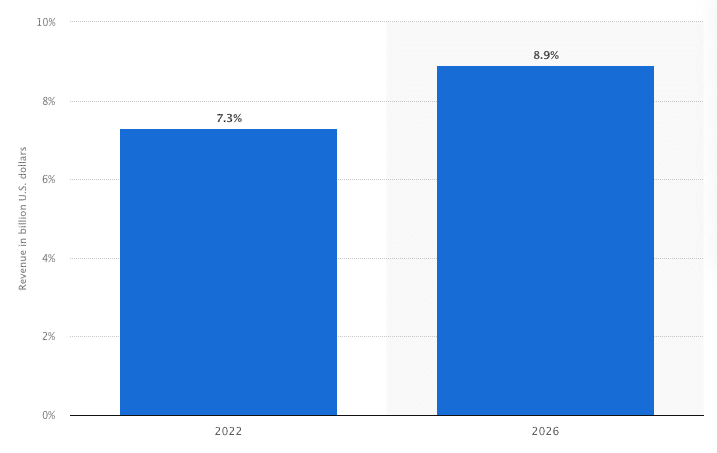
Image credit: Statista.
Challenges of E-commerce Enablement
Despite significant advancements in e-commerce enablement, brands and retailers
still face ongoing challenges and complexities that can impact their ability to succeed in the digital space. Supply chain management, logistics, and customer experience are just a few of the key areas where companies must navigate these challenges:
- Supply chain management is one of the biggest challenges that brands and retailers face in e-commerce. Ensuring that products are delivered cost-effectively to customers is critical, particularly in an era where Amazon can deliver products to customers in as little as two hours. During the pandemic, many companies faced supply chain disruptions due to factory closures and shipping delays, highlighting the need for robust supply chain management systems.
- Logistics is another challenge for businesses that sell internationally or operate in remote areas. The cost of shipping products can be prohibitively high, particularly for small brands. For example, some companies may be unable to ship products to certain countries due to complex regulations and restrictions.
- Customer experience is another critical factor in e-commerce, as consumers expect a seamless and hassle-free online shopping experience. This includes everything from the speed and ease of checkout to the quality of customer support. Brands that offer chatbots or other forms of automated customer support can reduce response times and improve customer satisfaction.
What does the future hold?
As e-commerce continues to grow and evolve, brands and retailers that want to remain competitive
will need to stay on top of the latest technological trends and advancements. The future of e-commerce enablement is likely to be shaped by several emerging technologies and trends. Here are some examples:
Augmented Reality (AR) and Virtual Reality (VR): These technologies have the potential to revolutionize the online shopping experience. Customers could use AR or VR to see how products would look in their homes before making a purchase.
Artificial Intelligence (AI) and Machine Learning (ML): E-commerce platforms are already using AI and ML to improve product recommendations, personalize marketing messages, and streamline logistics operations. In the future, we can expect more sophisticated uses of these technologies, such as AI-powered chatbots that can handle customer service inquiries and assist with purchases.
Internet of Things (IoT): The IoT is being used to enable smart homes and smart cities, but it also has potential in e-commerce. For example, IoT sensors could be used to track inventory levels in real-time, optimize supply chain logistics, and even monitor product quality.
Cryptocurrency: As more people embrace cryptocurrencies like Bitcoin and Ethereum, e-commerce platforms may start accepting these digital currencies as payment options. This could make online transactions faster and more secure, while also opening up new markets for e-commerce businesses. Overall,
the future of e-commerce enablement is likely to be driven by a combination of these and other emerging technologies, all of which have the potential to make online shopping more convenient, personalized, and secure. By leveraging these technologies, brands and retailers can enhance the online shopping experience for their customers, increase sales, and stay ahead of the competition in the fast-paced world of e-commerce.
.png?width=64&height=64&name=Adrian%20(1).png)
Adrian Gmelch
Adrian Gmelch is Director of Content at Lengow, where he leads content strategy while staying firmly hands-on: reading the research, and tracking the trends that matter before they go mainstream.


.png)