Horizontal and Vertical AI agents: two roles in the shopping journey
Shoppers can meet AI shopping agents in different places. Some use an assistant they already rely on for many other tasks, such as ChatGPT or Gemini, and ask it for product recommendations. Others use an assistant built into the retailer or platform where they shop. The market treats these as two categories, with different strengths.
| Caractéristique | Horizontal agents | Vertical agents |
|---|---|---|
| Main role | Discovery and comparison | Purchase context and transaction support |
| Typical environment | General-purpose AI interface | Retailer, marketplace or platform ecosystem |
| Main data access | Product content, prices, attributes and availability | Stock, delivery, payment, loyalty and authorised account data |
| Examples | ChatGPT shopping, Google AI Mode Shopping, Perplexity, Meta Muse | Amazon Rufus, Google Business Agent, retailer assistants |
| Main strength | Reach across merchants | Access to commerce infrastructure and customer context |
| Main limitation | Limited access to transaction context | More limited coverage outside the retailer or platform ecosystem |
The difference comes down to the data behind the experience
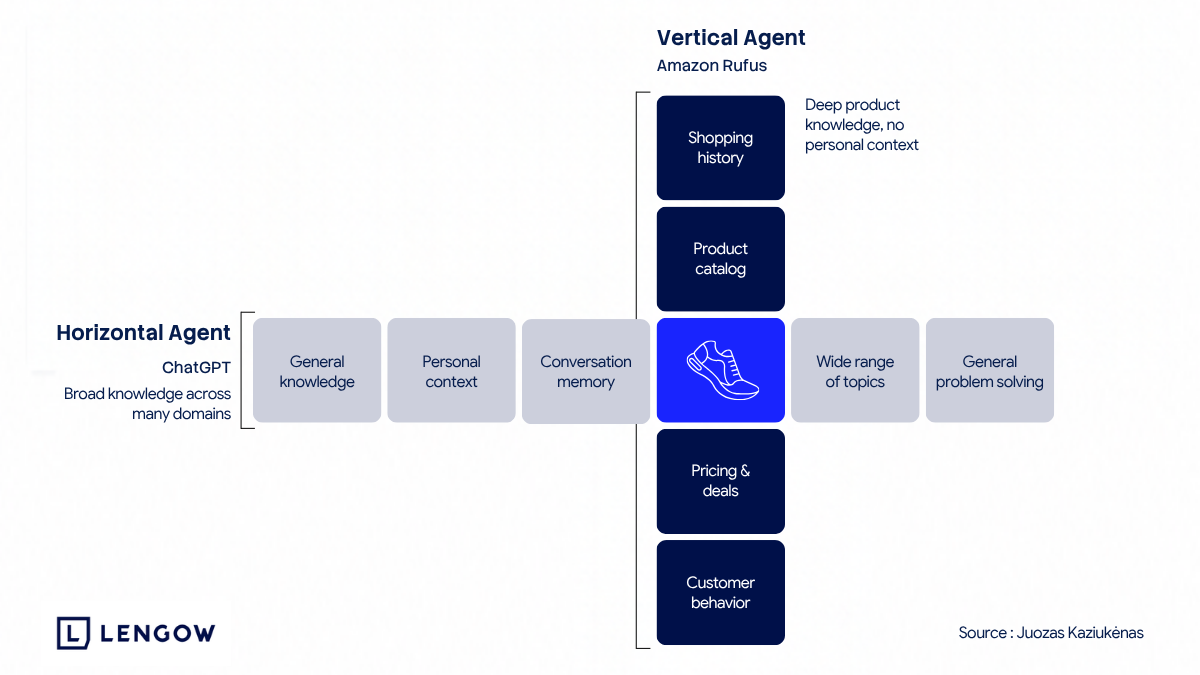
Horizontal agents rely on product data
A horizontal agent builds its answer from product information supplied by multiple retailers. To compare products accurately, it needs a consistent description of each one: what it is, what sets it apart, which variants exist and at what price.
To make comparisons reliable, that information must be consistent across merchants and complete. If key attributes are missing, prices are outdated or variants are unclear, a product may be harder to find or recommend, or left out altogether.
Vertical agents rely on operational data
Vertical agents also help shoppers search, but within a single retailer or platform. By accessing operational data, they show whether and how the retailer can sell the product at that moment: live stock, delivery options, applicable offers, loyalty benefits and payment methods.
This lets them answer questions a horizontal agent often cannot, such as whether an item is available in the right size or can arrive before the weekend. This information sits in the retailer’s operational systems rather than in product descriptions. Google’s Universal Commerce Protocol (UCP) follows this logic, linking agents, retailers and payment providers across discovery, checkout and post-purchase support.
The market is already choosing different levels of access
The data behind these agents only reaches them if retailers allow it. Retailers can open it to external horizontal agents, keep it within their own vertical assistants, or restrict access altogether.
Open integrations: agents support the shopping journey
Some retailers and marketplaces now let the shopping journey start where the shopper is already searching, through an external horizontal agent, and sometimes go all the way to the purchase. Carrefour has integrated its shopping experience into ChatGPT in France. Shoppers can search products, check availability, build a basket and choose delivery, then complete the purchase on Carrefour’s website. The service has since been extended to Belgium.
In the United States, shoppers can buy some Etsy items directly in Google’s AI Mode and the Gemini app, without visiting the Etsy website.
Controlled integrations: retailers define the boundaries
Other retailers keep tighter control over where and how agents operate. Some prefer to keep the experience in-house with their own vertical assistant: Zalando has rolled out its AI Assistant across its European markets. It combines product data with location, weather and occasion, and, since an update, with customer preferences and shopping history, within Zalando’s ecosystem.
Others open their catalogue to external agents, but only under conditions they set. Gap, for example, decides which third-party agents can browse its products and which can reach checkout.
Restricted access: third-party agents are limited or blocked
At the other end, some companies keep external agents out. Amazon restricts horizontal agents from OpenAI, Google, Anthropic, Perplexity and Meta, while operating its own vertical shopping assistant Rufus inside its ecosystem. This suggests that Amazon prefers shoppers to discover and buy through an interface it controls.
What this means for retailers
In a BCG survey of 50 leading retailers and 100 global brands, only 18% of retailers said their marketplaces were ready for AI agents. At the same time, 68% expect agentic commerce to have a significant or transformational effect within the next two years.
The gap between expected impact and current readiness is already visible. Retailers can start preparing before any agent comes out on top.
Prepare for AI discovery
AI-powered shopping is already part of how Europeans research purchases. Deloitte found that 56% of European consumers have used AI to shop at least once, and 57% of AI users rely on it to compare products. Few hand over the final step: only 8% of respondents would let an agent complete checkout and payment. Today, agents mostly influence the discovery stage, where shoppers search and compare products.
A first audit can stay simple, with these checks:
- Make sure key attributes and variants are filled in for your best-selling products
- Compare titles, prices and availability across your website, marketplaces and feeds
- Ask ChatGPT or Google AI Mode the questions your customers ask, and see how your products appear
Product feeds are one of the main ways retailers supply this data to AI shopping platforms. Lengow helps retailers prepare their product feeds for ChatGPT Shopping while keeping catalogue data consistent across the other channels they already manage.
Get the guide: AI Shopping: Is your catalogue ready for the agents?
Separate discovery readiness from transaction readiness
A retailer can appear in an agent’s recommendations without being ready to sell through it. Retailers should therefore assess two separate questions:
- Discovery readiness: can an agent understand the catalogue, compare products and recommend the right option?
- Transaction readiness: can the retailer confirm the price, fulfil the order and provide accurate delivery and returns information?
A recommendation can be correct and still lead to a poor experience if the selected variant is unavailable, the price has changed or the delivery promise cannot be kept. Delivery times and returns conditions are worth checking first, since they are the details agents are least likely to get from a product description.
Define what agents can do
Retailers do not have to grant every permission at once. Opening access gradually makes it possible to test each stage on a limited scope, check that the information agents return is accurate and keep control over what they can do before moving on.
The sequence below follows the shopping journey, from the lowest-risk stage to the most sensitive:
- Discovery: agents browse and compare products. This stage shows how your catalogue is read and presented.
- Cart and checkout details: agents add products and modify details. This only makes sense once prices, stock and delivery information are reliable and buyer authorisation is in place.
- Order submission and post-purchase support: these are separate decisions, since they involve payment, fulfilment and customer data.
The right level can vary by agent, market and product category: a retailer may allow price comparison for all products but reserve checkout access for a few trusted partners or a single country.
One journey, several agents
The market is unlikely to converge on a single shopping agent. Horizontal agents are gaining ground where shoppers explore and compare, while vertical agents remain better placed to confirm stock, delivery and payment.
When discovery, purchase and after-sales support happen in different places, a question remains open: who holds the customer relationship? New standards such as UCP and WebMCP, and the partnerships between retailers and agent providers, will shape the answer.

Adrien Lemaire
Adrien Lemaire is a freelance content manager covering technology and digital topics, including e-commerce, AI/data and social platforms.