
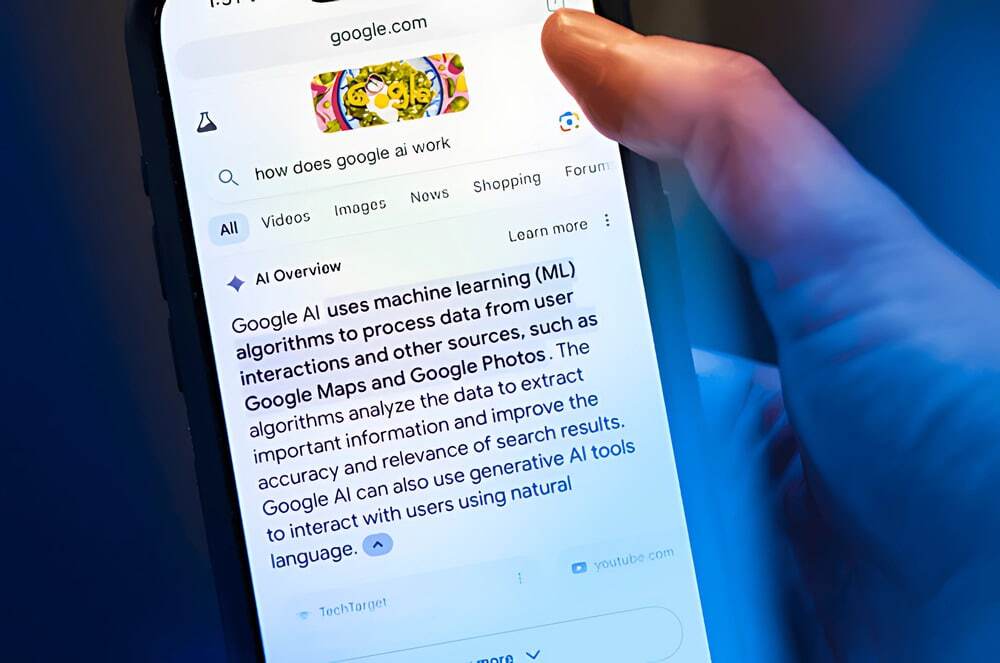

Who is affected? What are the impacts?
The most severely impacted are publishers of “informal” or “generic” content: travel blogs, recipe tutorials, DIY guides, media websites… Their content is often directly included in the AI Overviews, removing the need for users to visit the original website.
1. The Planet D
The travel blog The Planet D lost 90% of its traffic, resulting in staff redundancies.
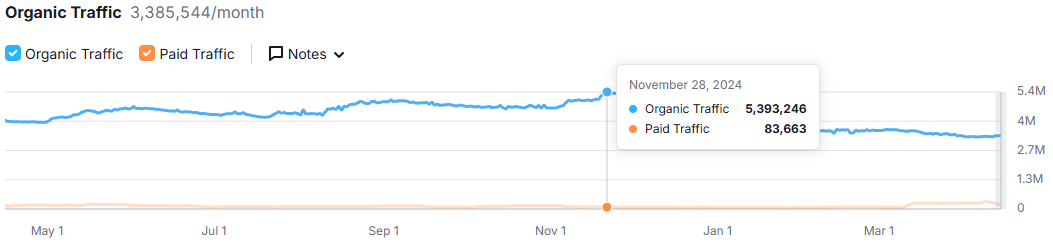
Below is a chart (over a two-year period) showing the dramatic fall in
The Planet D
’s traffic.
2. Mail Online
At
Mail Online
(260 million monthly visits), the
presence of an AI Overview causes the click-through rate to drop by 56.1% on desktop and 48.2% on mobile
, even when the site remains number 1 in organic results.
In the "best" case scenario, where the Mail’s link appears in the AI summary, the CTR is still 43.9% lower on desktop.
Carly Steven (SEO Director at Mail) describes the impact as "shocking" and recommends focusing on branded searches like "Meghan Markle Daily Mail," which are more resilient.
3. The Sun
- Impact: In September 2023, The Sun recorded a 40% decrease in monthly unique users, dropping from 134 million to 80 million.
- Context: This drop coincided with changes Google made to its search results, notably the introduction of AI Overviews. These AI-generated summaries provide direct answers to users, reducing the need to click through to publisher websites.
- Consequence: The decline in traffic contributed to lower digital advertising revenues for The Sun and other News UK brands.
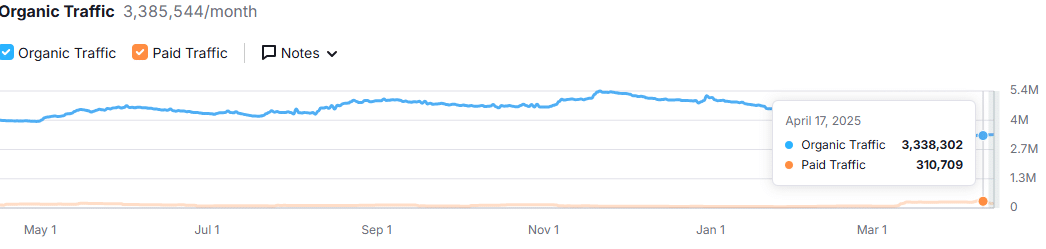
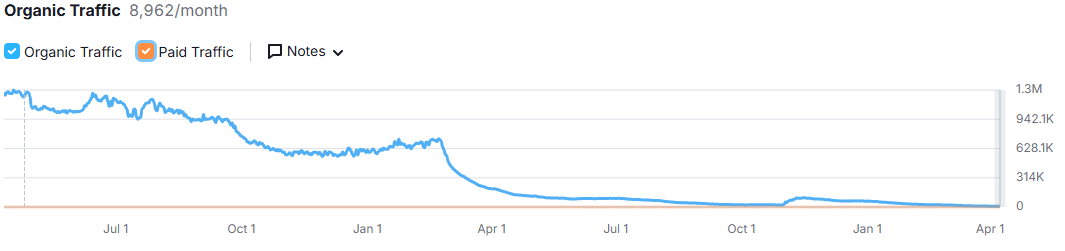
The year-on-year comparison of organic traffic on Chegg.com
These cases illustrate a radical shift: Google no longer redirects users, it serves them the answer directly.
But not all websites are impacted in the same way.
And what about e-commerce sites?
Good news
:
online retailers are, for the most part, spared
, at least for now. Why?
- “Transactional” search intent remains dominant. Users want to buy a product, compare prices, read reviews. This still involves visiting a website or marketplace.
- AI Overviews do not (yet) replace the shopping experience. Google doesn’t sell products. It can advise and guide, but it does not eliminate the need to go through a retailer.
Where are AI Overviews active?
Officially, AI Overviews are still in a testing phase, currently available mainly in the United States via the Search Labs programme. Rollouts have extended
to other countries
(Canada, the United States, Mexico, Japan, India, Australia, and the United Kingdom), but as of April 2025, France, Germany, and Spain are not yet affected.
That said, global rollout appears inevitable,
and publishers should start preparing now
.
SEO: A Strategy to Rethink
AI Overviews force a fundamental rethink of SEO strategies. Creating generic content to answer basic questions is no longer sufficient. The era of “easy clicks”
is over.
The rules of the game are changing, and the new approach might include
:
- Content that AI cannot easily replace
-
- Personal testimonials, experience-based storytelling
- Original data, proprietary studies
- Bold positioning within a specific niche
- Diversify your acquisition channels:
-
- Podcasts, YouTube videos, community newsletters
- Social commerce, influencer collaborations, interactive content
- Optimise for the AI itself:
-
- Platforms like YouTube, Reddit, and Quora are already appearing in AI-generated results. Being visible on these platforms is becoming just as important as optimising your own site.
Here’s what a search result looks like with Google AI Overviews.
A Profitable Strategy, for Google
The arrival of AI Overviews is far from neutral. It allows Google to keep users on its platform longer, increasing session duration, and thus advertising potential.
Fewer clicks on organic results = more room for Google Ads.
As a result, brands may be
encouraged to increase their investment in paid media
, especially
since ads still appear above AI Overviews
(in line with Google’s current monetisation model), including shopping campaigns, product extensions, or video formats.
So, what should e-commerce players do now?
- Keep producing content, but with a different approach:
- Highly targeted buying guides
- Rich product content combining text, visuals, and UGC
- SEO and UX-optimised category and product pages
- Anticipate the wider rollout of AI Overviews by closely monitoring your organic performance and traffic sources
- Focus on branding and emotional resonance.
- A strong brand is less vulnerable to a drop in clicks.
- Build trust, community, and customer loyalty.
Conclusion: A Quiet Yet Relentless Revolution
AI Overviews are profoundly changing the way content is consumed. For e-commerce sites, the threat may not be immediate—but the opportunity is very real: the chance to stand out through experience, human connection, and added value.
SEO isn’t dead BUT
generic SEO is.

Alexis Merelle
Alexis Mérelle est chargé du contenu et du SEO chez Lengow, où il transforme les données relatives aux places de marché et aux prix en articles, et observe l'impact de la recherche basée sur l'IA sur la découverte des produits.
.png)