

Why Is Online Brand Protection Important?
E-commerce brand protection is essential to safeguard your business from potential risks that can harm your reputation and bottom line. Brands face numerous threats, including counterfeit products, unauthorised resellers, and inconsistent pricing that can erode customer trust. Without a solid protection strategy, you may find your brand’s reputation suffering and your revenue declining.
A practical example of this is the fashion industry, where high-demand items often attract counterfeiters and unauthorised sellers. Brands like
Nike
and
Adidas
face constant challenges in maintaining their brand integrity due to the widespread availability of counterfeit products on online marketplaces and social media platforms.
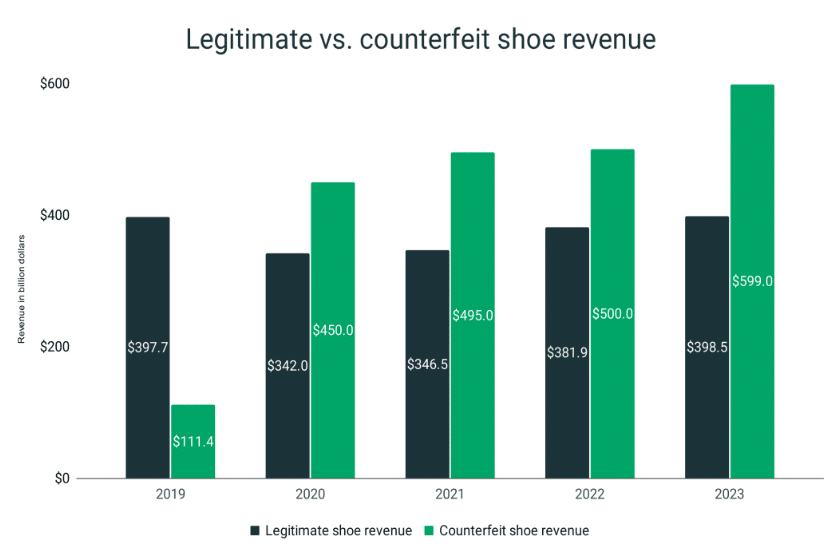
The graph below shows how counterfeit shoe revenue has surged past legitimate sales from 2019 to 2023, highlighting the urgent need for strong online brand protection.
To combat these threats, many brands implement comprehensive online brand protection strategies built around several key pillars:
Monitoring Marketplaces and Sales Channels:
Brands must continuously track how their products are presented and distributed on marketplaces like Amazon, eBay, and other online platforms. We are going to take Miele as an example. Miele is a premium German brand specializing in high-quality household appliances and commercial equipment, known for its durability, innovation, and sustainability. To maintain its high standards, Miele uses a selective distribution strategy, partnering with authorized retailers. In 2024, after withdrawing from Amazon, Miele intensified its monitoring efforts to protect its brand and ensure compliance across its distribution channels. The appliance brand issued numerous warnings to unauthorised resellers for using Miele logos and product images without permission. This rigorous control helps preserve brand integrity and prevents association with low-quality or counterfeit items.
Enforcing Distribution Policies:
Ensuring that only authorised distributors sell products is crucial for maintaining brand consistency.
Volkswagen, for instance, took legal action against unauthorised sellers who used its registered trademarks to market unapproved merchandise
. By strictly enforcing distribution policies, brands not only protect their image but also reinforce trust with their official retail partners.
Maintaining Pricing Consistency:
Keeping prices consistent across various sales channels is vital to protect brand value. One well-known French fashion brand (which unfortunately cannot be named here) uses NetMonitor by Lengow to ensure that its distributors follow product presentation guidelines and maintain coherent pricing strategies. By detecting price discrepancies or excessive discounting, brands can take corrective action to protect their pricing strategy and uphold customer trust.
Leveraging Market Data:
To effectively manage brand perception and ensure distribution compliance, leveraging market data is essential. Fluidra, a global leader in water treatment and pool equipment, uses NetMonitor to gather and centralise key insights on stock availability, product perception, and customer interactions. This data-driven approach allows Fluidra to make agile, informed decisions, optimizing its distribution network and improving e-commerce performance. NetMonitor by Lengow provides the tools needed to streamline these processes, ensuring Fluidra’s continued success in a competitive digital market.
The development of e-commerce is
facilitating the growth of counterfeiting
by providing new outlets for counterfeiters. Some key figures:
- In 2020, within the European Union, seizures related to e-commerce accounted for 30% of customs interceptions and 60% of legal proceedings initiated.
- 37% of French people state they have already purchased counterfeit products online, according to a survey by Ifop.
- 40% of French people believe counterfeit goods can be bought on social media, with this figure rising to 43% among 15-18-year-olds, representing an increase of 19% in 5 years.
- 23% of French 15-18-year-olds have already purchased counterfeit items on online sales platforms.
How to Implement Online Brand Protection
- Monitor Online Sales Channels: Keep track of how your products are presented on major online platforms like Amazon, eBay, and Google Shopping. This involves monitoring product listings, prices, and seller information to detect unauthorised sellers and counterfeit items.
- Track Pricing Discrepancies: Use pricing intelligence tools to ensure consistent pricing across different e-commerce channels. Inconsistent pricing can harm your brand perception and even violate agreements with authorised distributors.
- Enforce Distribution Policies: Clearly outline your brand guidelines and distribution policies to your partners and retailers. Regularly audit their compliance to prevent unauthorised reselling or price undercutting.
- Leverage Technology: Use advanced brand protection software to automatically scan online listings, detect violations, and take action against unauthorised sellers. Automating this process can save time and ensure continuous monitoring.
- Engage in Proactive Enforcement: When violations are identified, take immediate action. This may include issuing, takedown notices or working with marketplaces to remove counterfeit listings.
How NetMonitor Can Help
Implementing a robust e-commerce brand protection strategy can be challenging without the right tools. That’s where
NetMonitor by Lengow
comes into play. NetMonitor provides a comprehensive solution to monitor brand representation across online channels, detect unauthorised resellers, and track price discrepancies in real-time. This powerful tool allows brands to protect their reputation and revenue while staying ahead of the competition.
By integrating NetMonitor into your brand e-commerce strategy, you gain full visibility and control over your brand’s online presence, giving you the confidence to grow and expand without compromising on quality or reputation.

Alexis Merelle
Alexis Mérelle est chargé du contenu et du SEO chez Lengow, où il transforme les données relatives aux places de marché et aux prix en articles, et observe l'impact de la recherche basée sur l'IA sur la découverte des produits.


.png)