Today, physical commerce remains the preferred purchasing channel for consumers. At the same time, the internet and mobile phones are becoming essentials to research or discover products. Availability checks, reading reviews and sharing experiences are increasingly online and mobile today.
To offer consumers a seamless shopping experience, brands and retailers must nowadays think "phygital". This means combining online and offline to create a single customer experience, regardless of the point of contact, in order to generate traffic in stores. 76% of consumers now expect companies to understand their needs and expectations. To do this, retailers must have up-to-date and high-quality data to interact in a personalised and relevant way with their customers.
To offer consumers a seamless shopping experience, brands and retailers must nowadays think "phygital". This means combining online and offline to create a single customer experience, regardless of the point of contact, in order to generate traffic in stores. 76% of consumers now expect companies to understand their needs and expectations. To do this, retailers must have up-to-date and high-quality data to interact in a personalised and relevant way with their customers.
Your product catalogue: the key to successful online and offline integration
As online and offline commerce grows increasingly complex and the number of channels expands, it’s essential to capitalise on product data to target buyers in the right place at the right time. This is where your product catalogue comes into play - it’s the key to interconnect your online advertising with your offline activity. To guarantee the best possible advertising performance, each product in your catalogue must include much information as possible.
How can online advertising boost in-store sales?
Facebook,
Instagram, Google, Snapchat, Twitter..., several options are available to you to increase your traffic in physical stores from your online advertising actions.
With
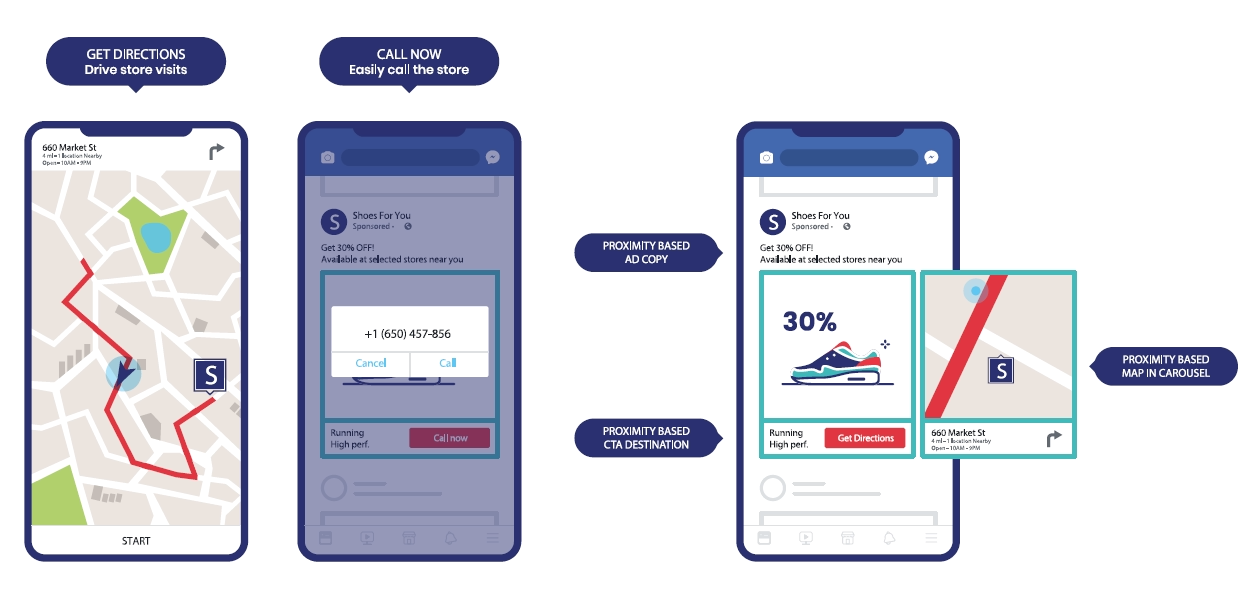
1.52 billion daily active users globally, Facebook enables you to encourage buyers to visit your stores through dynamic local advertising in the form of an image, video or carousel. By choosing the
"In-store traffic" advertising objective, individuals in a given distance around one or more of your points of sale are targeted.
These formats also include store mapping, "Get Directions" or "Call Now" action buttons, as well as personalised geographic targeting to choose from which distance to offer your ad.
These formats also include store mapping, "Get Directions" or "Call Now" action buttons, as well as personalised geographic targeting to choose from which distance to offer your ad.
Facebook also makes
Dynamic Ads for Retail, currently available to some advertisers in beta version. These dynamic ads are generated from your product catalogue and offer mobile users products based on their location and interests.
Learn how to prepare your product catalogue for Facebook with Lengow on page 29 of our white paper.
A must in the consumer shopping experience, Google assists brands and retailers to attract buyers to their stores. To do this, Google first provides you with
location extensions. These campaigns, which appear on Search Networks, Display and YouTube, are the best way to let your customers know you’re close to their geographical location and that you’ve got what they’re looking for. By providing an itinerary or the opportunity to contact you, you’re able to customise and define the best possible user experience for potential customers.
Google Shopping ads enable you to promote your products online and to display your in-store inventory through
Local Inventory Ads compatible with all types of devices. These
"Product in Store" ads display your products and their availability in-store to buyers searching Google in a location nearby.
As soon as they click on an ad, consumers are redirected to a window dedicated to your store in which they access the following information: the availability and price of the product in store, opening hours, how to get to the store, etc.
Learn how to prepare your LIA feed with Lengow on page 36 of our white paper.
As soon as they click on an ad, consumers are redirected to a window dedicated to your store in which they access the following information: the availability and price of the product in store, opening hours, how to get to the store, etc.
Learn how to prepare your LIA feed with Lengow on page 36 of our white paper.
Snapchat
According to
Snapchat, 85% of its users actively share their location while using the application. In addition to targeting your ads by location or specific perimeter (such as Snap Ads, Collection Ads and Story Ads), other features such as geolocated filters and lenses allow users to engage with your brand in a fun way. As an advertiser on Snapchat, you can import your store list and configure your ads to appear near your points of sale. This targeting can be defined up to 100km around a particular location. In addition, Shoppable Snap Ads allow you to automatically create ads from your product catalogue. A new advertising objective called "Catalogue Sales" has also been added, to help advertisers optimise their campaigns incorporating product data.
If you want to promote actions in physical stores from online ads, Twitter also provides advertisers with localized targeting by country, city, or postal code.
For more details and our tips on how to set up online ads to generate offline traffic, download our latest white paper:
For more details and our tips on how to set up online ads to generate offline traffic, download our latest white paper:
.png)