.png?width=48&height=48&name=Adrian%20(1).png)
What is Lengow AI Studio?
Launched in April 2026,
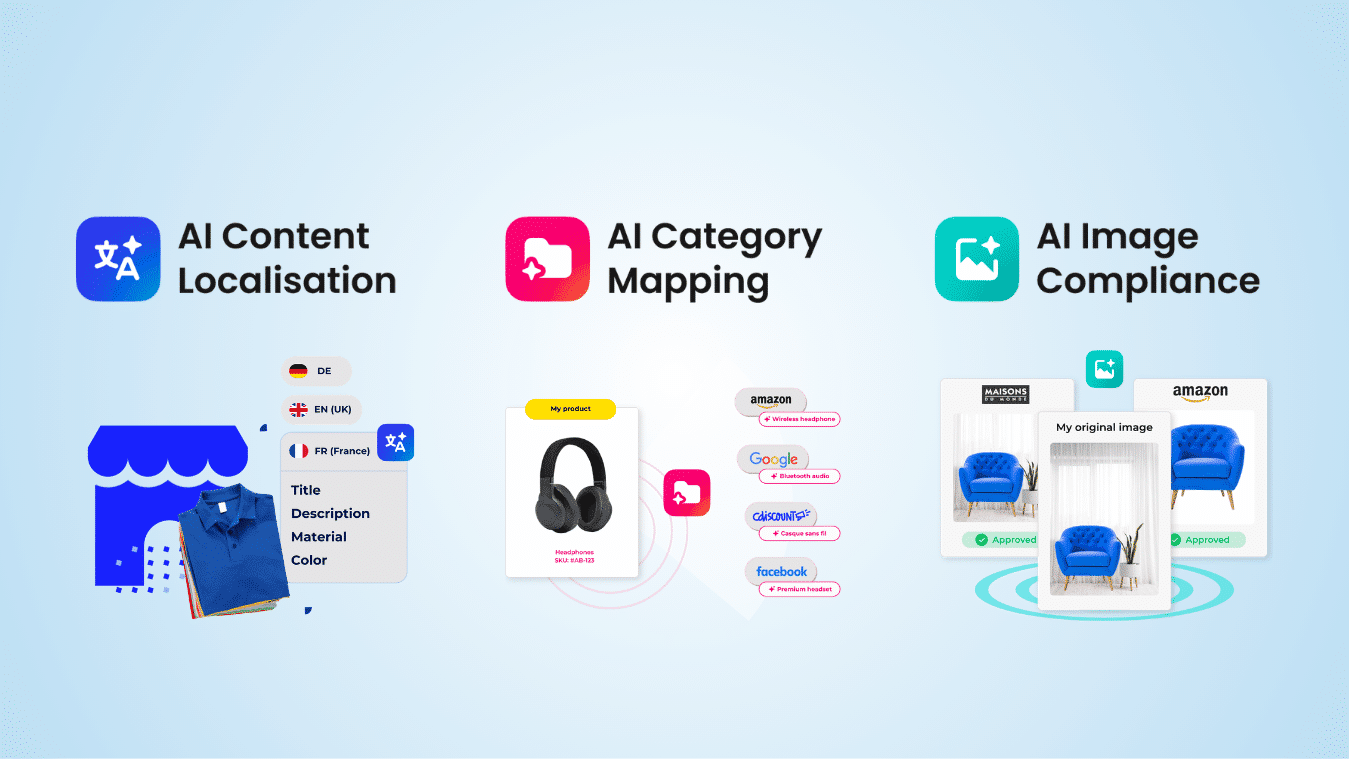
AI Studio is a suite of AI-powered applications built directly into the Lengow platform. Not a separate tool or a third-party integration. Something that runs inside the workflow you already use to manage and distribute your product catalogue. The three apps -
AI Category Mapping,
AI Content Localisation, and
AI Image Compliance - each target a different manual bottleneck in the multi-channel content workflow. Together, they cover the full journey from catalogue to channel: getting products into the right category, in the right language, with the right visuals. Let's look at each one through the lens of real merchant use cases.
Use Case 1: You're onboarding a new marketplace and taxonomy is a nightmare
You've decided to expand onto a new marketplace - say, Cdiscount, or Otto in Germany, or Zalando. Your products are ready. Your prices are competitive. But before a single listing goes live, your team needs to map every product in your catalogue to the right category in that channel's taxonomy. If you've done this before, you know how it goes. Hours of searching through category trees. Inconsistent decisions when two team members categorise the same product type differently. Listings rejected because a product landed in the wrong subcategory. And then you have to do it all over again for the next marketplace.
AI Category Mapping eliminates that bottleneck. The app
analyses your product titles and descriptions and automatically suggests the best-fit category for each channel. Based on early results from merchants already using the tool, 99% of suggestions are accurate, with only 1% requiring manual correction. For a retailer with a 10,000-product catalogue launching on three new channels simultaneously, the time savings are immediate and significant. What previously took weeks of internal work now happens in the background, with results delivered directly into the Lengow catalogue as a new column, ready for review. The app is already in use by many merchants from all industries.
Use Case 2: You want to sell in Germany, Poland, and the Netherlands - but have no local teams
International expansion is one of the biggest growth levers in e-commerce. It's also one of the most operationally demanding. Writing product content that genuinely resonates with local shoppers isn't just a translation problem, it's a localisation problem. The vocabulary, the tone, the cultural references: they all differ. Most growing merchants face the same dilemma: either hire expensive local copywriters or agencies (slow, costly, hard to scale), or push out machine-translated content that sounds flat and generic (cheap, fast, damaging to conversion).
AI Content Localisation offers a third path. Powered by GenAI models trained for e-commerce content, it adapts product titles, descriptions, and attributes to the linguistic variations and cultural expectations of each target market.
Currently supporting 12 languages across more than 30 regional contexts - including French, English, German, Dutch, Italian, Portuguese, Spanish, Polish, Romanian, Hungarian, Czech, and Greek - it covers the vast majority of European e-commerce markets. The real-world proof of concept comes from Damart, the French ready-to-wear brand, which tested the solution as part of its European marketplace expansion.
Alexandre Rochoux, Marketplace Manager at Damart, was direct about the results:
"We have conducted initial tests with Lengow that have proven very promising, enabling us to achieve a level of translation quality above market standards." The results were strong enough that Damart immediately pushed to extend the test to additional feeds and markets. And crucially, the localised content isn't locked inside Lengow - it can be exported and reused across your website, PIM system, or any other platform.
Use Case 3: Your product images are getting rejected on channel after channel
Every marketplace or channel has its own image requirements. Amazon wants white backgrounds. Zalando has specific dimension rules. Google Shopping has its own framing standards. Getting any of these wrong means your products get rejected - or worse, listed with non-compliant visuals that hurt click-through rates and conversion. For merchants managing thousands of references across multiple channels, manual image editing at scale is simply not viable. The alternative - juggling multiple image tools, briefing external retouching studios, managing feedback loops - is expensive and slow.
AI Image Compliance handles this automatically. It
transforms your product images to meet each channel's specifications (backgrounds, dimensions, framing, formats) using pre-configured channel templates, without any manual editing. Results are delivered directly back into your catalogue workflow. The app is currently in use by fashion, beauty and luxury merchants, and focuses in its current form on compliance use cases: background removal and modification, format and guideline alignment. Creative use cases - branded templates, marketing-optimised visuals - are on the roadmap for future releases.
AI in the execution layer
The e-commerce market is not short of AI tools that generate content. What it has lacked is AI that makes that content work, across the complexity of real multi-channel, multi-market operations. That distinction is at the heart of what Lengow AI Studio is trying to do. As
Nicolas Appert, CEO of Lengow, puts it:
"We are not just giving our clients another AI tool. We are embedding AI directly into the execution layer of commerce." For merchants, the practical implication is significant. AI Studio doesn't ask you to change your workflow, adopt a new platform, or manage another set of logins. It runs inside the Lengow platform you already use, and delivers results directly into your catalogue - ready to review, validate, and deploy. For teams stretched across catalogue management, channel operations, and international expansion, that's not a marginal improvement. It's a different way of working.
Who is AI Studio for?
In practical terms, AI Studio is most immediately valuable for merchants who:
- Are selling or planning to sell on multiple marketplaces simultaneously
- Are expanding into new European markets and need localised content at scale
- Have large catalogues (thousands of SKUs) where manual processes create real bottlenecks
- Are onboarding new channels frequently and losing time to taxonomy and image compliance work
.png?width=64&height=64&name=Adrian%20(1).png)
Adrian Gmelch
Adrian Gmelch is Director of Content at Lengow, where he leads content strategy while staying firmly hands-on: reading the research, and tracking the trends that matter before they go mainstream.
Table of content
Is your catalogue ready for AI Shopping?
Discover what AI assistants look for, how products get selected and what you can do now to stay visible in the new shopping journey.
.png)