
.png?width=48&height=48&name=Adrian%20(1).png)
Worldwide: five Amazon markets, then a different winner everywhere else
| Country | 🛒 Shoppers' #1 | 💼 Businesses' #1 |
|---|---|---|
| United States | Amazon (85%) | Amazon (87%) |
| Canada | Amazon (89%) | Amazon (73%) |
| India | Amazon (94%) | Amazon (94%) |
| UAE | Amazon (84%) | Amazon (87%) |
| Australia | Amazon (68%) | Amazon (92%) |
| China | Taobao (67%) | Taobao (77%) |
| Thailand | Shopee (90%) | Shopee (100%) |
| Argentina | Mercado Libre (93%) | Mercado Libre (98%) |
| Nigeria | Jumia (84%) | Jumia (83%) |
| South Africa | Takealot (88%) | Takealot (87%) |
| Brazil | Shopee (84%) | Mercado Libre (86%) |
| Malaysia | Shopee (96%) | Mudah (65%) |
| Saudi Arabia | Shein (81%) | noon.com (85%) |
| Morocco | Temu (67%) | N/A |
🛒 = most-used by shoppers · 💼 = most-used by businesses. Salmon cells mark markets where the seller's top platform differs from the shopper's. Source: DHL eCommerce, 2026 E-Commerce Trends Report.
Five of the fourteen countries on DHL's global marketplace map name Amazon as the platform shoppers use most: the United States, Canada, India, the UAE and Australia. That's the full list. In the other nine, a regional platform owns demand, and the pattern is clean enough to redraw the map by hand.
Southeast Asia belongs to Shopee. It's the most-used platform for shoppers in Thailand (90%) and Malaysia (96%), and it takes Brazil's shopper crown at 84%, reaching across the Atlantic into Mercado Libre's home region. Thailand is the most concentrated market in the data: 100% of businesses sell on Shopee, 90% of shoppers buy there. Latin America runs on Mercado Libre, clearest in Argentina at 93% of shoppers and 98% of businesses, about as close to a single-platform economy as a country gets. Sub-Saharan Africa splits between Jumia in Nigeria (84/83) and Takealot in South Africa (88/87). China sits on its own with Taobao at 67/77, lower than everyone else because Chinese demand spreads across more large players than any one map cell can hold.
The detail worth stopping on is the Chinese challengers. Temu is the most-used platform for shoppers in Morocco (67%). Shein is the most-used in Saudi Arabia (81%). These aren't share-gain stories; both are already number one on the demand side of a national market. And in Saudi Arabia the sellers didn't follow: 85% of businesses concentrate on noon.com, the regional heavyweight, while shoppers spend their time on Shein. Buyers discover in one place, sellers list in another.
Brazil shows the same fracture between two giants, shoppers on Shopee (84%) and businesses on Mercado Libre (86%), the only market where two heavyweights split the two sides cleanly. Malaysia splits harder: 96% of shoppers name Shopee, but the business number one is Mudah, a classifieds platform, at 65%. Near-total agreement on demand, real scatter on supply.
Europe is heavier on Amazon, and still not uniform
| Country | 🛒 Shoppers' #1 | 💼 Businesses' #1 |
|---|---|---|
| Germany | Amazon (86%) | Amazon (87%) |
| France | Amazon (85%) | Amazon (88%) |
| Spain | Amazon (89%) | Amazon (88%) |
| Italy | Amazon (92%) | Amazon (78%) |
| United Kingdom | Amazon (87%) | Amazon (78%) |
| Austria | Amazon (88%) | Amazon (88%) |
| Belgium | Amazon (64%) | Amazon (91%) |
| Sweden | Amazon (49%) | Amazon (63%) |
| Netherlands | Bol (92%) | Bol (73%) |
| Poland | Allegro (89%) | Allegro (92%) |
| Switzerland | Digitec Galaxus (60%) | Amazon (82%) |
| Denmark | Matas (61%) | Amazon (78%) |
| Portugal | Temu (66%) | Amazon (71%) |
| Czech Republic | Alza (67%) | Aukro (62%) |
| Türkiye | Trendyol (89%) | Hepsiburada (84%) |
🛒 = most-used by shoppers · 💼 = most-used by businesses. Salmon cells mark the five markets where the seller's top platform differs from the shopper's. Source: DHL eCommerce, 2026 E-Commerce Trends Report.
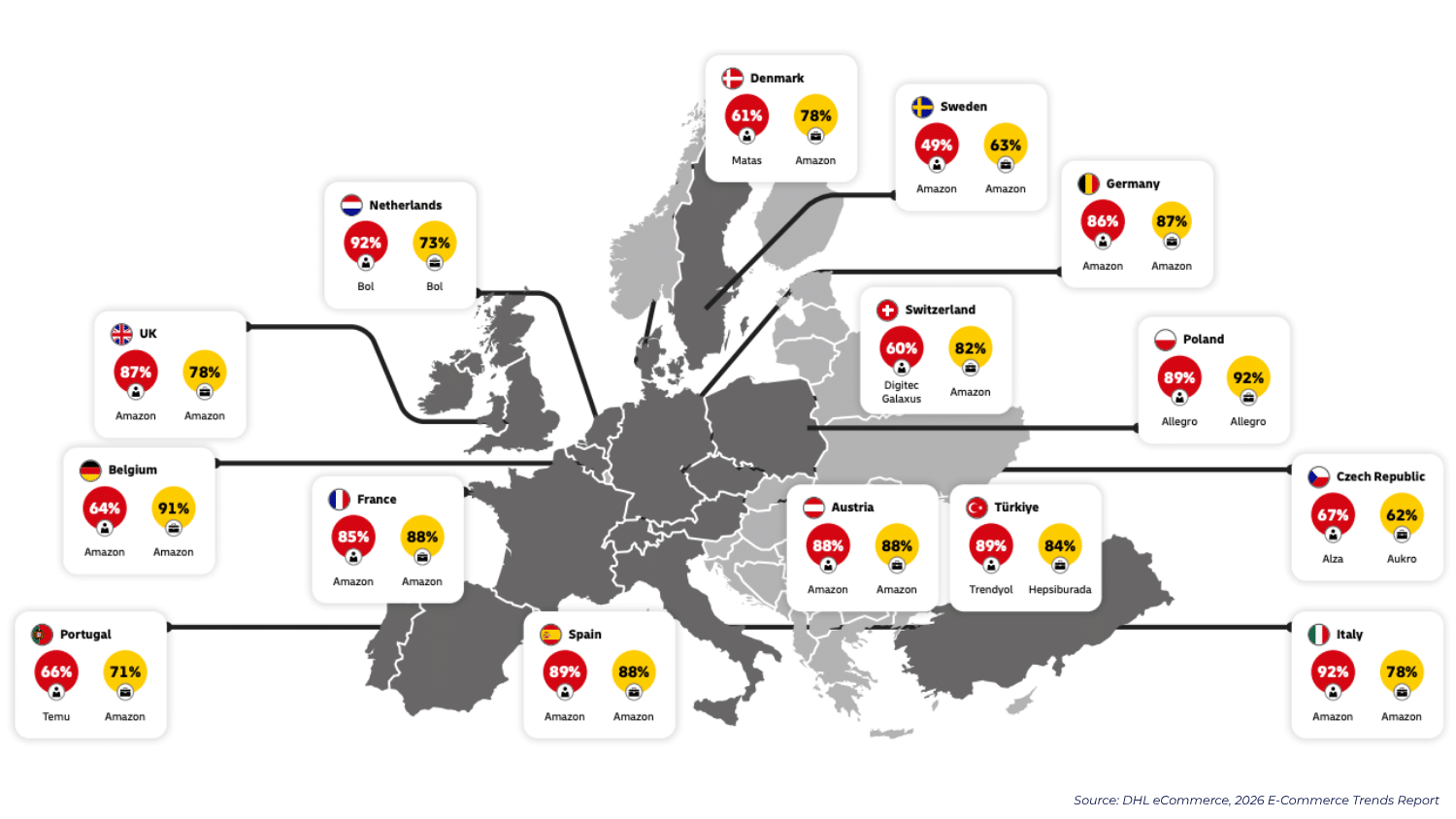
Europe gets its own map in the report, and Amazon's footprint is thicker here. It's the shopper number one in eight of fifteen markets: Germany, France, Spain, Italy, the UK, Belgium, Austria and Sweden. The exceptions are the ones to study. Bol owns the Netherlands on both sides (92% of shoppers, 73% of businesses). Allegro owns Poland even more completely, at 89% and 92%. These are markets where a foreign brand arriving with an Amazon-only plan has already lost the home crowd.
The sharper finding sits between the two columns. In five markets, shoppers and sellers aren't on the same platform. Danish shoppers favour Matas; 78% of Danish sellers are on Amazon. Swiss shoppers favour Digitec Galaxus; 82% of sellers are on Amazon. Portuguese shoppers favour Temu; 71% of sellers are on Amazon. Czechia splits Alza against Aukro, Türkiye splits Trendyol against Hepsiburada. Read down the whole map and one number explains it: Amazon is the business number one in eleven of fifteen markets but the shopper number one in only eight. Sellers are more locked to Amazon than the people buying from them. Belgium is the clearest case, with 64% of shoppers naming Amazon against 91% of businesses.
Shoppers move first, sellers wait
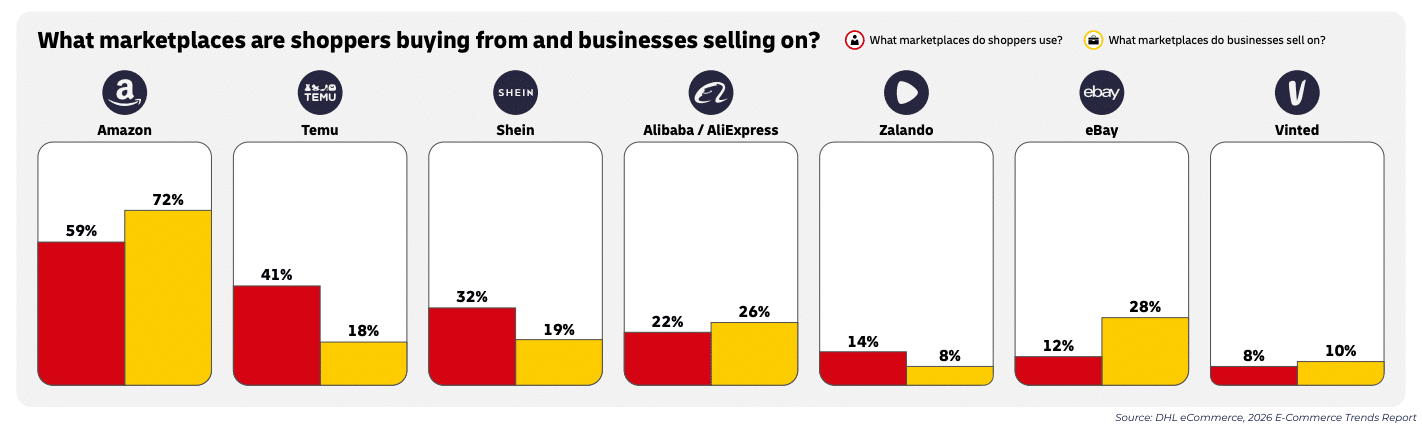
The report's aggregate view explains why those gaps exist. Across markets, shoppers adopt challenger platforms faster than businesses list on them. Temu reaches 41% of shoppers but only 18% of businesses sell there. Shein, 32% against 19%. Two platforms invert it: eBay (12% of shoppers, 28% of sellers) and AliExpress (22% and 26%), established seller bases that demand hasn't fully caught up with. The headline figures show confidence on both sides: 82% of shoppers expect to use marketplaces as much or more over the next five years, and 90% of businesses expect growth or stability. The buy side changes platform first; the sell side follows once the numbers are impossible to ignore.
What a seller should take from this
There's no default platform to build a plan around. An Amazon-first strategy covers the United States, the UK, Germany, France, Spain, Italy and Australia, then quietly misses the platform shoppers actually open in Poland (Allegro), the Netherlands (Bol), Brazil (Shopee), Saudi Arabia (Shein), Argentina (Mercado Libre) and Portugal (Temu). Cross-border selling isn't one channel repeated across borders; it's a different first choice in almost every market, which is the whole case for running marketplaces from one place rather than fifteen separate seller accounts.
.png?width=64&height=64&name=Adrian%20(1).png)
Adrian Gmelch
Adrian Gmelch is Director of Content at Lengow, where he leads content strategy while staying firmly hands-on: reading the research, and tracking the trends that matter before they go mainstream.


.png)