




How to choose the right marketplace in Europe
12/05/26
5'
For many European brands and retailers, choosing the next marketplace still comes down to intuition, internal opinions, and scattered market signals. Sometimes it works. Often, it leads to underperforming integrations, wasted budget, and launches that never quite take off.
Europe doesn’t make this easier. The continent has hundreds of active marketplaces of meaningful size – Lengow’s own database currently maps more than 90 – and they are spread asymmetrically. The variables that matter (average cart value, category depth, time to onboard, fee structure, GMV trajectory) are rarely sitting on a single page anyone can read.
Lengow’s new Marketplace Recommendation Tool, launched this month, is an attempt to turn that mess into a shortlist. The premise is straightforward: answer four questions about your business, and get a ranked recommendation of the marketplaces most likely to fit.
Four questions, a ranked answer
The interface is deliberately minimalist: four steps, each doing one job.
Profile: Are you a brand that manufactures or owns its products, or a retailer reselling third-party catalogue? The distinction matters more than it sounds. Brands and resellers don’t play on the same marketplaces, don’t pay the same fees, and don’t get accepted under the same conditions. A premium watch brand and a multi-brand watch reseller targeting the same country will often end up with quite different shortlists.
Market: Which country are you targeting? Marketplace strength is deeply national. Allegro dominates Poland; Bol owns the Benelux conversation; Cdiscount, La Redoute and Veepee anchor large chunks of French e-commerce. Picking the right geography is half the decision.
Product: What category do you sell, and where do you sit on price? Premium, mid-range or discount positioning maps to wildly different marketplace fits. Veepee and the off-price platforms exist for a reason; so do the curated, design-led marketplaces where margin and brand integrity matter more than volume.
Goals: This is the step that quietly does the heavy lifting. Up to three objectives (enter a new country, clear overstock, build brand presence, reduce dependency on Amazon, grow sales quickly, improve profitability) re-weight the ranking. The same brand asking “how do I clear overstock?” will get a different answer than one asking “how do I build brand presence?”. That’s the whole point.
What the output actually looks like
Hit See recommendations and the tool returns a podium of the top three marketplaces for your inputs, scored out of 100, followed by a full ranking of the relevant shortlist.
A test run as a mid-range brand looking to enter France in DIY & Garden surfaces a highly relevant top three: Leroy Merlin leads with a score of 100, followed closely by ManoMano at 99 and Castorama at 97. Below that, the ranking expands into a mix of retailer-led and specialist marketplaces, including Brico Cash / Bricomarché / Bricorama, Bricoman, Jardiland / Gamm vert, ManoMano Pro, and Spareka, each tagged by marketplace type and supported programmes such as Mirakl, B2B, and fulfilment.
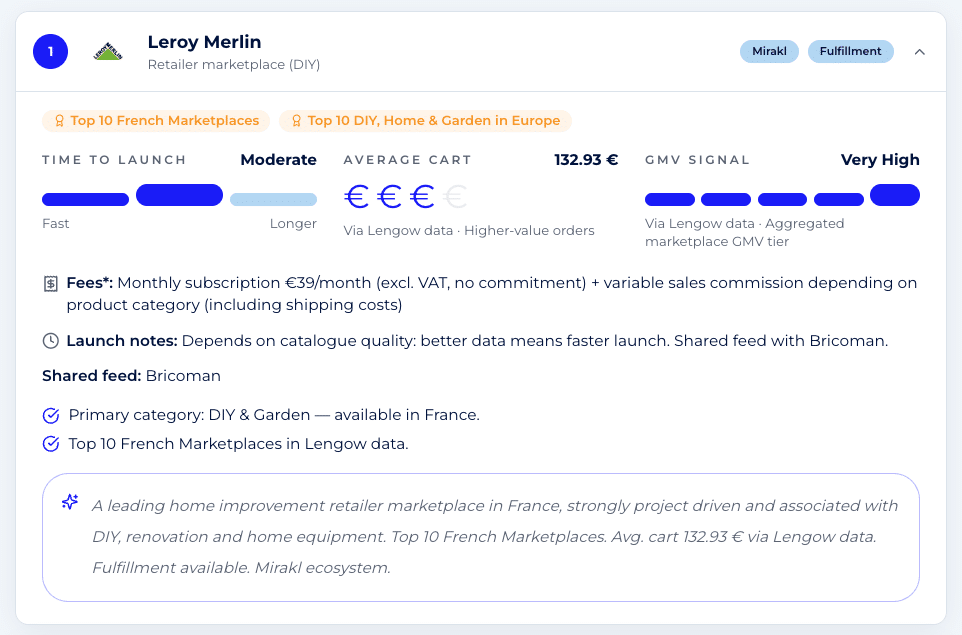
Each entry expands into a detail card that is more useful than a pure score. Leroy Merlin, in this example, carries two earned badges: Top 10 French Marketplaces and Top 10 DIY, Home & Garden in Europe, alongside three operational signals: a moderate time-to-launch indicator, an average cart value of €132.93, drawn from orders Lengow merchants ran through Leroy Merlin, and an aggregated GMV signal marked as very high. The card also surfaces the fee structure, with a €39/month subscription excluding VAT and no commitment, plus a variable sales commission depending on the product category, including shipping costs. It adds a practical launch note: launch speed depends on catalogue quality, and better product data means a faster launch. It also highlights that Leroy Merlin shares a feed with Bricoman, before closing with a plain-language summary explaining why this marketplace is a strong fit for DIY, renovation and home equipment brands in France.
That last part is the difference between a scoring engine and something a category manager can actually take into a meeting.
What the Marketplace Recommender is built on
The tool’s credibility rests on what’s underneath, and the data, once you look at it, is substantial. Across +90 marketplaces, Lengow tracks GMV, order volumes, active seller counts and average cart values – all aggregated from real merchant flows running through its feed management infrastructure. The biggest platforms in the dataset are the ones you’d expect (Amazon; Zalando; Cdiscount; Leroy Merlin; ManoMano; La Redoute, etc.), but the more interesting numbers are the second-tier movements no one is putting in a press release.
The category top-10 rankings produce their own surprises. In electronics across Europe, Kaufland sits at #3, ahead of MediaMarkt Saturn, Fnac and Darty – a German generalist quietly outselling three of the category’s specialist heavyweights. In fashion, Zalando holds #1 with Amazon at #2, but #3 is Veepee: the off-price model crowding the top of a category traditionally dominated by full-price brand platforms. In health and beauty, eBay still sits at #4, which will surprise anyone who has written it off as a legacy platform. And looking at countries rather than categories, Spain’s #2 marketplace by Lengow GMV is El Corte Inglés (a department store outranking Zalando on its home turf.
These rankings are not academic. They are exactly what the recommender uses to award the Top 10 badges that appear on the marketplace cards, and they are why a mid-range fashion seller targeting Spain gets pushed toward Zalando, El Corte Inglés and Privalia – three platforms that move volume in that market – rather than a generic “try Amazon” answer.
A sensible disclaimer applies to all of this: recommendations are not guarantees, and final onboarding still depends on each marketplace’s own approval and integration process. Performance, as ever, varies with the quality of your catalogue, your pricing, and your operational readiness. The point of the tool isn’t to remove that work; it’s to make sure you’re doing the work on the right marketplaces.
Who should actually use it
A few obvious profiles come to mind.
Brands plotting a country expansion will get the most immediate value: country-specific shortlists, fit scores, and a fast sense of whether the local generalist or a vertical specialist deserves the first integration. Retailers diversifying away from Amazon – a recurring theme in 2026 – can use the reduce dependency on Amazon goal to surface alternatives they may not have considered; in DIY, that conversation runs through ManoMano, Leroy Merlin, Castorama and HORNBACH long before it gets to Amazon. Sellers in over-indexed categories (fashion, beauty, home) will find the price-positioning filter useful for separating outlet-style platforms from premium ones – a distinction that matters enormously when 56 of the +90 mapped marketplaces are specialists rather than generalists.
And for anyone running a marketplace strategy who has spent the last two years saying “we should probably look at Kaufland, or maybe Allegro, or was it Bol?” – this is the kind of artefact that ends the discussion in roughly five minutes.
The Marketplace Recommendation Tool is free to use. It won’t replace a proper market entry analysis, and Lengow isn’t pretending it will. What it does, quite well, is replace the gut call with a ranked, evidence-backed starting point – which, for most teams, is exactly where the work should begin.
Your e-commerce library
Clarins x NetMonitor Success Story
Learn moreSuccess on Marketplaces
Learn moreCompetitive Intelligence
Learn moreSign up for our newsletter
By submitting this form you authorize Lengow to process your data for the purpose of sending you Lengow newsletters . You have the right to access, rectify and delete this data, to oppose its processing, to limit its use, to render it portable and to define the guidelines relating to its fate in the event of death. You can exercise these rights at any time by writing to dpo@lengow.com

Trending Posts
Marketplaces
The Top 10 Marketplaces in Europe (2026)
The e-commerce scene is a vibrant mix of marketplaces in Europe. These aren't just websites; they're bustling hubs where millions…
02/01/26
8'
Marketing channels
ChatGPT Ads and advertising on GenAI Search Engines: what you need to know
Advertising on generative AI-based search engines (GenAI) marks a new era in digital marketing. After two decades dominated by traditional…
18/01/26
8'
Marketplaces
The French Marketplace Landscape: What Brands Need to Know
France has quietly become Europe's marketplace laboratory. Lengow's exclusive ranking reveals why traditional retailers, not tech giants, dominate the game.…
08/01/26
6'
E-commerce Trends
Google’s Universal Commerce Protocol: The End of E-Commerce as We Know It?
On January 11, 2026, at the NRF Retail's Big Show in New York, Google unveiled the Universal Commerce Protocol (UCP),…
16/01/26
6'
Marketing channels
What the World Is Unboxing on TikTok and Instagram (Haul & Unboxing Index 2025)
Opening a package on camera has become much more than simple entertainment. In 2026, "haul" and "unboxing" videos serve as…
20/01/26
7'