OpenAI's E-Commerce Bet: What Went Wrong with ChatGPT Checkout
In just fourteen months, OpenAI signed retail partnerships with Walmart, Target, Shopify, Instacart, Etsy, PayPal, Salesforce and Amazon - and then quietly walked back its most ambitious bet. A look at what went right, what didn't, and what it means for the future of commerce.
Adrian Gmelch
Adrian Gmelch is Director of Content at Lengow, where he leads content strategy while staying firmly hands-on: reading the research, and tracking the trends that matter before they go mainstream.
It started with a grocery list. During the live demo that introduced the world to OpenAI's Operator agent in January 2025, a user held up a handwritten sheet of paper in front of their camera. Within seconds, the AI had read it, opened Instacart, built a cart, and scheduled a delivery. No typing. No searching. The audience applauded.
It was a genuinely compelling vision: a world where the friction of online shopping - the tabs, the comparisons, the abandoned carts - simply disappears into a conversation. And for the next fourteen months, OpenAI pursued that vision with unusual aggression for a company that had, until then, stayed out of commerce entirely.
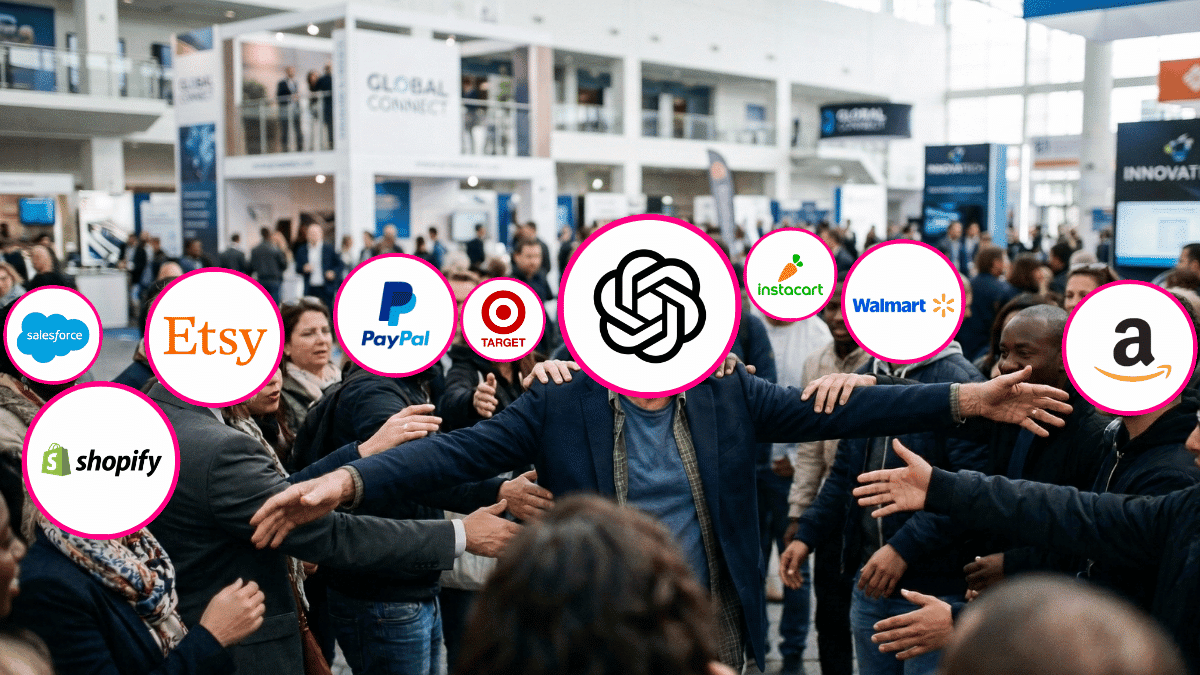
What followed was a sprint of partnerships with some of the biggest names in global retail. Walmart. Target. Shopify. Etsy. PayPal. Salesforce. And, just last week, Amazon - to the tune of $50 billion. The ambition was clear: make ChatGPT the place where people not only discover products, but buy them.
The reality, it turns out, was more complicated. This week, OpenAI confirmed it is stepping back from its most direct bet: native checkout inside ChatGPT. The reason, according to insiders, is painfully straightforward. People browse. They don't buy.
The promise: a new kind of storefront
To understand what OpenAI was trying to build, it helps to think about what traditional e-commerce actually looks like. You type a product name into a search bar. You get a list - sometimes hundreds of results, often cluttered with ads. You click around. You compare tabs. You add something to a cart, get distracted, and maybe come back later. Conversion rates across the industry hover somewhere between one and four percent.
OpenAI's thesis was that AI could collapse that entire process into a conversation. Ask ChatGPT what running shoes to buy for a half marathon, and instead of a list of links, you get a recommendation, a reason, a price, and a button. One tap, done.
The commercial logic was equally neat. With 700 million weekly users and a growing share of product-related searches, ChatGPT had an audience. Merchants needed reach. The Agentic Commerce Protocol - an open standard co-developed with Stripe - would be the technical glue between them: a universal checkout layer that any retailer could plug into, regardless of their existing payment infrastructure.
"For many years now, eCommerce shopping experiences have consisted of a search bar and a long list of item responses. That is about to change."
When Walmart signed up in October 2025, it felt like a watershed. The world's largest retailer (at the time), with 270 million customers a week and $681 billion in annual revenue, was betting that conversational AI was the next major commerce channel. Target followed weeks later. Instacart launched a full grocery experience in December. PayPal brought its 400 million wallets to the table. Salesforce connected the product catalogues of L'Oréal, Pandora, Saks, and hundreds of other enterprise brands.
On paper, OpenAI had assembled a retail ecosystem from scratch in under a year. The question was whether real shoppers would actually use it.
OpenAI × E-Commerce & Retail — Partnership Map
January 2025 – March 2026 · All major announced partnerships
Date
Partner
What was announced
Status
🏗 Commerce Infrastructure
2023 → ongoing
Stripe
Co-developed the Agentic Commerce Protocol (ACP) — the open standard powering all in-chat checkout. Continues development even after OpenAI's checkout pivot.
Live
Oct 14, 2025
Salesforce
Agentforce Commerce catalogs (L'Oréal, Pandora, Saks) integrated into ChatGPT Instant Checkout. GPT-5 inside Salesforce platform. ChatGPT + Codex in Slack.
Live
Oct 28, 2025
PayPal
PayPal wallet (400M+ users) integrated into Instant Checkout. Millions of SMB merchants to be onboarded via ACP server in 2026.
Live
🤖 Operator Agent Launch Partners
Jan 28, 2025
eBay
Named Operator launch partner. AI agent can browse and purchase on eBay on users' behalf. Building its own agentic commerce platform connecting to third-party agents.
Live
Jan → Sep 2025
Etsy
Operator launch partner, then inaugural Instant Checkout partner. Etsy covered OpenAI's merchant commissions to kickstart adoption. Eligibility limited to Offsite Ads members.
~12 merchants active
🛒 Platform Partners
Apr–Sep 2025
Shopify
1M+ Shopify merchants (SKIMS, Glossier, Spanx, Vuori) announced for Instant Checkout. Shopify's president later revealed only ~12 merchants actually integrated.
~12 merchants active
🏬 Mass-Market Retail
Oct 14, 2025
Walmart
Walmart and Sam's Club customers can shop directly in ChatGPT via Instant Checkout. ChatGPT Enterprise deployed to 2.1M associates.
Live
Nov 2025
Target
Beta app in ChatGPT with personalized recs, multi-item baskets, fresh food, and Drive Up delivery. Testing contextual ads via Roundel media network.
Live
Dec 8, 2025
Instacart
First full grocery app + Instant Checkout inside ChatGPT. Meal inspiration to doorstep delivery without leaving the chat. 1,800+ retailers across North America.
Live
☁️ Cloud & Strategic Deals
Nov 2025 · $38B
AWS
Seven-year, $38B deal. OpenAI models added to Amazon Bedrock. Infrastructure backbone for all of OpenAI's commerce AI capabilities.
Live
Feb 27, 2026 · $50B
Amazon
Multi-year strategic partnership + $50B investment. Customised AI models for Amazon apps (Alexa, Rufus, search). AWS becomes exclusive cloud provider for OpenAI Frontier. Amazon products will not be sold inside ChatGPT.
In progress
⚠️ Strategic Pivot
Mar 2026
All partners
OpenAI abandons native checkout. Users redirected to retailer apps to complete purchases. Only ~12 Shopify merchants ever integrated; no state sales tax system in place. ACP continues in app-based form. Advertising becomes the primary revenue strategy.
Strategy revised
Compiled by Lengow · Sources: OpenAI, Walmart, Salesforce, PayPal, Instacart and Amazon newsrooms · Retail Dive · Digital Commerce 360 · CNBC · WallStreetCN / Moomoo (Mar 2026)
The reality: browsing without buying
The problems emerged quietly, before any public announcement. OpenAI's internal teams began noticing a pattern: ChatGPT users were asking plenty of product-related questions - comparing laptops, hunting for gift ideas, researching running gear - but they weren't completing purchases inside the app. They were, in the language of e-commerce analytics, high-intent browsers with low conversion rates.
This wasn't entirely surprising in retrospect. Shopping is a behaviour built on habits. People know how to buy on Amazon. They trust the checkout flow on their favourite brand's website. They have saved cards, loyalty points, delivery preferences all embedded in platforms they've used for years. Asking them to complete a transaction inside a chatbot (however seamless) required rewiring a habit loop that commerce companies have spent decades reinforcing.
"Only about a dozen merchants - out of the millions on Shopify - actually integrated with ChatGPT's Instant Checkout. The promise of mass-market agentic shopping collided hard with the reality of merchant behaviour."
On the merchant side, the barriers were technical and structural. For ChatGPT to show a live price and confirm availability, inventory data needs to be synchronised in real time. For a large retailer with hundreds of thousands of SKUs, complex promotions, and regional price variations, that's a non-trivial engineering problem. Add fraud prevention - how do you build safeguards against AI-initiated erroneous transactions at scale? - and the integration cost starts to look significant relative to an unproven revenue opportunity.
Harley Finkelstein, President of Shopify, confirmed the gap at an investor conference with unusual candour. Of the millions of merchants on Shopify's platform, only about a dozen have integrated AI tools for sales. His diagnosis was direct: " The sole limiting factor is that we are just waiting for agent applications to open up further." In other words, the infrastructure was built. The merchants were watching. The users weren't converting.
There was also a compliance blind spot that had received little public attention. As of February 2026, OpenAI had not yet built a system for collecting and remitting state sales taxes in the US. For any transaction passing through ChatGPT's checkout, that was a live regulatory problem and a sign that the underlying commercial infrastructure was less complete than the press releases suggested.
Etsy, notably, had agreed to cover OpenAI's commission fees on behalf of its merchants to help jumpstart the ecosystem. The gesture underscored how much early partners wanted the model to work - and how much OpenAI still needed to prove.
The pivot: from checkout to discovery
This week, an OpenAI spokesperson confirmed the strategic shift in plain terms: " We are evolving our commerce strategy within ChatGPT to better meet merchants and users where they are. Instant checkout is transitioning to apps, where purchases can occur more seamlessly."
Translated: OpenAI is no longer trying to be the place where you buy things. It is trying to be the place where you decide what to buy and then routing you to the apps and websites where you actually complete the transaction.
It's a meaningful distinction, and not necessarily a failure. Discovery is still enormously valuable in e-commerce. The brands that get recommended by ChatGPT - ranked first when someone asks "what's the best moisturiser for combination skin" or "running shoes for wide feet under €100" - will see real commercial benefit. OpenAI is, in effect, pivoting from competing with Stripe and checkout providers to competing with Google Shopping and affiliate networks.
"The four partners that have functioning apps in ChatGPT today - Instacart, Target, Expedia, and Booking.com - represent the new model: AI handles discovery and intent; the transaction completes in the retailer's own environment."
The Amazon question
The pivot landed days after Amazon announced a $50 billion investment in OpenAI. The deal includes customised AI models for Amazon's consumer apps and makes AWS the exclusive cloud provider for OpenAI's enterprise platform. What it doesn't include, pointedly, is any agreement to sell Amazon products inside ChatGPT - Amazon had previously blocked ChatGPT from scraping its listings, and Andy Jassy has only said he'd collaborate "if the terms were attractive." The biggest bet in AI history left the most commercially interesting question deliberately unanswered.
Meanwhile, Google has integrated shopping into Gemini, Perplexity has launched agentic purchasing, and Meta is testing commerce inside WhatsApp. OpenAI's retreat from native checkout doesn't mean it has conceded the race, it means it's chosen discovery and influence over transaction and commission. Whether that's the smarter bet depends on how much of commerce's value sits in knowing what someone wants, versus processing the payment.
What this means for retailers
Four things worth acting on now.
First, visibility in AI is the new SEO - according to Adobe Analytics, traffic to retail sites from generative AI tools grew by 693% year-on-year over the 2025 holiday season. If ChatGPT doesn't recommend your product, you don't exist in that channel.
Second, the Agentic Commerce Protocol is worth watching: open-source, Stripe-backed, and likely to mature regardless of OpenAI's own commercial trajectory.
Third, protect your first-party data - brands racing onto external AI platforms risk surrendering the customer relationship to the intermediary.
Fourth, product feed quality will determine AI ranking. Rich titles, real-time pricing, complete catalogue coverage: the fundamentals of good feed management are now a competitive advantage.
The shop that never quite opened
The technology worked. The partnerships were signed, the protocol was built, the checkout button was live. What OpenAI discovered is that building the infrastructure for a new commerce channel and changing consumer habits are two entirely different problems. Mobile shopping took eight years to dominate, not two. Voice commerce was "next" for half a decade. The behaviour change always lags the technology.
What's different this time is the scale of surrounding investment - $50 billion from Amazon, an open protocol from Stripe, enterprise pipelines from Salesforce and Walmart. The foundations are being poured. The floor plan just needed to change.
Adrian Gmelch
Adrian Gmelch is Director of Content at Lengow, where he leads content strategy while staying firmly hands-on: reading the research, and tracking the trends that matter before they go mainstream.
Table of content
Is your catalogue ready for AI Shopping?
Discover what AI assistants look for, how products get selected and what you can do now to stay visible in the new shopping journey.
From emerging channels and shifting shopper behaviour to the technologies reshaping commerce, discover fresh data, ideas and perspectives worth having on your radar.

.png?width=48&height=48&name=Adrian%20(1).png)
.png?width=64&height=64&name=Adrian%20(1).png)

.png)