.png?width=48&height=48&name=Adrian%20(1).png)
Solving the N×N integration nightmare
Until now, every AI interface - whether a search engine, voice assistant, or mobile app - needed custom connections with each merchant to access catalogs, pricing, inventory, and business rules. Google calls this the "N×N" problem: the number of required integrations grows exponentially with each new surface and merchant.
Consider this: if five AI assistants (ChatGPT, Gemini, Alexa, Copilot, Perplexity) want to enable purchases from 1,000 retailers, that's 5,000 separate custom integrations, each with its own APIs, data formats, authentication processes, and payment systems. It's a logistical nightmare that's costly, slow to deploy, and nearly impossible to maintain at scale.
UCP changes the game by creating a single standardized language. Instead of connecting each agent to each merchant, one protocol exposes commerce capabilities (discovery, cart, payment, order tracking) in a format that all compatible agents can read and use.
A single integration
makes a catalog "actionable" across multiple conversational interfaces.
An ecosystem of interconnected protocols
UCP doesn't reinvent the wheel. It orchestrates
three existing protocols
to create a complete framework for agentic commerce:
- Agent2Agent (A2A): Originally developed by Google and now managed by the Linux Foundation, A2A enables communication between autonomous agents. Over 150 organizations support A2A, which uses JSON-RPC 2.0 over HTTP(S) for standardized interactions.
- Agent Payments Protocol (AP2): A standard for secure payments initiated by AI agents, developed by Google with PayPal and other payment industry partners. AP2 introduces cryptographic "mandates" - tamper-proof digital contracts proving a user authorized a specific transaction.
- Model Context Protocol (MCP): Created by Anthropic in November 2024 and adopted by OpenAI and Google DeepMind, MCP standardizes how large language models connect to external data sources and tools.
How shopping actually works in Google AI Mode
The traditional path looks like this: you search for "lightweight carry-on luggage for weekend trips" → Google sends you to 10 different sites → you open multiple tabs → compare prices, read reviews, check shipping costs → add to cart → create an account → fill in your details → pay.
With UCP and checkout integrated into Google AI Mode
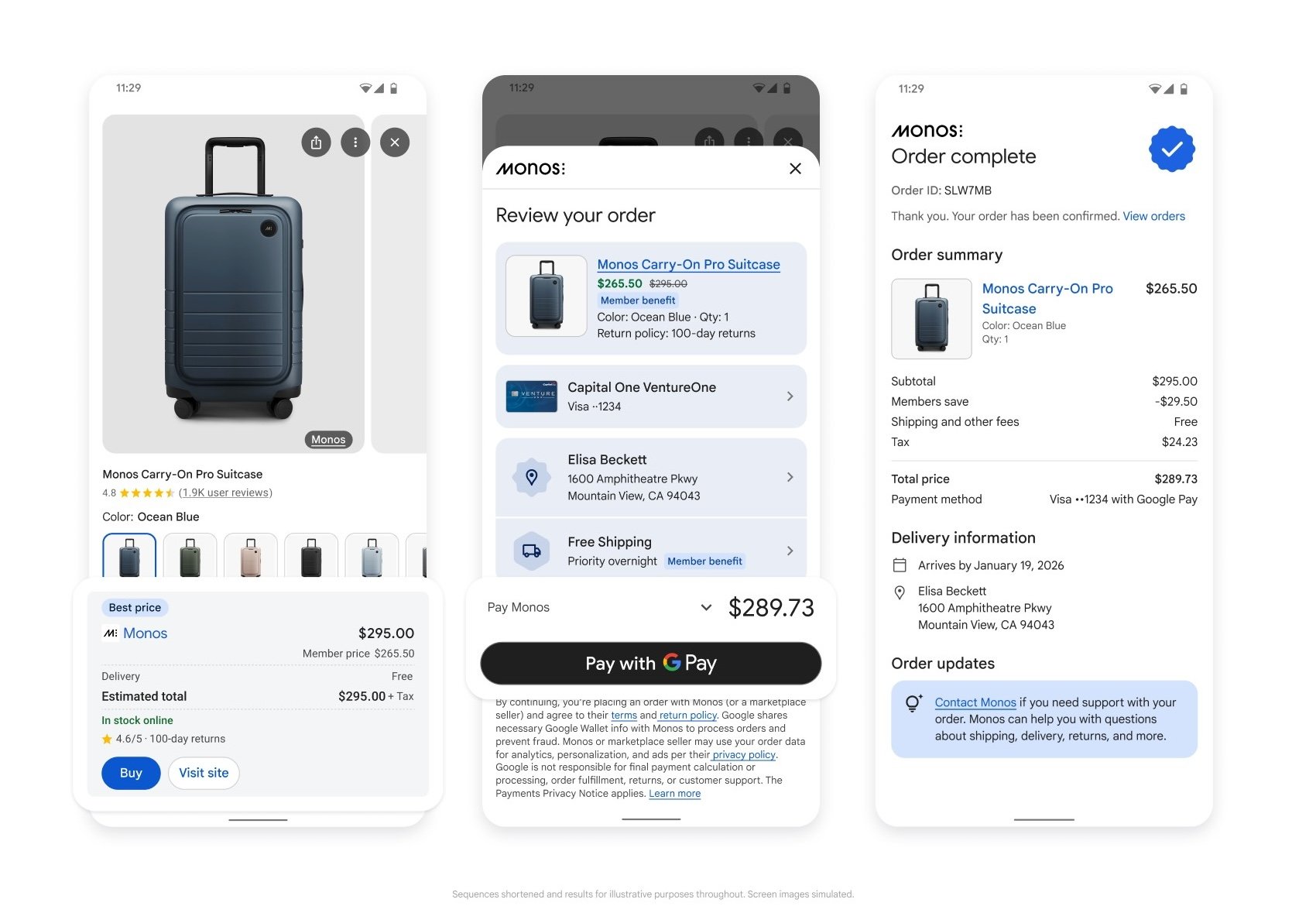
, the experience transforms completely. You type "I need a lightweight carry-on under 2 kg for a weekend in Barcelona." Gemini instantly analyzes catalogs from participating retailers, cross-references reviews, verifies real-time inventory and prices, and presents three curated options with a simple "Buy" button for each. Two clicks later, the purchase is complete without leaving Google.
Behind the scenes, when you click "Buy," the AI agent contacts the merchant's UCP server, creates a shopping session, adds the item to cart, retrieves your stored payment method (secured by AP2 mandates), processes payment, and confirms the order.
Microsoft and OpenAI join the race
Google isn't alone in this space.
Microsoft launched Copilot Checkout
in early January 2026 through a partnership with Shopify. Meanwhile,
OpenAI introduced "Buy it in ChatGPT"
in October 2025, allowing instant purchases directly in ChatGPT conversations.
However, there's a crucial distinction. While Microsoft and OpenAI created proprietary systems,
UCP is an open standard
explicitly designed for interoperability across all AI platforms. Google's strategy is clear: become the universal checkout infrastructure for the entire AI ecosystem rather than just another walled garden.
A new threat to e-commerce traffic
The rise of AI-powered shopping introduces what experts call the
"zero-click" crisis
. When users can complete purchases directly within AI interfaces, they never click through to merchant websites. This fundamentally changes the e-commerce traffic model that's existed for 25 years.
Data from late 2025 shows that
traffic from AI sources already converts 40-60% worse
than traditional search traffic. With UCP, this traffic may disappear entirely, users will buy without ever visiting your site. For brands built around website experiences, conversion funnels, and retargeting campaigns, this is deeply disruptive.
What this means for retailers
BCG estimates
that by 2028, 15-20% of e-commerce transactions will be AI-mediated. For retailers, this shift demands immediate action:
- Implement UCP integration: Retailers using Google Merchant Center can enable UCP through their existing infrastructure. Early adoption means higher visibility in AI shopping results.
- Optimize for AI discovery: Product data quality becomes paramount. Detailed descriptions, accurate attributes, high-quality images, and structured data determine whether your products surface in AI recommendations.
- Rethink brand strategy: When the website disappears from the purchase journey, brand differentiation must happen at the product and service level—exceptional quality, unique features, superior customer service, and competitive pricing.
- Prepare for margin pressure: Reduced customer acquisition costs from direct website traffic will be offset by increased competition in AI recommendation engines, potentially compressing margins.
The open questions
Despite Google's ambitious vision, significant questions remain. How will product discovery algorithms work when merchants can't leverage SEO and paid ads? Will UCP truly remain neutral, or will Google favor its own commercial interests? What happens to customer data and remarketing capabilities when the website visit disappears?
Most critically,
80% of e-commerce leaders remain unprepared
for AI agent traffic, despite projections showing this channel could represent a $9 trillion opportunity by 2030.
Google's Universal Commerce Protocol represents more than a technical standard, it's a fundamental reimagining of online shopping. The traditional e-commerce playbook centered on driving traffic, optimizing conversion funnels, and building direct customer relationships is being upended by a world where AI agents shop on behalf of users.
For retailers, the choice is stark: embrace UCP and adapt business models to this new reality, or risk becoming invisible in an AI-first shopping world. The companies that thrive will be those that recognize this is about preparing for a future where your website might not be where most of your customers shop.
.png?width=64&height=64&name=Adrian%20(1).png)
Adrian Gmelch
Adrian Gmelch is Director of Content at Lengow, where he leads content strategy while staying firmly hands-on: reading the research, and tracking the trends that matter before they go mainstream.
.png)