.png?width=48&height=48&name=Adrian%20(1).png)
What's actually happening in Croydon
Ingka Group
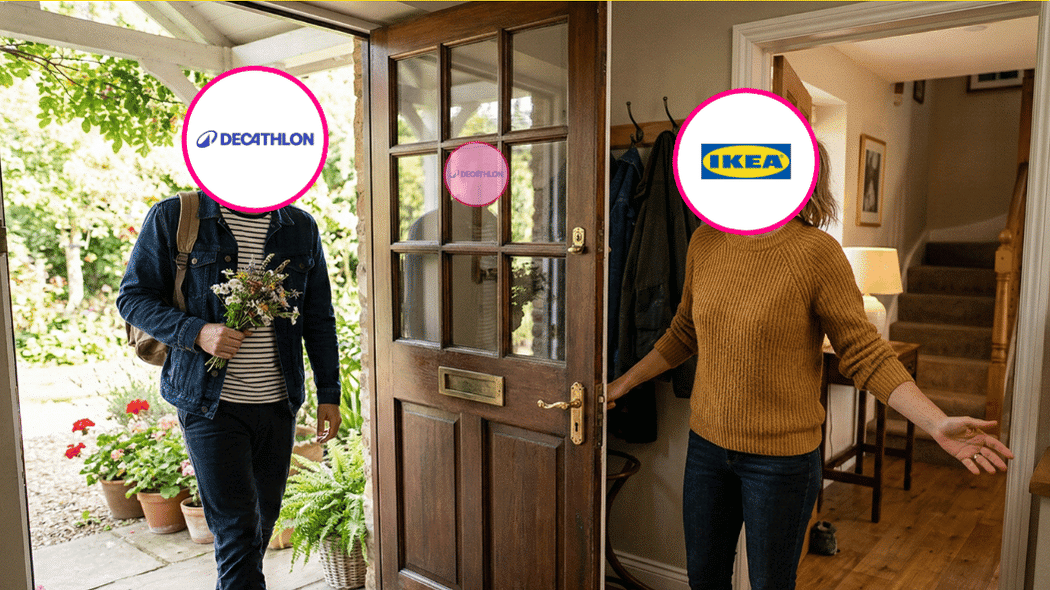
, the largest IKEA retailer, confirmed the partnership on February 24, 2026. A standalone Decathlon unit - covering 1,188 square metres of the 25,000-square-metre IKEA Croydon store - will open this spring with its own dedicated customer entrance. Inside, shoppers will find more than 5,000 Decathlon products spanning hiking, camping, running, fitness, swimming and cycling. There'll also be a Buyback circularity service and a Click & Collect option.
It's the
first time IKEA has ever hosted another global brand in one of its UK stores
. IKEA Croydon opened in 1992 - and until now, that blue box has been entirely IKEA's domain.
The logic behind the pairing isn't arbitrary. Both brands share a positioning built on affordability, quality and broad accessibility. IKEA's own
Life at Home Report 2025
found that 36% of people in the UK say spending time on hobbies and personal interests is their primary source of enjoyment at home. If you're already kitting out your living room, why not pick up a yoga mat or a bike helmet on the same trip?
This isn't a one-off
The Croydon pilot is the most high-profile example of a broader strategic shift that IKEA has been quietly rolling out across Europe.
In
Sweden
,
IKEA has been running a pilot with Kjell & Company
, a Nordic consumer electronics retailer, inside its Stockholm and Kalmar stores since late 2025. The concept focuses on smart home and technology products that complement IKEA's existing range, think connected devices, speakers, and home automation gear that sits naturally alongside IKEA's own smart home line. The pilot runs for an initial 18-month period.
In
Austria
, IKEA is investing €11 million in its biggest-ever renovation of the Klagenfurt store.
When the refurbishment completes in autumn 2026
, around 2,600 square metres will be carved out for third-party retailers, including Thomas Philipps, a discount home and garden specialist. Interactive family activity zones are also planned for the reimagined space.
Back in the
UK
, IKEA's Greenwich store has already been quietly hosting a co-working space through a partnership with
Hej!Workshop
- another signal that the brand is experimenting with the idea of the store as a broader lifestyle destination, not just a place to buy furniture.
Ingka's Commercial Manager, Javier Quiñones, has signalled the company is
exploring similar arrangements in additional European and North American markets
.
Why now? The context behind the strategy
This pivot doesn't come out of nowhere. IKEA has been under real pressure.
Ingka Group reported IKEA retail sales of €39 billion for FY2025
- down 1.6% from the previous year. Footfall across stores rose just 1.3%. The company is selling more units (volumes are up) because it has been deliberately cutting prices to stay competitive, but revenue itself has taken a hit. The wider home furnishing market has been sluggish across Europe, squeezed by the cost-of-living crisis and cautious consumer spending.
Big-box stores everywhere are grappling with the same fundamental challenge: huge square footage, high running costs, and a customer who no longer feels compelled to make a special trip just to browse shelves they can scroll through at home. The answer, IKEA seems to be betting, is to give people more reasons to show up.
The shop-in-shop model does several things at once. It generates rental income from space that might otherwise be underperforming. It increases dwell time. It broadens the category appeal of the visit. And it lets IKEA position itself as a curated lifestyle destination (not just a furniture warehouse) without having to develop and stock those categories itself.
Ingka Group has committed more than €5 billion
across its three-year investment plan from FY2024 to FY2026 to open new stores and refurbish existing ones. The shop-in-shop pilots are part of that wider store reinvention effort.
IKEA isn't alone: the broader shop-in-shop trend
The concept of hosting other brands within a store isn't new, but it's been accelerating rapidly across retail.
Shop-in-Shop: Who's Doing It and Why
A cross-market overview of major shop-in-shop partnerships in physical retail
| Host Retailer | Guest Brand(s) | Market | Since | Category | Status | Why? |
|---|---|---|---|---|---|---|
| IKEA | Decathlon | 🇬🇧 UK | Spring 2026 | Sports & outdoor | Pilot | Drive footfall & lifestyle destination |
| IKEA | Kjell & Company | 🇸🇪 Sweden | Late 2025 | Consumer electronics | 18-month eval | Complement smart home range |
| IKEA | Thomas Philipps | 🇦🇹 Austria | Autumn 2026 | Home & garden discount | Upcoming | Post-renovation space monetisation |
| IKEA | Hej!Workshop | 🇬🇧 UK | 2024 | Co-working space | Live | Store as lifestyle hub |
| Target | Ulta Beauty | 🇺🇸 USA | 2021 | Beauty & cosmetics | Live (800+ stores) | Attract younger beauty shoppers & grow basket |
| Kohl's | Sephora | 🇺🇸 USA | 2021 | Luxury beauty | Live (900+ stores) | Reverse footfall decline |
| El Corte Inglés | Bulgari, Prada, Cartier, Hugo Boss & others | 🇪🇸 Spain | 2010s → ongoing | Luxury fashion & jewellery | Long-standing model | 1.5M daily visitors as gateway to Spanish market; takes 28–32% of in-store sales |
| John Lewis | Various (WeWork-style offices & brands) | 🇬🇧 UK | 2022 → ongoing | Services & mixed brands | Experimental | Reimagine underused department store floors |
| Sources: Ingka Group · Across Magazine · FashionNetwork · Retail Bulletin · El Corte Inglés corporate reports — compiled by Lengow, Feb. 2026 | ||||||
Target
in the US has long been a standard-bearer of the model, partnering with brands like Apple, Ulta Beauty and Disney to create branded shops-within-shops. The Ulta Beauty partnership in particular has been widely credited with driving incremental footfall and attracting beauty shoppers who might not have otherwise visited Target.
Sephora inside Kohl's
became another widely-studied case in the US: Kohl's, struggling with traffic, brought in Sephora to attract a younger, beauty-focused demographic. Early results showed meaningful lifts in overall store sales in locations with Sephora shops.
In the UK,
John Lewis
has been experimenting with hosting third-party brands and services in its department stores, including WeWork-style office spaces in some locations, as it works to redefine the role of its large retail footprint.
What all these examples share is the same underlying logic: underutilised physical space, combined with the desire to become a destination rather than just a transaction point.
The bigger picture: retail's destination imperative
What IKEA is testing in Croydon, Klagenfurt and Stockholm is really a version of something the whole physical retail sector is wrestling with:
how do you make a store worth visiting in a world where almost anything can be bought from a sofa?
The answer increasingly looks like this; you stop thinking of your store as a product distribution point and start thinking of it as a place. A place that offers things online simply cannot: the spontaneous discovery, the physical experience, the convenience of doing multiple things in a single trip.
Shop-in-shop partnerships, when they're curated well, are one of the more elegant solutions to that challenge. They add footfall-generating reasons to visit, spread fixed costs across multiple tenants, and allow both brands to benefit from each other's customer bases.
For IKEA, the stakes are real. Its stores are enormous assets and enormous liabilities if they're not full of people. Getting this right could redefine the blue box for the next generation of shoppers. Getting it wrong just makes the flatpack even harder to justify the drive for.
Retail watchers will be paying close attention to the Croydon experiment.
.png?width=64&height=64&name=Adrian%20(1).png)
Adrian Gmelch
Adrian Gmelch is Director of Content at Lengow, where he leads content strategy while staying firmly hands-on: reading the research, and tracking the trends that matter before they go mainstream.
Table of content
Is your catalogue ready for AI Shopping?
Discover what AI assistants look for, how products get selected and what you can do now to stay visible in the new shopping journey.
.png)