
What OpenAI actually announced
The update focuses on
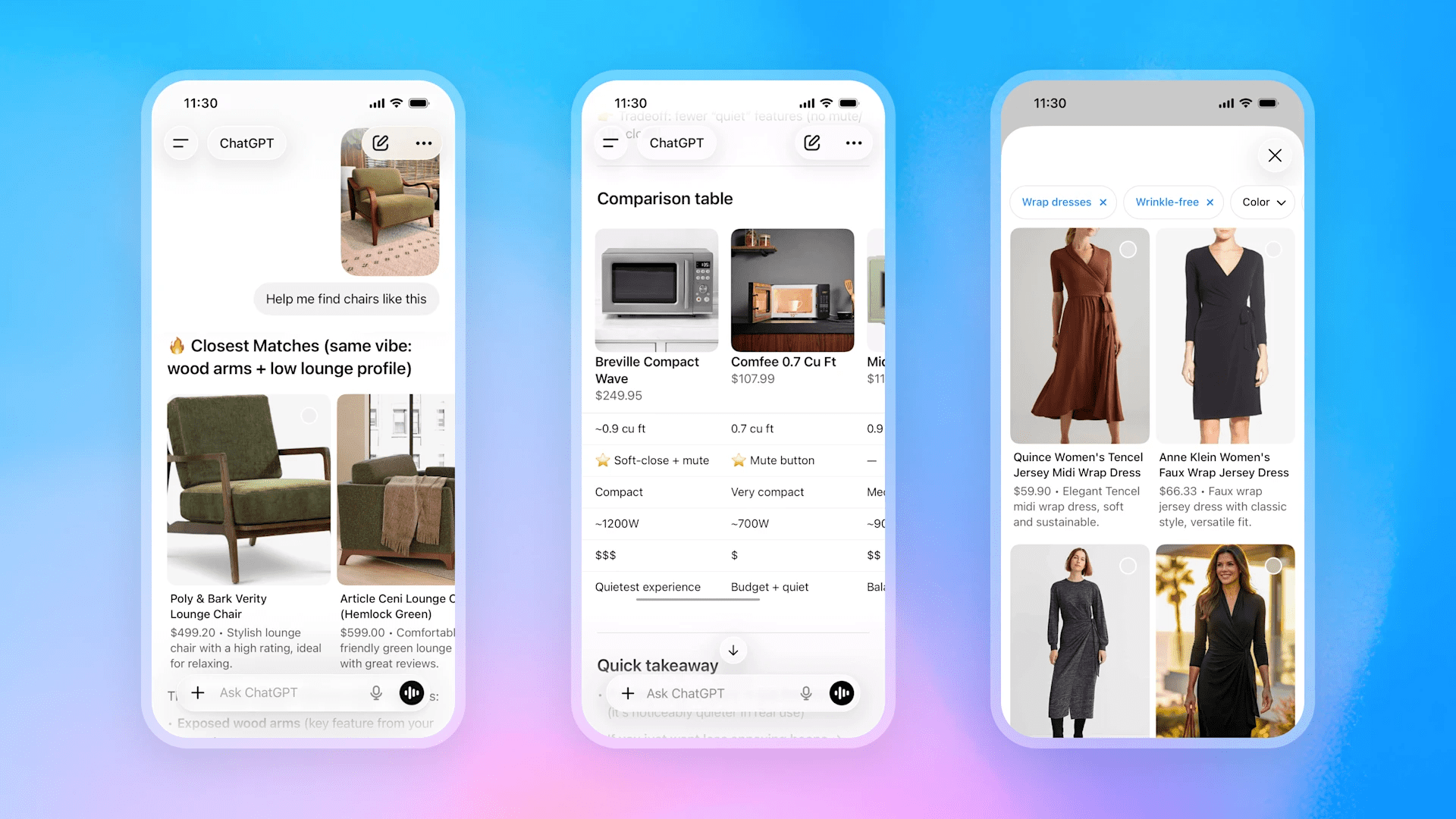
discovery, not transaction. ChatGPT now surfaces product grids with images, specs, prices, and reviews. Users can describe what they need, refine their criteria conversationally, and compare options without leaving the interface. Think of it less like a checkout and more like an extremely knowledgeable personal shopper who happens to have access to millions of products. On the infrastructure side, the ACP now powers the discovery phase, not just checkout. Merchants who connect their catalogs can push structured product data, promotions, and real-time stock or pricing information directly into ChatGPT's results. Major retailers including Target, Sephora, and Best Buy are already integrated. Shopify merchants get automatic inclusion through Shopify Catalog with no additional setup required. Crucially, OpenAI has stepped back from the idea of native in-chat purchasing. Transactions still happen on the merchant's own site or app. The numbers explain why: while 22% of users have purchased directly through an AI interface,
50% have purchased after using AI during their research phase
(source: ecommerce nation). Conversion rates for direct-in-chat purchases were reportedly three times lower in some tests. The opportunity is in influencing the decision, not hosting it.
AI captures purchase intent, but it does not replace the e-commerce site.
ChatGPT vs. Google Shopping: a real comparison
These two surfaces serve the same consumer need but operate on fundamentally different logic. Understanding the difference is the first step to feeding each one correctly.
| Google Shopping Mature | ChatGPT Shopping Emerging | |
|---|---|---|
| Discovery model | Keyword-driven: user searches for a specific product or category | Intent-driven: user describes a need or problem in natural language |
| Ranking factors | Bid, feed quality, relevance score, CTR, landing page quality | Structured data completeness, catalog accuracy, ratings, real-time freshness |
| Feed format | Google Merchant Center (title, GTIN, price, availability…) | ACP-compliant catalog; Shopify Catalog auto-syncs for Shopify merchants |
| Paid placement | Product listing ads (PLAs) above organic results | No paid placement: visibility is purely data-quality driven |
| Conversion point | Merchant website or (limited) Buy on Google | Merchant website: no native checkout in the current model |
| Attribution | Click tracked directly from the Shopping tab | Unclear: user may discover in ChatGPT, buy later on-site |
| Funnel position | Mid-to-low funnel: user often has a specific item in mind | Upper-to-mid funnel: user is exploring, comparing, deciding |
| Image search | Google Lens integration | Native: upload a photo, find similar products |
| Scale & maturity | Billions of queries, established ROI benchmarks | 500M+ weekly users; shopping behavior still maturing |
| Key risk | Rising CPCs, fierce competition on high-intent terms | Feed gaps = invisibility; no data quality means no recommendation |
Why your product feed is now twice as important
Here is the uncomfortable truth both channels share: garbage in, garbage out. Google Shopping has penalized poor feed quality for years. ChatGPT's model takes that logic further because there is no bid to compensate for weak data. Your product either surfaces or it does not, based entirely on how well-structured and complete your catalog is. For ChatGPT specifically, visibility depends on:
- Accurate, real-time pricing and availability (stale data means irrelevant recommendations)
- Rich product attributes that map to natural language queries ("waterproof hiking boots under €120")
- Customer reviews and ratings, which ChatGPT factors into its comparisons
- Clear product categorization that an AI can interpret without ambiguity
One feed strategy, two channels
This is precisely the problem a
feed management platform like Lengow is designed to solve. Rather than maintaining separate, manually updated feeds for each new surface, a centralized feed management layer lets you enrich your product data once and distribute it correctly to every channel: Google Shopping, Meta, Amazon, affiliate networks, and increasingly, AI-powered discovery surfaces like ChatGPT. As the number of channels where consumers discover products keeps growing, the teams that win will not be those who react fastest to each new platform. They will be the ones who built a clean, complete, and adaptable product catalog from the start.
Make your catalog AI-ready
The front door to e-commerce is not changing. It is multiplying. And the key to every single one of them is the same: your data.
Lengow helps you centralize, enrich, and distribute your product feeds across Google Shopping, ChatGPT, and 1,800+ other channels. One platform, every discovery surface.

Alexis Merelle
Alexis Mérelle works on content and SEO at Lengow, where he turns marketplace and pricing data into articles, and tracks what AI search is doing to product discovery.
.png)