Picture the standard retail playbook for 2026. You list on Zalando. You run a sponsored products campaign on Amazon. You connect your feed to new marketplace seller platforms for good measure, and you pray the algorithm is kind. You track your ROAS obsessively and spend half your marketing budget fighting for visibility you used to get for free.
Now picture Primark. No online shop. No marketplace presence. No home delivery, no returns portal, no "add to basket." If you want a Primark hoodie, you get off the sofa and walk into a store.
Last year, Primark grew revenues by 6% to £9.4 billion . Operating profit jumped 51%. So: is Primark a relic stubbornly refusing to adapt? Or is it playing a game the rest of the industry hasn't quite figured out?
The answer is more interesting than either.
The world's most profitable abstainers
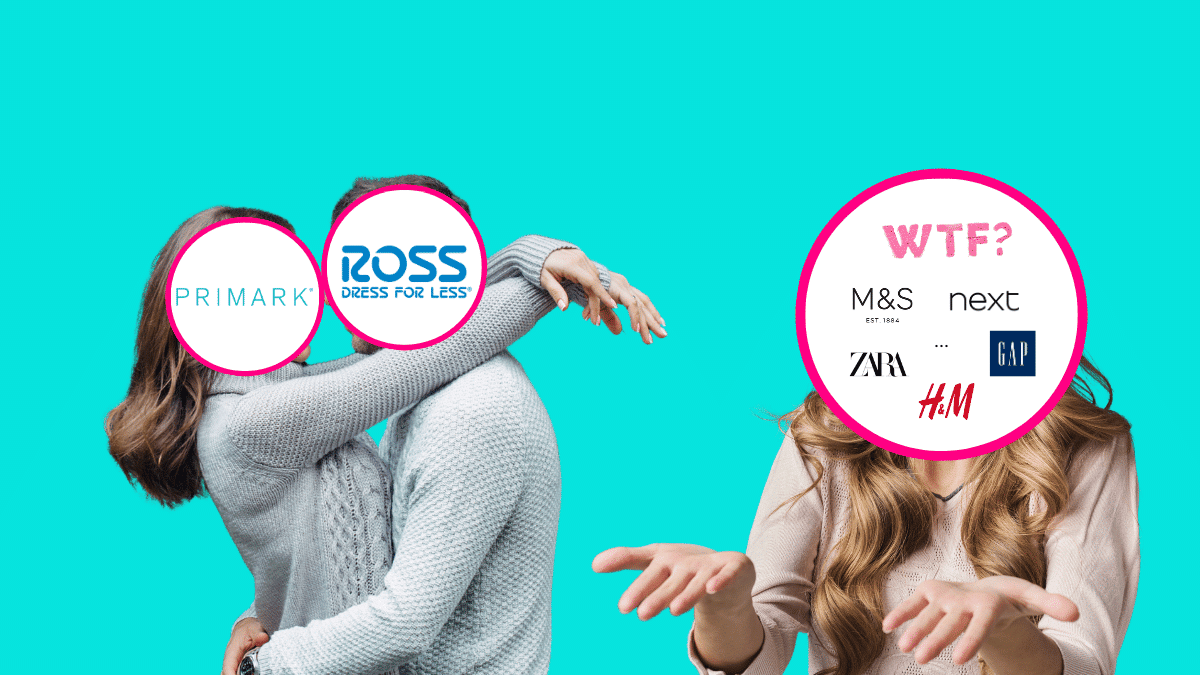
There aren't many of them. Retail analysts who try to list major fashion chains with genuinely no online sales channel keep arriving at the same two names, almost embarrassingly quickly.
There's Primark, the Irish-born, AB Foods-owned value giant, now operating over 450 stores across 17 markets. And there's Ross Dress for Less, the American off-price behemoth that just crossed 1,900 US locations and posted fiscal 2024 revenues of $21.1 billion.
Ross's website, to this day, is essentially a store finder. Their product assortment - discounted designer surplus, manufacturing overruns, cancelled orders - changes week to week. You cannot build a predictable online catalogue around inventory that doesn't exist yet.
In Q3 2025 alone, Ross's comparable store sales grew 7% . The company is opening roughly 90 new stores this year. Its long-term ambition is 3,600 locations. This is not a business in decline. It's a business in expansion.
So why does the rest of retail - including many people reading this - assume that "offline" equals "behind the curve"?
The arithmetic no one talks about
Here's the thing about e-commerce that gets lost in the enthusiasm: it costs a lot of money to run.
Picking, packing, last-mile delivery, and returns can add €8 to €15 per order before you've paid a marketplace a single euro in commission. On a €5 T-shirt, that's not a margin problem. That's a business model problem.
Primark's own leadership has made this explicit : putting products online would force them to raise prices, which would destroy the very thing that makes people choose Primark over everyone else. The ultra-low price is the product. Compromise it and you're just another mid-market fashion brand with a warehouse problem.
Ross has the same constraint, but with an added twist. Its entire model is built on buying opportunistic, irregular inventory at 20–60% below department store prices . Stock comes and goes. There's no replenishment. The treasure hunt - that feeling of finding a Calvin Klein jacket for $19.99 in a store in suburban Ohio - is the whole point. You cannot replicate that feeling with a product page and a static image.
"The ultra-low price is the product. Compromise it and you're just another mid-market brand with a warehouse problem."
Beyond the unit economics, there's another calculation that rarely surfaces in the press: margin ownership. Marketplace commissions typically run 15–25% of sale price. Add advertising spend to maintain visibility, and you can easily lose 30–35 cents of every euro you make on a platform. Primark keeps all of that inside its own four walls. So does Ross. For two businesses running on tight margins at extraordinary volume, that difference is enormous.
Then there's brand positioning. The moment Primark lists on Amazon, its €6 fleece sits next to a generic equivalent for €4.50. The mystique collapses. The urgency - that feeling that you need to go to the store now, this week, before it sells out - disappears. Going online isn't just a logistics decision. It's a brand decision. And for these particular retailers, it's the wrong one.
"Offline" isn't what it used to mean
Here's where the story gets more nuanced - and, frankly, more interesting.
Primark hasn't been sitting still. In November 2022, it quietly began trialling something called Click & Collect: browse online, choose what you want, reserve it, pick it up in store. No delivery. No last-mile cost. The store does the fulfilment.
By May 2025, all 187 UK stores had the service live , offering over 5,000 products across womenswear, menswear, kids' clothing, accessories and homeware. Web traffic was up around 50% . New customer demographics (people who liked Primark but didn't live near a store) were showing up for the first time.
The language CEO Paul Marchant used to describe it is telling. "Primark will always be committed to stores," he said. Click & Collect is "designed to support stores, not compete with them."
That's not spin. That's a genuine strategic distinction. Primark isn't trying to become ASOS or Zalando. It's using its website as a traffic funnel - turning what used to be a purely informational page into a reservation engine that generates incremental footfall. You browse at home, you reserve, and then you walk into the store. And once you're in the store, you buy more. The upsell happens in person, the way it always has.
Analysts have started calling this model "low-cost omnichannel" : digital discovery and reservation, physical fulfilment. It costs a fraction of a conventional e-commerce operation. And it keeps the store at the centre of everything.
Ross, for now, has made no comparable move. Its off-price, ever-changing inventory makes even a limited online catalogue operationally painful. But it's worth watching.
So why not just list on marketplaces?
It's the obvious question. If you won't build your own e-commerce, why not let a platform carry the infrastructure costs and hand you the customers?
For Primark and Ross, the reasons stack up quickly.
First, the margin. Third-party marketplaces now account for over 80% of digital apparel sales in Europe - which is exactly why those platforms can charge what they charge. Commission rates, fulfilment fees, advertising spend to appear in search results: you can easily end up surrendering 30 cents of every euro you make. That's a death sentence for a business selling €5 leggings.
Second, the dynamics of comparison shopping. Marketplaces are comparison engines. They put your product next to every cheaper alternative in the same frame. The customer who finds Primark on Zalando next to a slightly cheaper Shein version has no reason to feel any particular loyalty. The treasure hunt is gone. The brand pull is gone. What's left is just price.
Third (and this is underappreciated) the operational integration cost. Connecting a high-volume, fast-turn, non-standardised supply chain to a marketplace's feed, inventory sync, and returns system is not trivial. For Ross, whose stock is irregular by design, it might be practically impossible at scale without rebuilding the entire operation.
That said, strategic commentary suggests Primark has at least floated the idea of limited marketplace experiments - a capsule collection here, a brand test in a new market there. Not as a core channel, but as a tactical probe. The door isn't permanently locked. It's just not open yet.
The most unboxed brand that doesn’t ship
Here's something that should stop you in your tracks.
Lengow's Haul & Unboxing Index 2025 analysed haul and unboxing content across TikTok and Instagram for 50 major brands. The ranking, based on cumulative public content linked to each brand's hashtags globally, reads as follows at the top: Shein. Zara. Temu. Sephora. Amazon.
And then, at number six: Primark.
A brand with no online shop, no home delivery, and no marketplace presence is the sixth most unboxed brand on social media in the entire world. Ahead of H&M. Ahead of Vinted. Ahead of AliExpress.
Haul & Unboxing Index 2025 — Top 10 Global Social
| Rank |
Brand |
Category |
Score |
| 1 |
Shein |
Fashion |
6.2 |
| 2 |
Zara |
Fashion |
5.8 |
| 3 |
Temu |
Value / Fashion |
5.7 |
| 4 |
Sephora |
Beauty |
5.7 |
| 5 |
Amazon |
High-tech / Value |
5.4 |
| 6 |
Primark No online shop |
Fashion |
5.3 |
| 7 |
Vinted |
Fashion (secondhand) |
5.0 |
| 8 |
H&M |
Fashion |
5.0 |
| 9 |
AliExpress |
Gadgets / Fashion |
4.9 |
| 10 |
Action |
Value / Home |
4.9 |
Source: Lengow Haul & Unboxing Index 2025. Based on cumulative public TikTok + Instagram content as of 30 Dec 2025. Measures social desirability, not sales volume.
Think about what that means for a moment. The haul format - those videos of people spreading £40 worth of clothes across their bed, narrating each item to camera - is built around the act of receiving a delivery. The packaging, the reveal, the pile on the floor. Primark doesn't deliver anything to anyone. And yet its products are being filmed, tagged, and shared at a scale that most e-commerce brands spend millions trying to achieve.
"Primark is the sixth most unboxed brand on social media globally. It doesn't ship a single order."
This is Primark's secret weapon, and it's one that the pure e-commerce playbook doesn't have a good answer to. Social desirability doesn't require a delivery box. The haul happens in-store and gets filmed at home. The £3 top gets held up to the camera just like the Shein parcel, but the discovery moment happened on a high street, not on a product page.
This also reframes the question of whether Primark needs e-commerce. It doesn't need a website to drive desire. TikTok does that. The website, increasingly, just needs to tell people where the nearest store is - and soon, let them reserve what they've just seen in a haul video before it sells out. Which is exactly what Click & Collect enables.
Can they keep this up?
The numbers say yes (for now).
Primark is planning 4–5% annual sales growth through further store rollouts, with an accelerating push in the US. Ross is building toward 3,600 locations and posting margin figures that are roughly double the sector average. Neither shows any sign of strategic distress.
But the context is shifting. Industry research for 2025 and beyond is unambiguous: e-commerce and physical retail are converging, not competing. Younger shoppers expect to move fluidly between a brand's digital and physical presence. Click & collect, real-time stock visibility, mobile discovery - these aren't nice-to-haves anymore. They're table stakes.
Primark has understood this, which is why it's building exactly that infrastructure - carefully, cheaply, and only where it strengthens the store rather than cannibalising it.
The honest verdict: a fully offline strategy works if you have a unique cost advantage that genuinely can't be replicated online, a store network dense enough that access isn't a problem, and the discipline to use digital only in ways that serve the physical estate. Take away any one of those three conditions and the logic falls apart.
For a mid-size fashion brand without Primark's cost structure or Ross's store density? Staying offline would be a slow-motion exit from the market. The data, the reach, the younger shoppers - they're all on platforms now. Ceding that ground is a choice you don't get to undo.
"Full "no online" will fade. "No home delivery, but strong digital services around stores" is where cost-sensitive retail is heading."
Meanwhile, on the other side of the argument
It's worth spending a moment with the retailers who made the opposite bet - and won.
Start with Next. In the 1990s, Next was a perfectly conventional British high street fashion chain. Catalogues, stores, that was the model. Then it started investing, quietly and persistently, in its online capabilities. Today, online sales account for more than half of Next's total revenue - £2.54 billion in FY2024 alone. The company just crossed £1 billion in pre-tax profit . It has built something called Total Platform, a full-service e-commerce engine it now licenses to other brands like Reiss, FatFace, and JoJo Maman Bébé. Next didn't just go digital. It became a digital infrastructure business that also happens to sell clothes.
Or take Marks & Spencer. For years, M&S was the cautionary tale everyone cited when discussing the perils of a legacy retailer failing to adapt. Too slow, too physical, too convinced that its brand alone would carry the day. The pivot has been painful and protracted. But the results are now undeniable: profit before tax rose 22.2% to £875.5 million in fiscal 2025 - the highest in over 15 years. Online sales grew 11.3% in the most recent half-year. The company is now targeting 50% of its clothing and home sales coming from e-commerce by 2028 , up from 34% today. The transformation is still messy, expensive, and incomplete — but it's working.
Then there's Zara. Inditex launched Zara's first online shop in 2010 — fifteen years ago — at a time when many industry observers thought e-commerce and fast fashion were fundamentally incompatible (too high a return rate, too low an average basket). They were wrong. Zara.com generated $2.2 billion in online sales in 2024 , up 10–20% year-on-year. Inditex group revenue nearly doubled from 2020 to 2024, reaching €38.5 billion . The secret wasn't just building a website — it was integrating stores and online so completely that the two became indistinguishable. In-store RFID, click & collect via robotic fulfilment arms, real-time inventory visibility across channels. Zara didn't go digital. It built a machine where digital and physical are the same thing.
The seven retailers: revenue, margin & digital share
| Retailer |
Revenue |
Op. Margin |
Online Share |
E-commerce model |
| Primark No delivery |
£9.4B |
~12% |
0%* |
Click & Collect (UK only) — no home delivery |
| Ross Dress for Less No delivery |
$21.1B |
~12% |
0% |
None — website is a store locator only |
| Zara (Inditex) |
€38.5B |
~18% |
~30% |
Full omnichannel — RFID, robotic C&C, real-time inventory |
| Next |
£5.8B |
~18% |
~52% |
Digital-first + Total Platform (e-commerce as a service) |
| Marks & Spencer |
£13.1B |
~10% |
34% |
Growing digital, targeting 50% online by 2028 |
| H&M |
€21B |
~5% |
~20% |
Omnichannel — execution still lagging Zara |
| Gap Inc |
$15.2B |
~8% |
~38% |
Ship-from-store across 3,600 locations, 70M loyalty members |
* Primark online share excludes Click & Collect reservation value. Sources: company annual reports, FY2024/25.
All of these stories make the same point from different angles: for retailers who can absorb the cost and complexity of going digital, the upside is real. More reach, more data, younger customers, and a revenue engine that doesn't switch off when footfall dips.
The key difference with Primark and Ross isn't ambition. It's economics. These five brands sell products at margins wide enough to fund delivery, returns, and a proper digital operation. Their average basket sizes (and their price positioning) justify the infrastructure. Primark's €5 T-shirt doesn't. Ross's ever-changing closeout inventory structurally resists it.
What all seven of them prove, each in their own way, is that the answer to "should we go digital?" is never universal. It always comes back to the same question: what does your cost structure actually allow?
The phygital minimalist
There's a new retail archetype emerging from all of this. Call it the phygital minimalist : a retailer that uses the absolute minimum of digital infrastructure to keep its stores relevant, while protecting with everything it has the low-cost model that makes those stores work.
Primark is the clearest example of it in practice. Ross is arguably the purest holdout. Between them, they're demonstrating something the industry spends a lot of time forgetting: that the point of retail is to sell things profitably, not to be on every platform.
The practical takeaway for marketplace professionals is this. The Primark and Ross of the world are not irrational. They're not ignorant of digital. They've looked at the economics carefully and concluded that, for their particular model, the cost of going fully online outweighs the benefit. That calculation may shift over the next decade as fulfilment costs fall and their core shoppers age out. But for now, they're growing, profitable, and expanding.

.png?width=48&height=48&name=Adrian%20(1).png)
.png?width=64&height=64&name=Adrian%20(1).png)


.png)