
.png?width=48&height=48&name=Adrian%20(1).png)
There's a telling moment in the history of every new commerce channel. Someone unveils the technology, the demos look flawless, the press releases are glowing - and then real users get their hands on it and nothing quite happens the way the slides promised. Voice commerce was going to be "next" for six years. Social commerce is still waiting for its “true” mainstream moment in Europe.
Agentic Commerce - the idea that an AI agent browses, compares, and actually buys things on your behalf - is now living through its own version of that moment. In the West, at least. Because somewhere else, the revolution already happened.
Meanwhile, in China
While OpenAI was quietly
walking back its native checkout ambitions
in March 2026, Alipay had just reported a rather different milestone:
120 million AI-agent transactions processed in a single week in February 2026
. Not browsing sessions. Not chatbot conversations. Completed purchases - ordered through a chatbot, paid without leaving the conversation.
The structural reason is simple but profound. Chinese firms like Alibaba, Tencent and ByteDance benefit from integrated ecosystems, rich behavioral data, and consumer familiarity with super apps. The advantage China has is that these agents are most valuable when they can act - completing purchases, transferring money, and coordinating services - all of which requires seamless end-to-end integration across payments, logistics, messaging and e-commerce apps, already consolidated within China's super apps.
Alibaba updated its Qwen AI chatbot
, allowing users to complete transactions directly within the interface (ordering food, booking flights) connecting Qwen to Taobao, Fliggy, and Alipay, all without leaving the chatbot. A user types "I want bubble tea." The agent crosses app boundaries invisibly, compares options, pays, and confirms delivery. In under 30 seconds. No tap required.
And just this week, Alibaba released Wukong, a new agentic AI platform for enterprises that will progressively integrate into Taobao and Alipay. Southeast Asia is accelerating in parallel:
Google and Sea announced a partnership in February 2026 to jointly explore building an AI agentic shopping prototype on Shopee
, while Lazada has already deployed multiple AI agents and both major card networks are running live pilots across the region.
Why Western consumers aren't ready (and the numbers prove it)
A
McKinsey survey
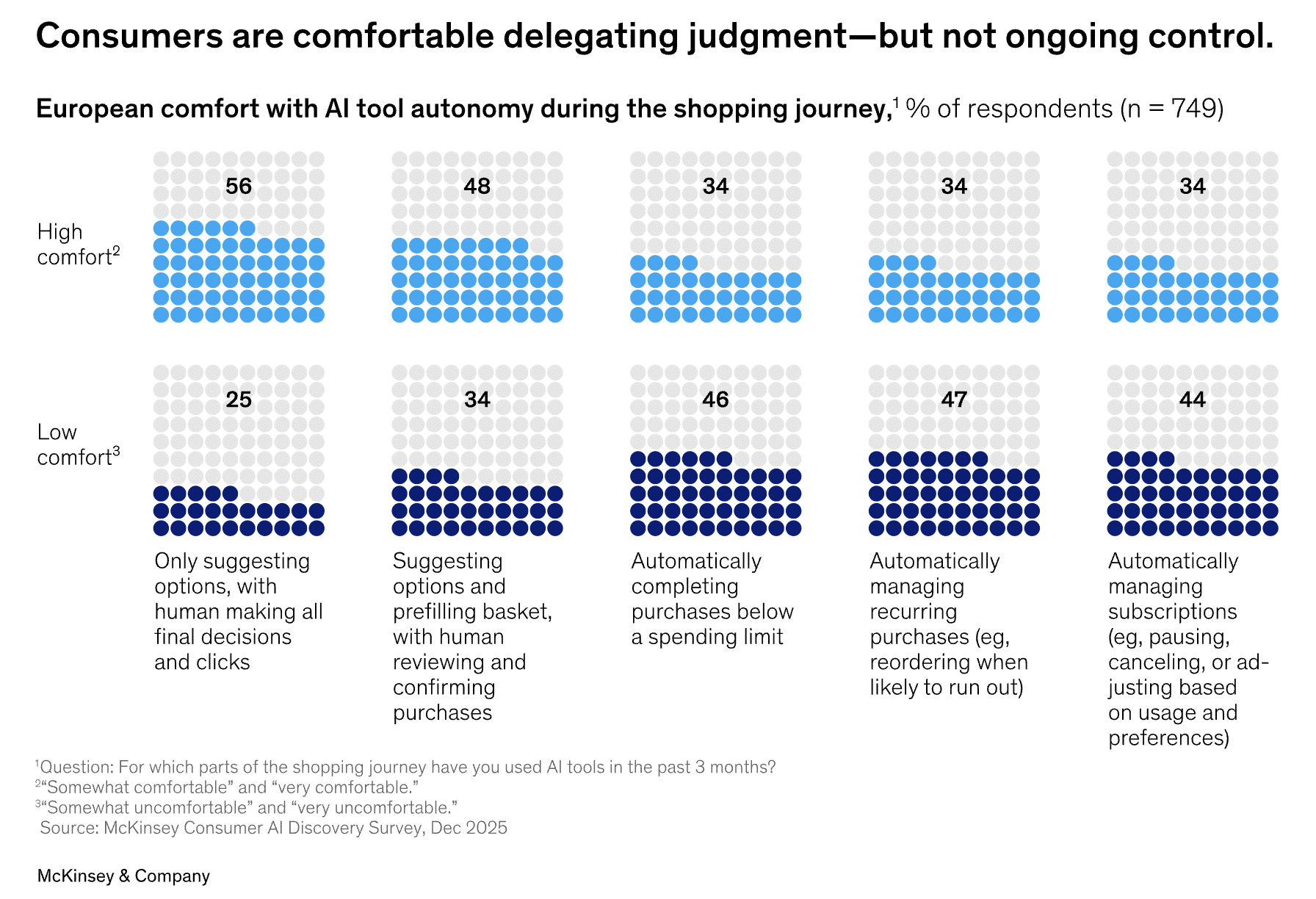
across France, Germany and the UK (December 2025, n=749) produced a chart that tells the whole story. 56% of European consumers are comfortable when AI suggests options and they make the final call. That drops to 48% for AI pre-filling a basket. And then comes the cliff: the moment AI automatically completes a purchase (even below a spending limit they themselves set) comfort crashes to 34%.
Same AI. Same product. Same price. They literally pre-approved the category. And still, one in two Europeans says: no thanks, I'll click confirm myself.
That final tap is a micro-moment of deliberate choice. "I chose this." European consumers aren't afraid of AI getting it wrong. They're afraid of not being the one who got it right.
Only 24% of US consumers
feel comfortable letting AI complete purchases today. Just 10% have ever bought something using AI in any form, mostly for low-stakes grocery items.
42% of consumers
fear losing control over what's purchased, and 28% flag a lack of transparency as one of their biggest concerns.
This isn't irrationality. It's about identity. That final tap is a micro-moment of deliberate choice.
"I chose this."
European consumers aren't afraid of AI getting it wrong. They're afraid of not being the one who got it right.
China solved this over a decade, through WeChat Pay and Alipay: each platform slowly expanding the perimeter of what you'd let an app do on your behalf, one convenience at a time, until autonomous felt obvious. Europe doesn't have that conditioning. Or those super-apps.
And that leads to the deeper question: why doesn't it?
Why the West never built super-apps
The answer is partly political - and more direct than people expect.
Western companies face more fragmented data and stricter privacy regulations, slowing cross-service integration
. But the fragmentation didn't happen by accident. In the US, antitrust law has actively prevented the kind of platform consolidation that makes super-apps possible. In Europe, GDPR, the AI Act, and the Digital Markets Act create overlapping constraints that make unified data architectures legally complex by design.
China made two political decisions that happened to be perfect for agentic commerce: block foreign competitors (creating a captive market for domestic super-apps), and historically under-regulate personal data collection (letting those super-apps integrate everything). The result was an architecture ideally suited for AI agents that need to act across payments, logistics, and commerce without navigating competing protocols.
The West did the opposite: open internet access plus strong data protection equals structural fragmentation that can't be unwound quickly.
What merchants stand to lose
For Western merchants, the concerns are less philosophical and more existential. When an AI agent mediates every transaction, the customer never visits your website, never gets exposed to your content, never builds loyalty with your brand.
A BCG report
finds that retailers could face reduced insight into customer behaviour, loss of loyalty, and diminished cross-selling opportunities as AI becomes more of an intermediary.
There's a technical problem too.
"There's a big gap between tight, keywordy product catalogs and the context GenAI needs,"
says Scot Wingo of ReFiBuy. AI agents require rich, granular data - fit, quality, durability, live inventory - not the stripped-down attributes most Western merchants still push to their feeds today. And in Europe,
the EU AI Act will enforce strict rules from August 2026, with potential fines of up to 7% of global revenue for non-compliance
. "Let's let an AI buy things on our customers' behalf" is not a proposal that sails smoothly through legal approval.
There's a big gap between tight, keywordy product catalogs and the context GenAI needs.
There's a technical problem too.
"There's a big gap between tight, keywordy product catalogs and the context GenAI needs,"
says Scot Wingo of ReFiBuy. AI agents require rich, granular data - fit, quality, durability, live inventory - not the stripped-down attributes most Western merchants still push to their feeds today. And in Europe,
the EU AI Act will enforce strict rules from August 2026, with potential fines of up to 7% of global revenue for non-compliance
. "Let's let an AI buy things on our customers' behalf" is not a proposal that sails smoothly through legal approval.
What needs to happen
Start small and earn it.
47% of consumers say they'd use an AI agent for boring or repetitive purchases
. Reorders. Replenishments. Routine deliveries. That's the on-ramp. Not autonomous luxury purchases, habitual ones.
Give consumers the steering wheel back.
Mastercard's Verifiable Intent initiative creates a cryptographic, tamper-resistant record of what a consumer authorised when an agent acts on their behalf
- exactly the kind of infrastructure that makes delegation feel safe rather than reckless.
Invest in product data now.
In an agentic world, success is no longer about ranking on a page - it's about ensuring products are visible, understandable, and trusted by machines making decisions on behalf of humans
. Rich titles, real-time pricing, complete
feed management
: these are no longer back-office details. They are your visibility strategy.
The EXIT sign is a warning, not a destination
The brands that win in European agentic commerce won't be the ones that automate fastest. They'll be the ones that make you
want
to stop clicking confirm, by earning trust one category, one saved minute, one frictionless reorder at a time.
Given the speed of recent rollouts, China will probably be both the testing ground and a leading indicator for agentic AI
. The gap is real and widening. The question for Western merchants isn't whether to prepare, it's whether they do it on their own terms, with their customer relationships intact, or get dragged in later by a fait accompli.
The EXIT sign in the background doesn't have to be the ending. It's just a reminder of what happens when you forget who actually has to say yes.
.png?width=64&height=64&name=Adrian%20(1).png)
Adrian Gmelch
Adrian Gmelch is Director of Content at Lengow, where he leads content strategy while staying firmly hands-on: reading the research, and tracking the trends that matter before they go mainstream.

.png)