
.png?width=48&height=48&name=Adrian%20(1).png)
The platform everyone underestimated
When TikTok launched its Shop feature in the US in September 2023, the reaction in e-commerce circles was politely skeptical. Social commerce had a track record in Western markets that, to put it kindly, wasn't inspiring. Facebook had killed its live shopping feature. Instagram had
pulled its dedicated shop tab from the main navigation
. YouTube had dabbled and retreated. The narrative was clear: Western consumers just didn't want to shop inside social apps the way their Chinese counterparts did.
That narrative has been systematically dismantled over the past two years.
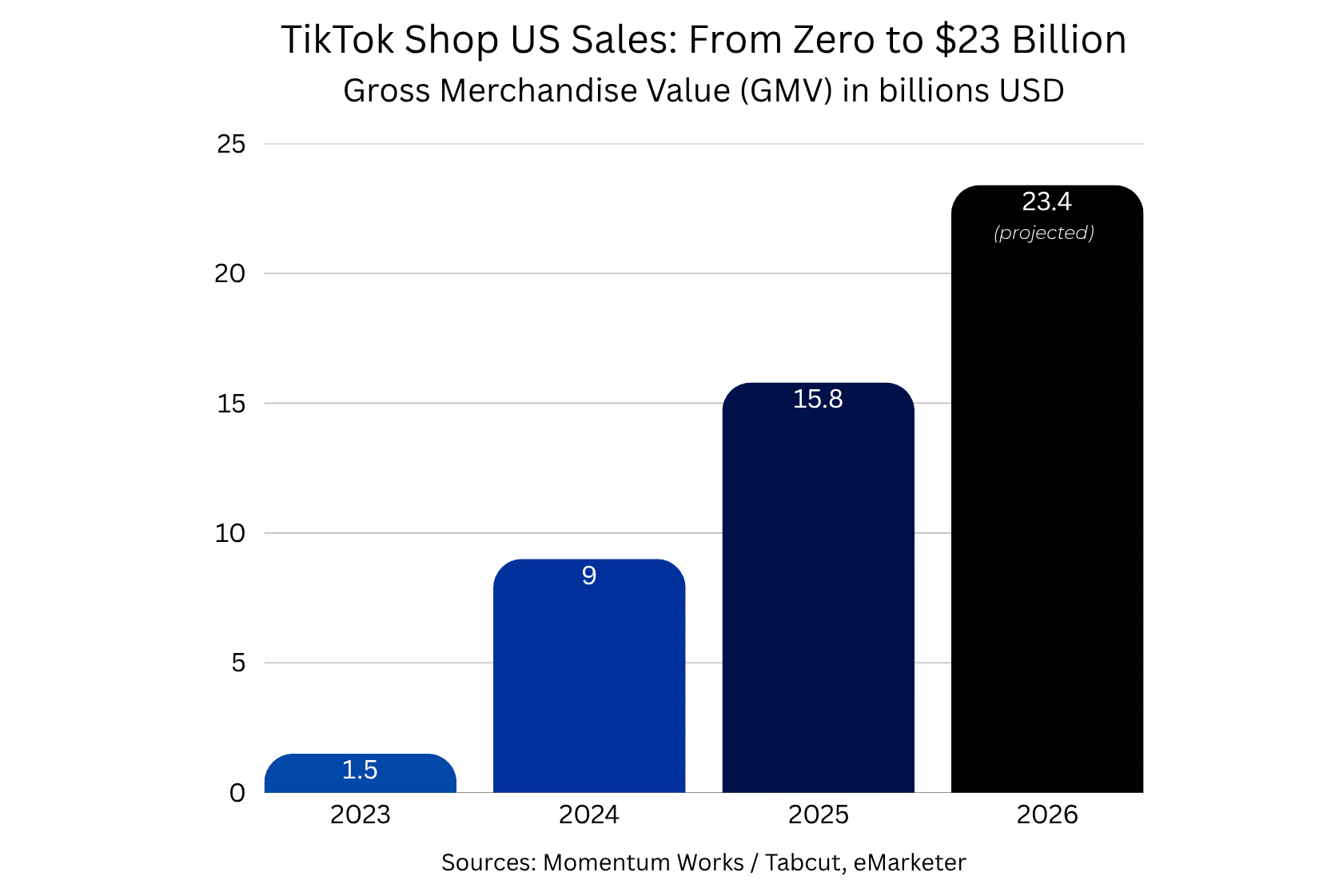
TikTok Shop grew its US sales by 407% in 2024
, then added another 108% growth in 2025 to reach $15.82 billion. To put that in perspective: this is a marketplace that didn't exist in the US before late 2023, now generating mid-eight-figure revenue every single week. In 2026, eMarketer projects TikTok Shop's US sales will surpass $20 billion, and its share of total US social commerce is expected to climb from 18.2% today to 24.1% by 2027.
In Europe, the trajectory looks similar. The UK became an early proving ground, and the numbers were striking:
during Black Friday 2025, TikTok Shop in the UK recorded its highest sales day ever
, with 27 items sold every second at peak demand, and overall sales during the Black Friday and Cyber Monday period rose 50% year-over-year. TikTok Shop has since pushed into Spain, France, Germany, and Italy, establishing the continent as its next major growth frontier alongside Japan.
In Germany specifically - a market historically cautious about new e-commerce entrants - TikTok Shop marked its one-year anniversary by reportedly surpassing €700 million in sales, per NielsenIQ data, landing it already in the top 15 e-commerce players in the country.
What actually changed
Here's the part the industry consistently got wrong about social commerce: it assumed the model was about building a shopping destination. A tab, a marketplace, a place where people would consciously choose to go and buy things. Instagram's Shop tab operated on that logic. So did Facebook Shops. They were essentially storefronts bolted onto social platforms, competing with Amazon and Google Shopping but without the intent signals that make those channels convert.
TikTok's approach was fundamentally different, and the distinction matters. It wasn't building a shopping tab. It was building a creator affiliate marketplace.
When Instagram
removed its Shop tab in early 2023
, it framed the move as an effort to "make it easier for people to share and connect with their friends and interests" - but internally, the reality was starker. The commerce organization was being given, as internal memos reportedly put it, "a new northstar more directly tied to advertising revenue." In other words: the standalone shopping experience had failed to generate meaningful traction, so the company retreated to what it knew: ads.
TikTok's approach was fundamentally different, and the distinction matters. It wasn't building a shopping tab. It was building a creator affiliate marketplace.
Affiliate links on TikTok have a 5.2% engagement rate - 160% higher than on Instagram
. TikTok influencers with fewer than 50,000 followers generate a 30.1% engagement rate on affiliate links, which is 1,570% higher than comparable Instagram influencers. Those aren't marketing statistics, they're a description of a different kind of commerce behavior. When a creator you follow enthusiastically recommends a serum or a kitchen gadget mid-video, the psychology is entirely different from encountering a sponsored post or clicking a shop tab. The trust is pre-built. The discovery feels organic even when it isn't.
On TikTok, shoppers arrive for entertainment, then end up shopping, which is essentially the opposite of the intent-driven model that built, for example, Amazon. It turns out that impulse purchasing, when triggered by authentic-feeling content from trusted voices, can be enormously powerful.
71.2% of TikTok shoppers
report being inspired to buy something they stumbled across in their feed
.
The creator affiliate program was the real product all along. In Germany, early data showed that 87% of TikTok Shop revenue at the top 100 stores was coming from creator-made videos. The platform hadn't just built another marketplace, it had built a commission-based sales force of millions.
And now everyone wants back in
The scale of TikTok Shop's success has done something that years of analyst reports and Accenture forecasts about social commerce's potential never managed: it has forced Meta and Google to take the category seriously again.
Meta's move came in late March 2026.
Instagram announced a new "Add Products" feature
that lets creators tag up to 30 products directly in a Reel, items drawn from a brand's existing commerce catalog or added via affiliate link. The product launches with Amazon and Shopee as first partners, with
reports suggesting Temu, eBay, and Mercado Libre are also in the mix
. Creators who are eligible can earn an affiliate commission when followers tap through and purchase.
Meta is taking those learnings and really making it a lot easier, both from a discovery perspective of what they're doing with affiliates to conversion.
This is notably different from what Instagram tried before. The previous Shop tab asked users to go somewhere to buy things. The new shoppable Reels approach puts commerce directly inside the content, which is exactly the mechanic that made TikTok Shop work. As Katya Constantine, CEO of agency Digishopgirl Media,
told Retail Brew
: "Meta is taking those learnings and really making it a lot easier, both from a discovery perspective of what they're doing with affiliates to conversion."
Simultaneously, Meta announced a
new "Buy Now" button embedded directly within ads
- a Stripe-powered checkout mechanism that lets users purchase without leaving the platform. Advertisers will choose the checkout partner and fulfill orders directly, lowering the friction between ad exposure and transaction completion. Meta is, in effect, running two parallel bets: one on creator-driven discovery, one on converting its existing ad infrastructure into a transactional layer.
YouTube's move was less dramatic in its announcement but potentially just as significant in its implications.
Shopping has been named by CEO Neal Mohan as one of the platform's strategic priorities for 2026
, with a specific ambition: making YouTube "a premier shopping destination" by enabling purchases without leaving the app. More telling was the change YouTube made to its Shopping Affiliate Program eligibility. Previously requiring 20,000 subscribers (later reduced to 1,000)
the threshold has now dropped to just 500 followers
. Creators can now tag products in Shorts, standard videos, and livestreams and earn a commission on any resulting sale.
The math on this is interesting. Some individual creators have reportedly
multiplied their earnings fifteenfold
through YouTube's integrated shopping links. Dropping the eligibility bar to 500 followers is a signal that YouTube understands what made TikTok Shop work: not a handful of mega-influencers, but a vast, distributed network of micro-creators with high audience trust in narrow niches.
The creator economy as commerce infrastructure
What's really happening here, when you strip away the product announcements and the platform competition, is a structural shift in how social commerce is being understood.
The first generation of Western social commerce - the Instagram Shop tabs, the Facebook Stores, the live shopping experiments - was built on the idea that platforms could become destinations in their own right. They would be the mall, and brands would be the tenants. That model never truly took off in Western markets, partly because Amazon had already won the intent-to-purchase game, and partly because consumers weren't browsing Facebook to shop any more than they were browsing Google Maps to discover new restaurants.
TikTok understood that the platform's real asset wasn't traffic to a store, it was trust between creators and audiences. Monetize the creator relationship directly, give brands access to that trust through a commission structure, and you get a commerce channel that doesn't feel like advertising because it largely isn't. It's recommendation, scaled.
Social commerce as a whole still represents only about 6.9% of retail e-commerce, but that share is projected to climb to 9.3% by 2029
, with US social commerce surpassing $100 billion for the first time in 2026. The numbers are growing fast enough that no platform with a large content-creator ecosystem can afford to ignore it.
For brands and retailers (particularly those already managing multi-channel e-commerce strategies) this convergence creates both opportunity and complexity. The fundamental question now is which platforms, in which categories, with which creator profiles, deliver the best return.
The answers will vary.
Beauty and personal care, fashion, and health products have driven the lion's share of TikTok Shop GMV
- categories that align naturally with how people use TikTok: tutorials, "get ready with me" content, before-and-after clips, lifestyle routines. Instagram's visual-first environment may favor slightly different categories. YouTube's longer-form format suits considered purchases and products that benefit from demonstration.
A second chance
So is this really a "comeback"? Partially. Social commerce never stopped being viable, TikTok Shop proved that. What's returning is the ambition of Meta and Google, this time driven by competitive pressure rather than speculation.
The model looks different from the one that failed: less destination-based, more creator-led, more embedded in the content itself. The lesson TikTok taught is simple - social commerce doesn't work when you bolt a storefront onto a social network. It works when you give creators a financial reason to sell.
Whether Meta and YouTube can replicate that flywheel is still an open question. Building a creator affiliate ecosystem takes years, not a product announcement. But the direction is clear: social commerce in the West, in 2026, is a real category. The platforms that sat it out are back and playing a different game.
.png?width=64&height=64&name=Adrian%20(1).png)
Adrian Gmelch
Adrian Gmelch is Director of Content at Lengow, where he leads content strategy while staying firmly hands-on: reading the research, and tracking the trends that matter before they go mainstream.


.png)