
.png?width=48&height=48&name=Adrian%20(1).png)
The Current State of Online Marketplaces
As of now, online marketplaces are thriving. A report by ChannelX affirms that globally more than 35% of all online purchases are made on a marketplace.
In Europe, marketplaces account for 85% of web traffic and represent 62% of the top 100 retailers by category.
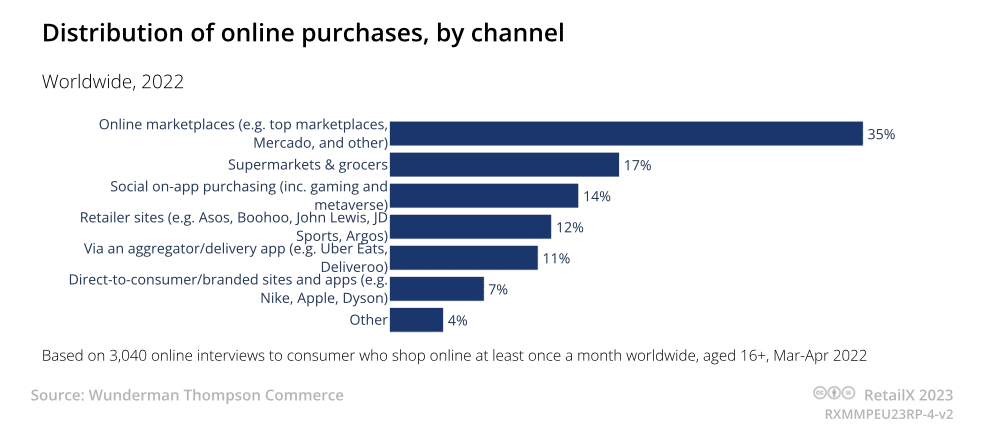
Part of online marketplaces in total e-commerce worldwide (Image credit: ChannelX).
Marketplaces also play a crucial role in cross-border e-commerce, constituting 63% of Europe's cross-border revenue, a figure expected to increase to 65% by 2025. They facilitate an impressive €167 billion in cross-border sales. Leading this charge are industry giants such as Amazon and eBay, which together have achieved a combined turnover of €78.2 billion (source: Cross Border Commerce Europe).
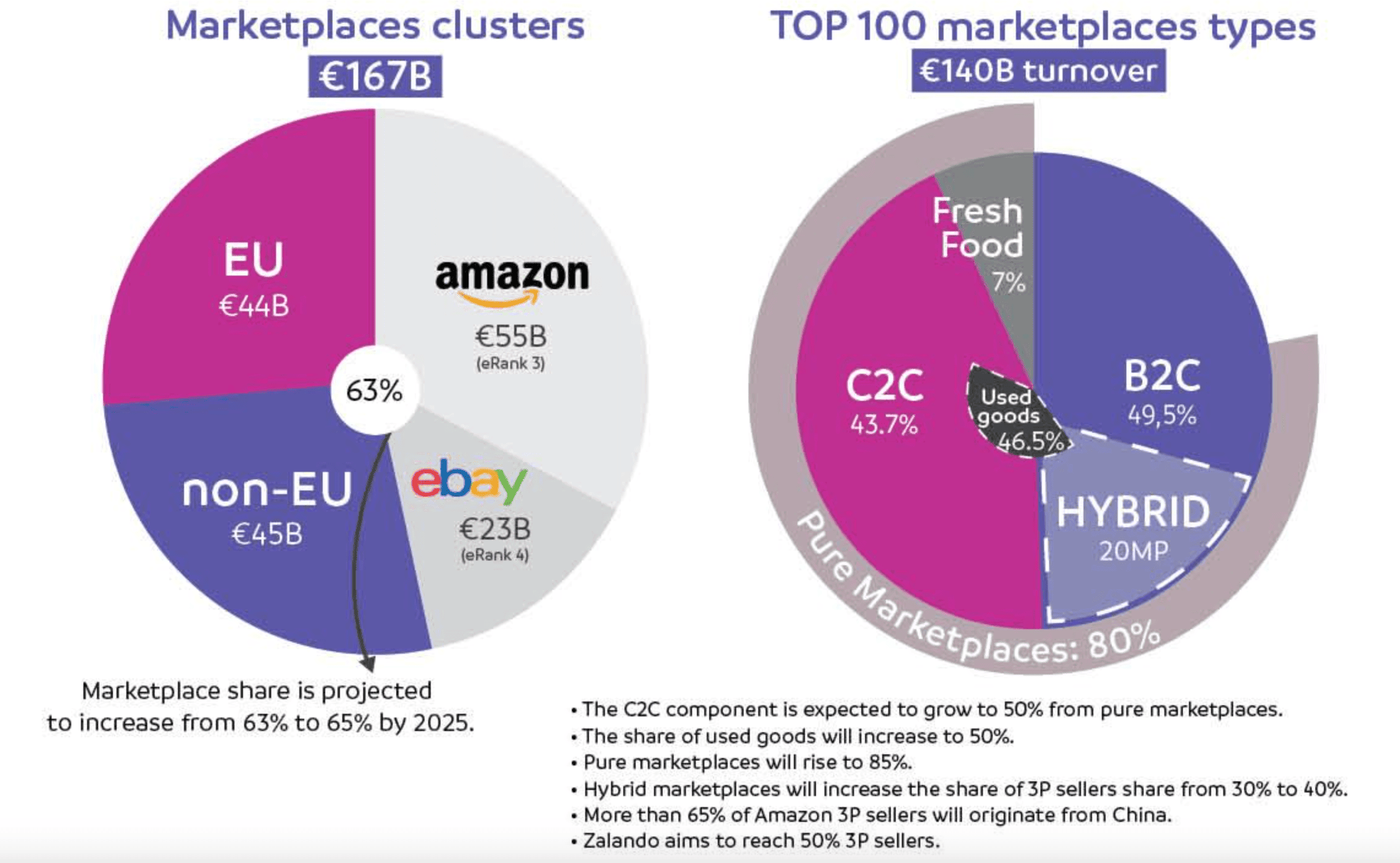
Global Marketplaces Cross-Border-EU turnover (Image credit: Cross-Border Commerce Europe).
This growth is fueled by a range of factors such as the convenience these platforms offer, a wide variety of choice, easy-to-manage delivery options, mostly competitive pricing, the ability to act as ‘search engines for shopping’ and very good customer service.
The proliferation of third-party marketplaces globally is reported to be heading towards accounting for almost 60% of online sales by 2027. In China, marketplace sales account already for 80% of total e-commerce sales in 2023.
Emerging Trends and Predictions for Marketplaces
AI and Machine Learning
Artificial Intelligence (AI) and Machine Learning (ML) are set to revolutionize marketplaces. By analyzing customer data, these technologies can offer personalized shopping experiences, improve search functionalities, and streamline logistics.
Amazon for example
has introduced Rufus
, a new AI-powered conversational shopping assistant within its mobile app. Rufus is designed to enhance the shopping experience by providing answers to customer questions, offering product recommendations, and facilitating product discovery,
all based on Amazon's extensive product catalog
and web information. Currently in beta for select U.S. customers, Rufus will be progressively rolled out. It allows customers to conduct product research, compare items, and get detailed information on products, improving the ease and confidence of shopping decisions.

Illustration of Amazon's Rufus (Image credit: Amazon).
And MediaMarktSaturn, a European electronics marketplace, is developing
an interactive chatbot-based instruction manual
. This chatbot will offer detailed information about the customer's purchased products. Initially, it's being trained for the retailer's own-brand items like washing machines and kitchen appliances, aiming to enhance customer interaction and product understanding.
Spatial Commerce
Spatial Computing technologies are poised to transform the shopping experience, also called Spatial Commerce. Imagine trying on clothes virtually or visualizing how a piece of furniture looks in in 3D or your home before buying. This immersive experience could reduce return rates, which currently stand at around 30% for online purchases.
Shopware, an e-commerce platform, is incorporating Spatial Computing to simplify and speed up the creation of 3D visuals using AI and machine learning, a feature previously affordable only to big brands. This innovation aims to answer how products can be displayed from every angle without multiple clicks and whether products can be integrated into real-life scenarios on web pages. This trend towards 3D visuals, which are more engaging than traditional images or videos, is something marketplaces might need to adopt as well to stay ahead. 3D visuals of products a way more engaging than traditional images or videos.
Social Commerce
The integration of e-commerce into social media platforms is already underway. Platforms like TikTok or Instagram and Facebook are testing the waters, but future marketplaces might emerge directly within these social platforms, leveraging their vast user bases.
The best example is TikTok Shop, an integrated e-commerce platform within the TikTok app that allows users to explore and purchase products without the need to navigate away from the app. This feature represents TikTok's shift from a short-video platform to an interactive marketplace. It enables in-app purchasing with secure storage of billing and shipping details, and TikTok's algorithm personalizes shopping content to match user preferences and behaviors. This approach blends entertainment with convenient shopping.
But traditional marketplaces, like Amazon, are also embracing Social Commerce. Amazon's Inspire offers an in-app shopping experience akin to TikTok, with a swipeable feed of photos and videos from customers, influencers, and brands, allowing direct purchases. Additionally,
Amazon's partnership with Meta
integrates shopping on Facebook and Instagram, where users can link their accounts for seamless shopping using their Amazon details. This feature displays real-time information on Amazon products within the social media platforms.
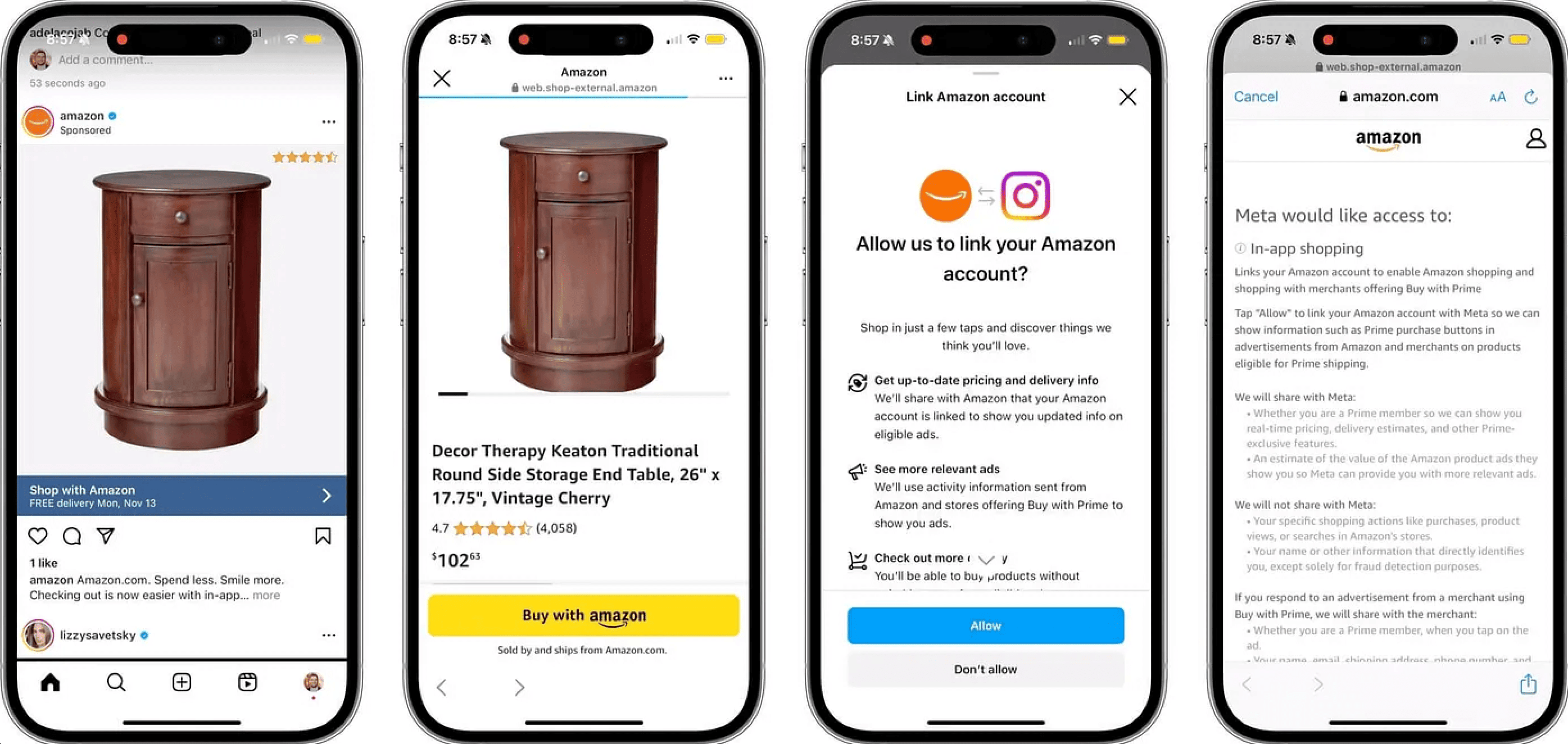
How to buy with Amazon on Instagram (Image credit: Meta).
Department Stores of the Future
Online marketplaces are clearly advancing to take the place of 20th-century department stores
Marketplaces are rapidly transforming the landscape of retail, much like the evolution from traditional department stores in the 20th century. They attract a diverse audience: retailers reinventing themselves as marketplaces, brands keen to establish a presence on these platforms, and consumers increasingly favoring them for their purchases.
In a few years, it's expected that more than two-thirds of B2C online sales will be conducted through these platforms. This shift is a significant factor in the decline of large shopping halls and department stores. However, for marketplaces to eclipse even more the appeal of department stores, they need to invest more in the entertainment aspect of shopping. A prime example is Temu, which is revolutionizing the shopping experience in the western world by incorporating elements of gamification and interactive engagement, setting a new standard for enjoyable and immersive online shopping.
The Need for Balance
While embracing technological advancements, it's crucial for marketplaces to balance innovation with user privacy and ethical considerations. The human element shouldn't be lost in the pursuit of technological excellence. Also, small and medium-sized enterprises should be supported to thrive alongside the giants.
The future of online marketplaces is bright but complex. It's a future that demands innovation and a commitment to enhancing the user experience. As we move forward, these platforms will not just be marketplaces but ecosystems that reflect our evolving digital and social landscapes.
.png?width=64&height=64&name=Adrian%20(1).png)
Adrian Gmelch
Adrian Gmelch is Director of Content at Lengow, where he leads content strategy while staying firmly hands-on: reading the research, and tracking the trends that matter before they go mainstream.


.png)