




AI and luxury: customers are one step ahead of brands
07/07/26
4'
Luxury has always moved at its own pace, that of long-term thinking and controlled craftsmanship. Faced with artificial intelligence, this pace is clashing for the first time with that of its own customers, which is far faster. This is the finding of the study “Winning Over the Customer in the Age of AI”, conducted by Bain & Company for the Comité Colbert among 23 luxury houses and groups, and supplemented by a consumer survey in three countries. The industry is still watching, while its buyers have already made the shift.
A widening gap
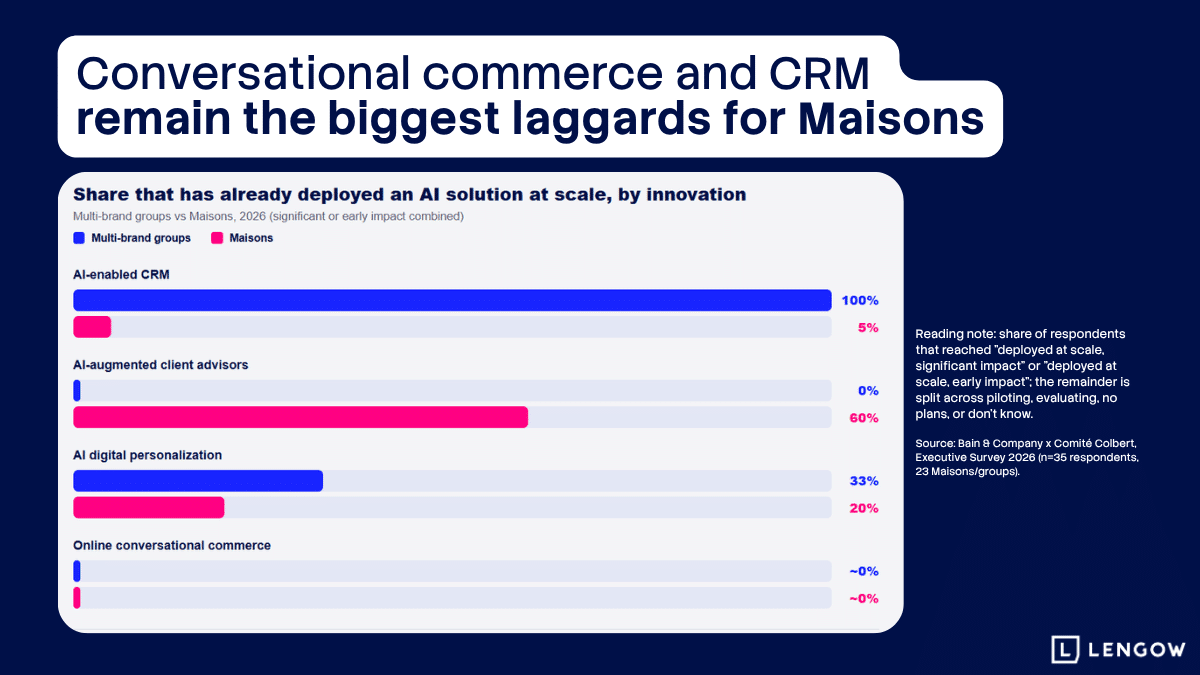
On the brand side, AI has clearly risen up the strategic agenda. It is now among the top 3 priorities for 22% of the groups and houses surveyed, compared with just 5% two years earlier. But this progress remains largely defensive and operational. Large-scale rollouts primarily concern the back office, knowledge management, IT and sourcing. In customer-facing functions, and online retail in particular, AI remains confined to testing, even though this is where its perceived potential is considered highest.
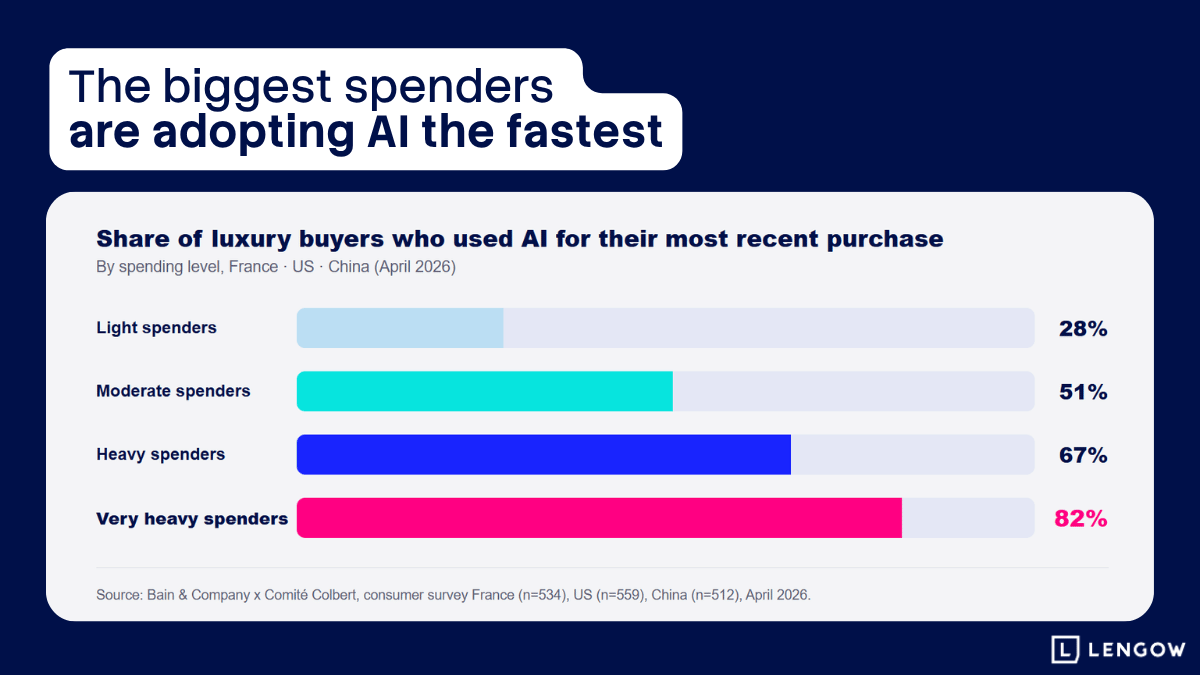
On the customer side, the shift has already happened. In April 2026, 64% of Chinese shoppers and 54% of American shoppers said they had used AI during their most recent luxury purchase. The figure falls to 27% in France, but rises sharply with spending level: 82% of the very high-spending shoppers surveyed had used it for their most recent purchase, compared with 51% of moderate shoppers. In other words, the most valuable customers are adopting these tools the fastest.
Brand recommendations are no longer under brands’ control
The real disruption lies not so much in the use of AI as in the way it builds its responses. Conversational agents rely heavily on data that brands do not control: customer reviews, influencer content and press articles. This is what specialists call “off-site” content, as opposed to the brand’s official website. Joëlle de Montgolfier, Executive Vice President Global Retail and Luxury at Bain & Company, puts it bluntly: customers have moved faster than the houses.
Search behaviour confirms this shift. In the thousands of queries analysed in partnership with Meikai, around 70% of questions asked to generative AI about luxury do not mention any particular brand. The buyer is not asking for a Vuitton bag or a Cartier watch, they are asking for an answer to a need, a gift, a style. It is the conversational agent that then suggests the brands, based on content that the company controls only at the margins.
Generative search, the new battleground
This dynamic has created an issue that most houses are only just beginning to discover: generative engine optimisation, or GEO. Fewer than half of groups and houses currently track their visibility performance in AI-generated answers, and only 10% consider themselves strong in this area.
Size does not offer as much protection as one might think. Among the luxury brands most visible in generative AI answers, many are not the sector’s largest groups, and several smaller houses far exceed their actual market weight in terms of visibility. Third-party content also carries more weight than the official website in the citations generated by AI, particularly in categories such as watchmaking, where brand domains account for only a small share of the sources cited. And freshness matters almost as much as the source itself: models favour recently updated pages and reviews.
What this means in practice for a luxury brand
Bain draws several practical recommendations from this to help brands regain control of this new discovery journey. The first is to define a clear brand positioning across all touchpoints indexed by AI, rather than delivering messaging that varies from one channel to another. The next is to align product content with the way customers actually phrase their searches at every stage of the buying journey, moving away from the usual institutional language.
Perhaps the most counter-intuitive step for houses accustomed to controlling everything in-house is to invest in content beyond their direct control: communities, specialist media, customer reviews and third-party platforms. Finally, they should ensure content remains fresh and technically well structured, both on and off their website, so that it remains easily understood by AI models.
For product and e-commerce teams, one point deserves particular attention: this battle for generative visibility depends heavily on the quality and structure of product data. Up-to-date, consistent and properly enriched product listings across every distribution channel no longer serve only traditional SEO or marketplaces. They become the raw material that generative engines use to describe, compare and recommend products. Feed management, long regarded as a purely technical matter, is therefore becoming central to the visibility strategy of luxury brands.
Staying in control without losing touch with the customer
None of this means that luxury should abandon its fundamental promise: human contact, the rarity of craftsmanship and attention to detail. The Bain report explicitly points this out: enhancing the customer experience with AI does not mean delegating it to AI. The technology can remain behind the scenes, supporting the sales adviser rather than replacing them.
There is one point on which waiting is no longer sustainable: visibility in generative AI answers is being built now, whether brands choose it or not. The question is no longer whether conversational agents will shape luxury purchase decisions, they already do. It is whether houses choose to influence what these agents say about them, or let that narrative be written without them.
Your e-commerce library
Sign up for our newsletter
By submitting this form you authorize Lengow to process your data for the purpose of sending you Lengow newsletters . You have the right to access, rectify and delete this data, to oppose its processing, to limit its use, to render it portable and to define the guidelines relating to its fate in the event of death. You can exercise these rights at any time by writing to dpo@lengow.com

Trending Posts
Marketplaces
The Top 10 Marketplaces in Europe (2026)
The e-commerce scene is a vibrant mix of marketplaces in Europe. These aren't just websites; they're bustling hubs where millions…
02/01/26
8'
Marketing channels
ChatGPT Ads and advertising on GenAI Search Engines: what you need to know
Advertising on generative AI-based search engines (GenAI) marks a new era in digital marketing. After two decades dominated by traditional…
18/01/26
8'
Marketplaces
The French Marketplace Landscape: What Brands Need to Know
France has quietly become Europe's marketplace laboratory. Lengow's exclusive ranking reveals why traditional retailers, not tech giants, dominate the game.…
08/01/26
6'
E-commerce Trends
Google’s Universal Commerce Protocol: The End of E-Commerce as We Know It?
On January 11, 2026, at the NRF Retail's Big Show in New York, Google unveiled the Universal Commerce Protocol (UCP),…
16/01/26
6'
Marketing channels
What the World Is Unboxing on TikTok and Instagram (Haul & Unboxing Index 2025)
Opening a package on camera has become much more than simple entertainment. In 2026, "haul" and "unboxing" videos serve as…
20/01/26
7'