




Amazon vs. TikTok Shop: two models fighting for Europe’s online beauty market
19/06/26
9'
The online beauty market in Europe is undergoing its most significant structural shift in years. Two platforms are pulling ahead of the pack – but they couldn’t be more different in how they sell.
Amazon and TikTok Shop are both growing fast in European online beauty. But the comparison stops there. One is the established leader – methodical, infrastructure-driven, dominant across markets. The other is the challenger – disruptive, creator-led, and moving at a speed that has caught the industry off guard. Together, they are reshaping the competitive landscape and putting traditional beauty e-tailers under pressure on two fronts at once.
Amazon: the undisputed leader, moving up the value chain
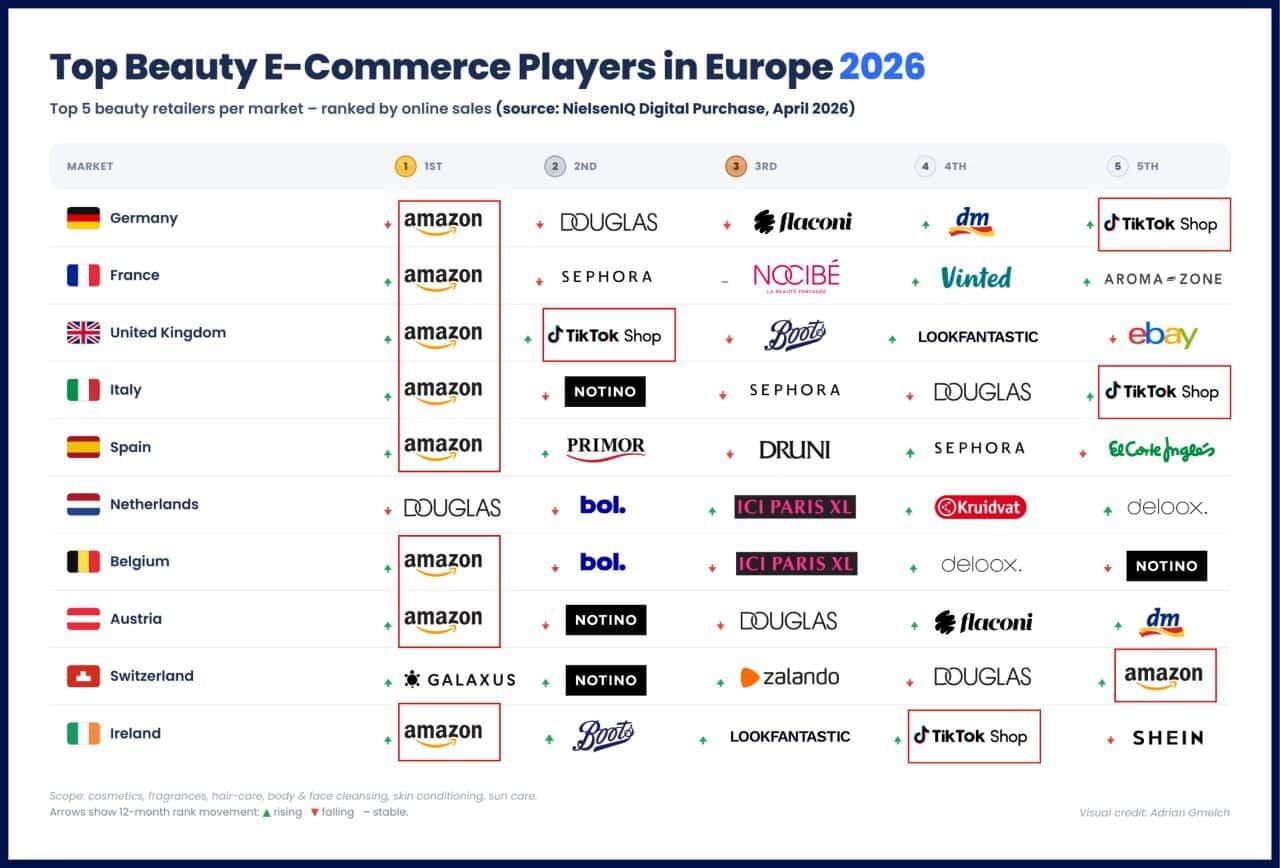
Amazon’s position in European online beauty is not in question. According to NielsenIQ Digital Purchases data (April 2026), the marketplace ranks first in eight out of ten European markets measured. In countries like the UK, Germany and France, it has been a top-three beauty destination for years. That scale gives it structural advantages that no competitor has yet come close to matching: vast product breadth, Prime delivery speed, a review ecosystem that shapes purchase decisions, and an advertising stack that generates significant revenue for both Amazon and the brands using it.
A case in point is L’Oréal. The world’s largest beauty group has built one of the most deliberate Amazon strategies in the industry, combining a full-funnel DSP approach with multi-brand storefronts to capture both awareness and conversion. Its Kiehl’s brand opened a dedicated Amazon Premium Beauty storefront, joining Lancôme and La Roche-Posay across the UK, Germany, France, Italy and Spain. The model is clear: differentiate what you offer on Amazon from what you offer in prestige retail, and treat the two as complementary rather than competitive. L’Oréal even ran Beauty Secrets, a first-ever live shopping activation on Amazon.de, bridging social entertainment and marketplace conversion.
What is notable heading into 2026 is that Amazon is not sitting still at the mass end of the market. The retailer opened its first physical beauty store in Milan in February 2025 – a direct signal that it wants to compete with prestige beauty specialists, not just capture mass-market volume online. This premium ambition reflects the same credibility gap it is actively closing against specialists like Sephora or Douglas.
The advertising data reinforces this momentum. According to Pacvue’s Q1 2026 Retail Media Benchmark Report, average daily spend in the beauty vertical increased 7.8% year-over-year on Amazon, with CPC rising 4.5% in parallel. Brand investment in the channel is intensifying, which in turn drives more visibility and more conversion – a cycle that entrenches Amazon’s position further. Brands that are not investing in Amazon’s ad ecosystem are increasingly invisible on the platform.
TikTok Shop: a challenger that has already arrived
The TikTok Shop story in European beauty is one of the fastest commercial expansions the industry has seen. Launched in the UK in late 2021, the platform initially struggled to gain traction – social commerce was a foreign concept to most Western shoppers at the time. The real inflection point came later: Spain and Ireland joined in late 2024, France, Germany and Italy launched in March 2025, and Austria, Belgium, the Netherlands and Poland came onboard in June 2026. In just over eighteen months, TikTok Shop went from a UK-only experiment to a presence across twelve European markets.
The results have been striking. Since the EU launch phase across France, Germany, Italy, Spain and Ireland, over 100,000 European businesses joined the platform, and TikTok reported triple-digit growth in daily GMV between August 2025 and February 2026 across those markets. In the beauty category specifically, NielsenIQ ranks TikTok Shop in the top five in Germany, Italy and Ireland, and at number two in the UK – ahead of both Boots and eBay. In Spain, it climbed from #76 in 2024 to #6 in Q1 2026.
This is not a niche phenomenon. According to NielsenIQ, beauty categories represent 41% of FMCG sales on TikTok Shop Europe, with cosmetics, fragrances, hair care and skin care all making meaningful contributions. The platform has also been the fastest-growing beauty e-commerce player in Germany, France, Italy, Spain and Ireland – every market where it has operated for at least a year.
Here too, L’Oréal is the most instructive example of how an established player is doubling down. When TikTok Shop launched in Spain in late 2024, L’Oréal was among the first brands to activate. By early 2026, its agency had delivered 18 live shopping events totalling 42 hours of live content, with sessions running nearly every week. The same playbook is now being rolled out across Europe. L’Oréal is listed by TikTok as one of the household-name brands already active across existing European TikTok Shop markets, alongside NIVEA, MAC Cosmetics and The Body Shop. The same brand runs premium storefronts on Amazon and weekly live commerce sessions on TikTok Shop. That dual presence is the strategy.
Two dynamics explain TikTok Shop’s broader speed. First, it creates new buyers rather than simply redistributing existing demand. NielsenIQ’s year-one customer analysis across Germany, Italy and France found that roughly 30% of TikTok Shop beauty buyers had not purchased beauty online in the previous twelve months. Second, customers converted from other channels ended up spending more on beauty overall: an additional €37 in Germany, €41 in Italy, and €47 in France year-on-year. The platform is expanding the category, not just cannibalising it.
A closer look at the beauty category on TikTok Shop
Kalodata’s 2026 TikTok Sales Report puts the category dynamics in sharp relief. Beauty consistently accounts for 40%+ of GMV on TikTok Shop globally, driven by the “shoppertainment” effect: dramatic before-and-after results in short-form video, creator-led skincare tutorials, and immediate visual payoff that builds purchase intent in seconds. The price sweet spot sits between $15 and $45 – affordable enough for impulse purchasing, premium enough to feel credible. Products like peptide serums, LED face masks and hydrating patches outperform precisely because they fit the format: quick to demonstrate, visually compelling, and easy to explain in under 60 seconds. The implication for brands is structural. Success on TikTok Shop does not come from catalogue size. It comes from selecting the right products for the format, briefing creators effectively, and maintaining a content cadence that keeps SKUs visible as trends cycle through.
Two completely different purchase journeys
The strategic divergence between these two platforms goes beyond rankings. They operate on fundamentally different purchase logics, and that has significant implications for brands.
Amazon is a search-first environment. Shoppers arrive with intent, type a query, and convert. Winning on Amazon means mastering SEO, advertising bidding, review generation, and content on the product detail page. It rewards brands with catalogue depth, operational discipline, and advertising budgets.
TikTok Shop is a discovery-first environment. Shoppers are not necessarily looking for a product – the product finds them, via a creator video, a live event, or a viral trend. According to NielsenIQ Consumer Outlook data cited in the report, 43% of consumers say they are likely to search social media before a traditional search engine when looking for product information. On TikTok Shop, 68% of purchases are made on impulse. Winning here means mastering creator partnerships, live commerce, and the ability to generate content that converts in-feed.
This is not a question of one model replacing the other. NielsenIQ data shows that 27% of luxury beauty brand buyers also purchased on TikTok Shop in the past twelve months, and 30% of beauty specialist shoppers did the same. The same consumer regularly buys a premium fragrance at an average price of £118 at a beauty retailer, and a skincare item at £8.80 on TikTok Shop. These platforms serve different moments in the same consumer’s life – which means brands need a strategy for both.
What this means for traditional beauty specialists
The two-platform rise puts real pressure on the more traditional players. Sephora is losing share in France and Italy. Douglas is declining in every European market where NielsenIQ tracks it. Specialty beauty retailers built for a world where curation, in-store experience and brand relationship were differentiators are now competing against Amazon’s scale and TikTok Shop’s cultural velocity simultaneously.
Neither threat is temporary. Amazon is methodically building toward premium legitimacy. TikTok Shop is running a proven playbook for rapid market entry – the UK trajectory, from launch in 2021 to second-largest beauty retailer, is a clear preview of what France, Germany and Italy could look like by 2027 or 2028.
Why channel complexity Is growing
For brands and retailers managing product data across channels, the emergence of TikTok Shop as a serious player adds a layer of complexity that cannot be addressed with the same toolkit used for traditional marketplaces.
TikTok Shop vs Traditional Marketplaces
| TikTok Shop | Traditional marketplace | |
|---|---|---|
| Catalog | Curated selection: trend-driven, viral and discovery-focused | Broad catalog: widest selection of active products, greater coverage |
| Key KPI | Visibility, engagement and content-driven conversion | Orders, profitability and catalog rotation |
| Demand driver | Creator gifting drives trial, content and reach | No gifting required: demand comes from search or comparison |
| Planning | Content calendar and planned launches | Ongoing management of pricing, inventory and catalog |
| Sales origin | Sales stem from discovery and inspiration | Sales stem from purchase intent |
| Format | Storytelling matters: video format and social proof | Product datasheets, price, reviews and availability matter |
Source: Lengow
Amazon requires structured, SEO-optimised product feeds with precise taxonomy, rich product descriptions, A+ content, and constant optimisation against keyword and advertising data. TikTok Shop requires a fundamentally different set of assets: product information formatted for in-video display, creator-facing catalogues that can be activated at scale, and the ability to rapidly update listings around trend cycles that move faster than traditional retail calendars.
A brand that manages these two channels with a unified feed strategy risks underperforming on both. The most effective approach treats them as distinct environments: Amazon as the conversion engine where purchase intent already exists, TikTok Shop as the demand-creation surface where the product needs to earn its moment through content. Feed management infrastructure that enables rapid, channel-specific adaptation – different data structures, different update rhythms, different content priorities – is increasingly a competitive prerequisite for any brand serious about European online beauty.
The race is not over – but the direction is clear
Amazon leads today, and its structural advantages mean it will remain the dominant force in European online beauty for the foreseeable future. But the gap with TikTok Shop is closing faster than most incumbents anticipated, and in a category where cultural relevance matters as much as price and availability, the platform that owns discovery has real leverage.
The brands and retailers best positioned for the next phase of European online beauty are not choosing between Amazon and TikTok Shop. They are building capabilities on both – and recognising that these two platforms, more than any others, will define where European beauty shoppers spend their money online over the next three years.
Sources: NielsenIQ Digital Purchases (April 2026) – “Why Ignoring TikTok Shop is a Strategic Risk”; NielsenIQ “Beauty E-commerce 2026: The New Rules of Growth”; TikTok Newsroom; Business of Fashion; WWD.
Your e-commerce library
Sign up for our newsletter
By submitting this form you authorize Lengow to process your data for the purpose of sending you Lengow newsletters . You have the right to access, rectify and delete this data, to oppose its processing, to limit its use, to render it portable and to define the guidelines relating to its fate in the event of death. You can exercise these rights at any time by writing to dpo@lengow.com

Trending Posts
Marketplaces
The Top 10 Marketplaces in Europe (2026)
The e-commerce scene is a vibrant mix of marketplaces in Europe. These aren't just websites; they're bustling hubs where millions…
02/01/26
8'
Marketing channels
ChatGPT Ads and advertising on GenAI Search Engines: what you need to know
Advertising on generative AI-based search engines (GenAI) marks a new era in digital marketing. After two decades dominated by traditional…
18/01/26
8'
Marketplaces
The French Marketplace Landscape: What Brands Need to Know
France has quietly become Europe's marketplace laboratory. Lengow's exclusive ranking reveals why traditional retailers, not tech giants, dominate the game.…
08/01/26
6'
E-commerce Trends
Google’s Universal Commerce Protocol: The End of E-Commerce as We Know It?
On January 11, 2026, at the NRF Retail's Big Show in New York, Google unveiled the Universal Commerce Protocol (UCP),…
16/01/26
6'
Marketing channels
What the World Is Unboxing on TikTok and Instagram (Haul & Unboxing Index 2025)
Opening a package on camera has become much more than simple entertainment. In 2026, "haul" and "unboxing" videos serve as…
20/01/26
7'