
.png?width=48&height=48&name=Adrian%20(1).png)
The two axes to map marketplaces
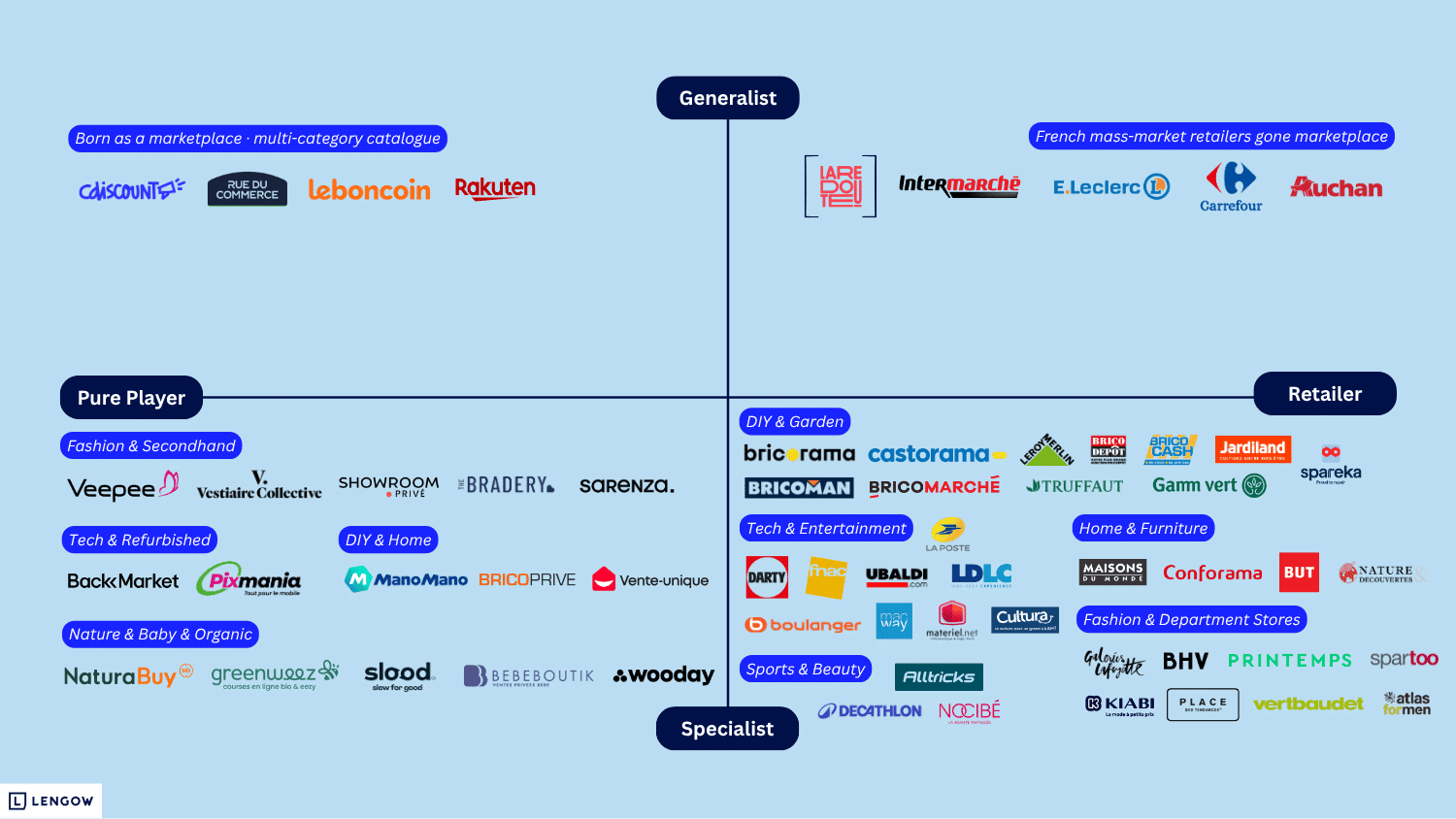
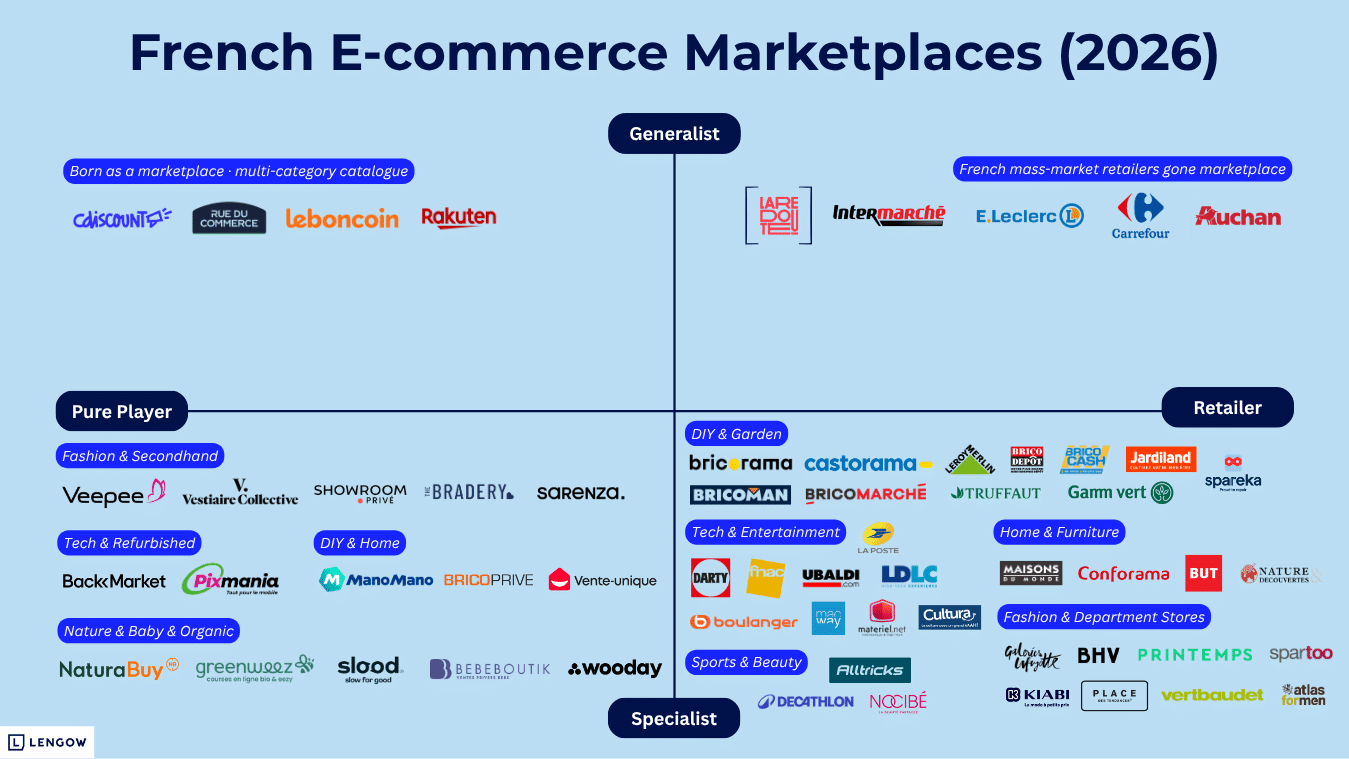
The vertical axis runs from Generalist at the top (broad, multi-category catalogue) to Specialist at the bottom (single vertical, expert audience). The horizontal axis runs from Pure Player on the left (born as a marketplace, no physical retail history) to Retailer on the right (brick-and-mortar chains that opened their platforms to third-party sellers).
These axes weren't chosen arbitrarily. They cut to the two most structurally important questions about any marketplace: what it sells, and where it came from. And in France, the answers reveal a pattern that looks nothing like Germany, the UK, or the Netherlands.
Top-left: born digital, gone broad
This is the quadrant where you'd expect France's digital champions to cluster. The pure players who built multi-category platforms from scratch. Instead, it's the emptiest corner of the map.
Four names: Cdiscount , Leboncoin , Rue du Commerce , Rakuten France (formerly PriceMinister, founded in Paris in 2000 by Pierre Kosciusko-Morizet). All born as marketplaces. All with broad catalogues spanning tech, fashion, home, and more.
And all eventually acquired by larger groups. Cdiscount by Casino. Rue du Commerce by Carrefour. Rakuten France by the Japanese giant. None of them scaled into a truly independent generalist platform with the reach of an Amazon or an Allegro (except Cdiscount).
Top-right: the hypermarkets go digital
This quadrant is where French mass-market retail converted to marketplace at scale and where the strategic logic becomes very clear.
Carrefour, E.Leclerc, Auchan, Intermarché - the four pillars of French grande distribution - all opened their platforms to third-party sellers, primarily through Mirakl. The one missing is Coopérative U (no marketplace yet). And La Redoute anchors this quadrant in a way that tends to surprise people.
No physical stores, so why not a pure player? Because La Redoute was founded in 1837 in Roubaix as a wool merchant, spent 150 years as one of France's biggest mail-order catalogues, then became an e-commerce player, then a marketplace. It now operates La Redoute Intérieurs corners in over 50 Galeries Lafayette stores across France, from Haussmann to Bordeaux, Montpellier, and Grenoble. That's not a pure player. That's a 187-year-old retailer that reinvented itself three times.
Bottom-left: where the unicorns live
This is the quadrant that defines France's pure-player success story. And the pattern is impossible to miss.
Every platform that broke through went deep, not wide.
Back Market owns refurbished electronics globally. ManoMano owns DIY and garden across France (and Europe). Vestiaire Collective owns pre-owned luxury fashion. Veepee owns flash sales. None of them tried to out-smart Amazon on generalist territory. They found a category where incumbents were weak, built category authority, and defended it.
Three of these pure players - Back Market, ManoMano, Vestiaire Collective - are French unicorns. Their valuation didn't come from breadth. It came from depth.
This quadrant also holds a newer generation of highly vertical platforms that rarely make it into mainstream rankings: Slood (eco-responsible fashion, beauty and home, incubated at LDLC), Wooday (the first marketplace dedicated entirely to wood heating - logs, pellets, stoves, accessories, installation services), Bebeboutik (baby and childcare), NaturaBuy (hunting, fishing and outdoor), Label-Park (board sports). These aren't household names. But they illustrate something important about the French market: it keeps producing niche pure players with genuine category authority, and those niches can be remarkably specific.
Bottom-right: the most French quadrant of all
This is where the map becomes genuinely revealing, and where France diverges most sharply from every other European market.
The bottom-right quadrant is the densest on the map . Legacy retailers, across every conceivable vertical, that opened their catalogues to third-party sellers. Not just to grow revenue but to become platform businesses in their own right.
DIY and Garden alone accounts for more than ten platforms: Leroy Merlin, Castorama, Bricomarché, Bricorama, Bricoman, Brico Privé, Jardiland, Truffaut, Gamm vert, Spareka. An entire ecosystem of home improvement retailers running serious marketplace operations in parallel to their physical networks.
Home and Furniture : Darty, Boulanger, But, Conforama, Maisons du Monde, Ubaldi. Each running a marketplace alongside its core retail business.
Fashion and Department Stores : Galeries Lafayette, Printemps, BHV Marais, Kiabi, Place des Tendances, Vertbaudet, Spartoo, Atlas for Men. Historic French institutions turned two-sided platforms.
Tech and Entertainment : Fnac, Cultura (which launched its marketplace in November 2024 via Mirakl — one of the most recent entrants on the map), LDLC, MacWay, Materiel.net.
Sports and Beauty : Decathlon, Alltricks, Nocibé.
The common thread: these are all retailers that chose to extend their category authority into a marketplace model , rather than cede that ground to generalist platforms. France's retailers didn't wait to be disrupted. They disrupted themselves.
What Lengow's data confirms
Several of the platforms on this map also appear in Lengow's 2025 French marketplace barometer - built on aggregated, anonymised data from 600 merchants selling in France across the full year. The ranking measures GMV, number of orders, and number of active sellers. The top 10 is: Cdiscount, Leroy Merlin, ManoMano, La Redoute, Veepee, Maisons du Monde, Darty, Decathlon, Castorama, Showroomprivé.
A few things stand out when you overlay that ranking on the quadrant.
Eight of the top ten are retailers . That's the same structural finding the map shows visually, now backed by transaction data. Leroy Merlin at #2 reflects the extraordinary scale it has built since launching its marketplace in late 2020 via Mirakl - it now has over 3 million marketplace references on top of its own catalogue. Decathlon at #8 reflects a platform that has leveraged deep customer trust in sports to attract both specialist brands and general sports equipment sellers. Castorama at #9 sits in the same DIY cluster as Leroy Merlin and ManoMano, confirming that this vertical has become the most contested marketplace battleground in French e-commerce.
Two pure players in the top 10 - ManoMano (#3) and Showroomprivé (#10) - are both specialists. ManoMano in DIY, Showroomprivé in flash sales and private events. Again: the pure players that made the top 10 went deep, not wide.
What the ranking also confirms: Cdiscount remains the reference point for French marketplace sellers , despite being in the relatively empty top-left quadrant. Its hybrid model - part retailer, part marketplace, powered by its own Octopia infrastructure - gives it a scale and seller ecosystem that no vertical specialist has matched.
What this means if you're selling in France
The Lengow marketplaces map creates both clarity and complexity for brands and international sellers.
The clarity : French marketplaces are category-specific by design. Leroy Merlin shoppers are actively looking for home improvement products. Decathlon customers want sports equipment. Nocibé visitors want beauty and fragrance. The purchase intent is built into the platform, you're not fighting for attention in a generic feed.
The complexity : you cannot manage these platforms the way you manage Amazon. Each has its own onboarding requirements, content standards, commission structures, and customer service expectations. Several - including Fnac, Decathlon, and Leroy Merlin - require French-language customer service as a condition of selling. Quality KPIs on some platforms can get you delisted faster than on any generalist marketplace.
The strategy : be selective. The right two or three marketplaces for your category will outperform a scattered presence on ten. Map your vertical against this quadrant. Identify where your category clusters. Build depth before breadth.
A market that rewards understanding
France has the most complex - and arguably the most interesting - marketplace ecosystem in Europe. More than 55 platforms. Multiple technology stacks. A landscape built by retailers as much as by startups. And a cultural dynamic where consumer trust in established brands translates directly into marketplace performance.
21% of the EU1000 marketplace ranking is headquartered in France (RetailX 2025). That's not a coincidence. It's the result of an industry that started converting early, built the infrastructure to do it at scale, and kept going.
The map is the starting point. What you do with it is the strategy.
.png?width=64&height=64&name=Adrian%20(1).png)
Adrian Gmelch
Adrian Gmelch is Director of Content at Lengow, where he leads content strategy while staying firmly hands-on: reading the research, and tracking the trends that matter before they go mainstream.


.png)