

.png?width=48&height=48&name=Adrian%20(1).png)
The five pillars of marketplace success
Through analyzing hundreds of marketplace sellers across Europe, we've identified five critical dimensions that determine success:
1/ Coverage
measures your marketplace footprint. Are you present on the platforms where your customers shop? Have you expanded beyond Amazon into category-specific marketplaces like Zalando for fashion or Decathlon for sports equipment? Cross-border expansion and niche marketplace penetration are crucial for reaching new customer segments and reducing platform dependency.
2/ Catalog evaluates your product data quality. This is where many sellers stumble. High error rates consume significant team time. Quality catalog management means minimal errors, rich product descriptions with high-quality images, and efficient data updates across all channels.
3/ Pricing examines your strategy for staying competitive. Without a clear pricing approach, you're flying blind. Successful sellers monitor competitor pricing, adjust dynamically based on market conditions, and maintain profitability through strategic positioning rather than racing to the bottom.
4/ Operations looks at your fulfillment capabilities and process efficiency. Can you handle orders seamlessly across multiple marketplaces? Do you have systems in place to manage inventory accurately? Operational excellence separates growing businesses from those struggling to scale.
5/ Analytics measures your ability to track performance and make data-driven decisions. The best marketplace sellers don't guess, they measure everything. From channel profitability to customer behavior patterns, analytics transform marketplace selling from guesswork into science.
Understanding your marketplace maturity stage
The Marketplace Maturity Index categorizes sellers into five distinct stages, each representing a different level of sophistication and capability:
- Nascent (0-39 points) characterizes businesses just beginning their marketplace journey. These companies typically operate on one or two platforms with basic capabilities. Their immediate focus should be on establishing fundamental processes and expanding platform presence.
- Emerging (40-59 points) describes sellers who've established a marketplace presence but face operational challenges. Catalog quality issues persist, pricing strategies remain reactive, and cross-border expansion is limited. These businesses have significant growth potential by systematizing their operations.
- Established (60-74 points) represents companies with solid marketplace foundations. They manage multiple platforms effectively, maintain reasonable catalog quality, and have basic analytics in place. Their next step involves optimization and strategic expansion.
- Advanced (75-89 points) identifies sophisticated operators who excel across most dimensions. These businesses use data extensively, maintain high catalog quality, and operate efficiently across diverse marketplaces. They're positioned for aggressive growth.
- Elite (90-100 points) represents marketplace leaders who've mastered all five pillars. These companies set industry benchmarks, leverage cutting-edge tools, and continuously innovate their marketplace approach.
From assessment to action
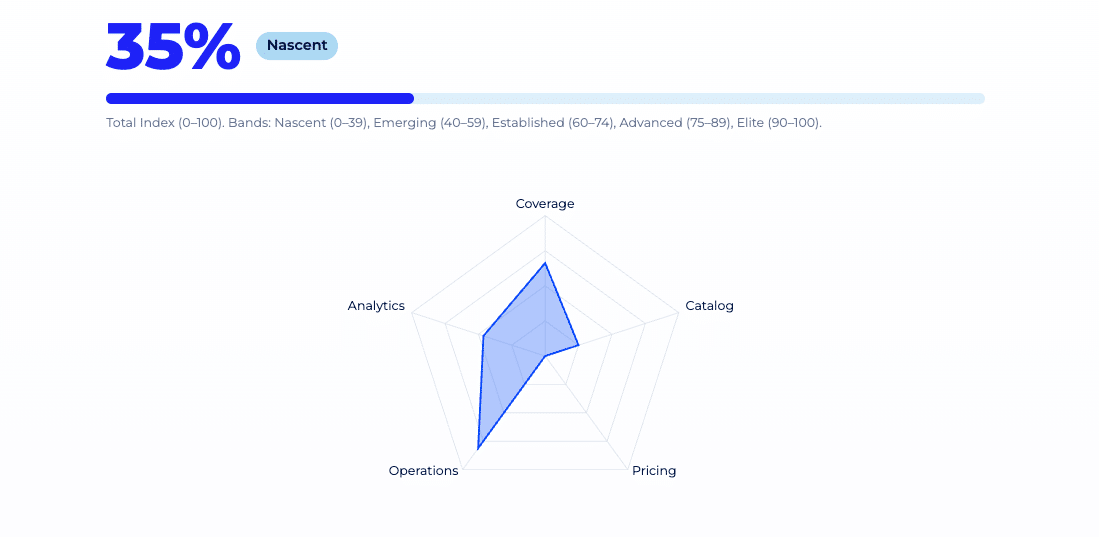
The real value of understanding your maturity level lies in knowing what to do next. Let's take a practical example.
Imagine a company scoring 35 overall - placing them in the Nascent category. Their breakdown reveals: Coverage at 53 (Emerging), Catalog at 20 (Nascent), Pricing at 0 (Nascent), Operations at 65 (Established), and Analytics at 37 (Nascent).
This profile tells a clear story: the company has decent operations and some marketplace presence, but catalog quality and pricing strategy need immediate attention. Without addressing these gaps, they'll struggle to grow despite being on multiple platforms.
The recommended action plan would prioritize:
Catalog quality
as the top priority. Conducting a comprehensive audit to identify missing attributes and data inconsistencies, implementing robust validation rules to reduce errors by 50%, enriching product descriptions and adding high-quality images for top-performing SKUs, and automating product data updates to marketplaces.
Pricing strategy
as the second focus. The company should establish a clear pricing approach that balances competitiveness with profitability, implement competitor monitoring to understand market dynamics, and create dynamic pricing rules for different product categories and marketplaces.
Marketplace expansion
to increase coverage. By identifying 2-3 new high-potential marketplaces in target geographies within four weeks, onboarding at least one new cross-border platform within two months, and analyzing competitor presence on untapped marketplaces to identify strategic entry points.
Focus: Why the European context matters
European marketplace strategy differs significantly from other regions due to market fragmentation. While American sellers can achieve massive scale by mastering Amazon and perhaps adding Walmart, European sellers must navigate country-specific champions (like Cdiscount in France or Bol.com in the Netherlands), category leaders (Zalando for fashion, ManoMano for DIY), and emerging platforms across 27+ countries with different languages, currencies, and consumer preferences.
This complexity makes maturity assessment even more critical. A "one size fits all" approach fails in Europe. French consumers behave differently from German ones. What works on Amazon.de might not translate to Bol.com. Success requires localized strategies informed by data and guided by clear maturity benchmarks.
Evaluate your marketplace performance
The Marketplace Maturity Index assessment takes approximately four minutes to complete. It consists of 25 questions covering all five key areas. Questions are designed to be straightforward, no too complex calculations or extensive research required. Most sellers can complete it using information their e-commerce or marketplace teams already have at hand.
Once completed, you receive a detailed score breakdown across all five dimensions, your overall maturity classification with benchmark comparisons based on aggregated data and expert studies, and a personalized action plan with specific recommendations to improve performance and accelerate growth.
.png?width=64&height=64&name=Adrian%20(1).png)
Adrian Gmelch
Adrian Gmelch is Director of Content at Lengow, where he leads content strategy while staying firmly hands-on: reading the research, and tracking the trends that matter before they go mainstream.


.png)