




Same product, different price: how online retailers are fragmenting price perception in Europe
30/06/26
6'
The same running shoe. The same perfume. The same dog food. Depending on which retailer you buy from, you could pay anywhere from 60 euros to 140 euros for the exact same item. That is not a promotional anomaly. It is the daily reality of e-commerce across Europe in 2026, and it is reshaping the way consumers perceive brands and the platforms where they shop.
Between January and May 2026, Lengow analyzed price data from NetRivals across four European markets: Germany, Spain, France and Italy. The methodology was simple: identify the same product sold across multiple online retailers and measure the gap between the cheapest and most expensive price observed over the period. The results are striking enough to deserve a hard look from anyone managing a brand or a product catalog online.
For a deeper look at these trends, our Price Radar studies on France and Spain analyse how brands and products moved on Amazon between January and May 2026.
What we found: price gaps are systematic, not exceptional
The instinctive reaction when confronted with a 135% price difference for the same product is to assume an outlier, a data error or a promotional blip. What the data actually shows is that significant price dispersion is consistent across categories, countries and product types.
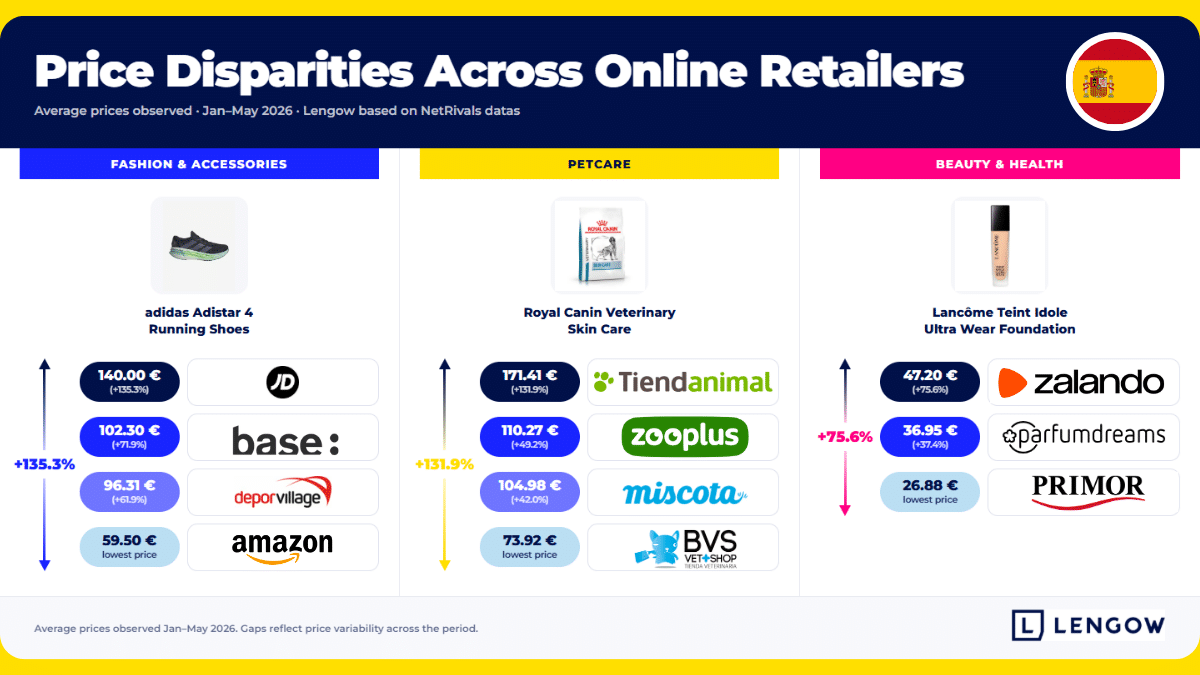
To be clear: some degree of price variation across retailers is normal, and even healthy. A gap of 10 to 12% between the cheapest and most expensive seller can reflect legitimate differences in service level, shipping terms, loyalty programs or retail positioning. That kind of spread does not confuse consumers and does not damage brands. The problem starts when the gap grows well beyond that threshold, into the 30%, 70% or 100% territory documented here. At that point, the variation no longer reads as a natural market dynamic. It reads as a loss of control, and it actively harms both the price image of the brand and the credibility of the retailers carrying it.
In Spain, a pair of adidas Adistar 4 running shoes was listed at 59.50 euros on Amazon and at 140 euros on JD Sports, a gap of 135.3%. In Germany, the adidas Entrada 22 rain jacket ranged from 27.50 euros at Sport-Greifenberg to 60.92 euros on Zalando, a 121.5% spread. In France, a Royal Canin Veterinary Skin Care product for dogs ranged from 73.92 euros to 171.41 euros depending on the retailer. These are not niche or obscure products. They are mainstream items from major brands sold on major platforms, all tracked across the same five-month window.
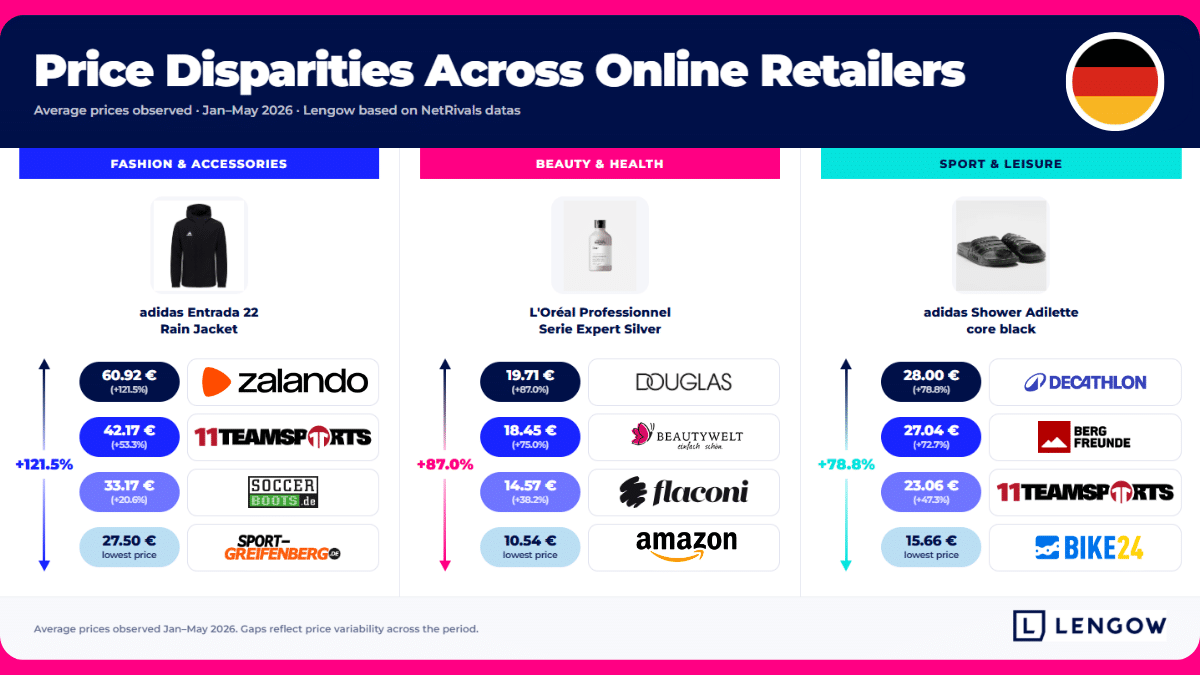
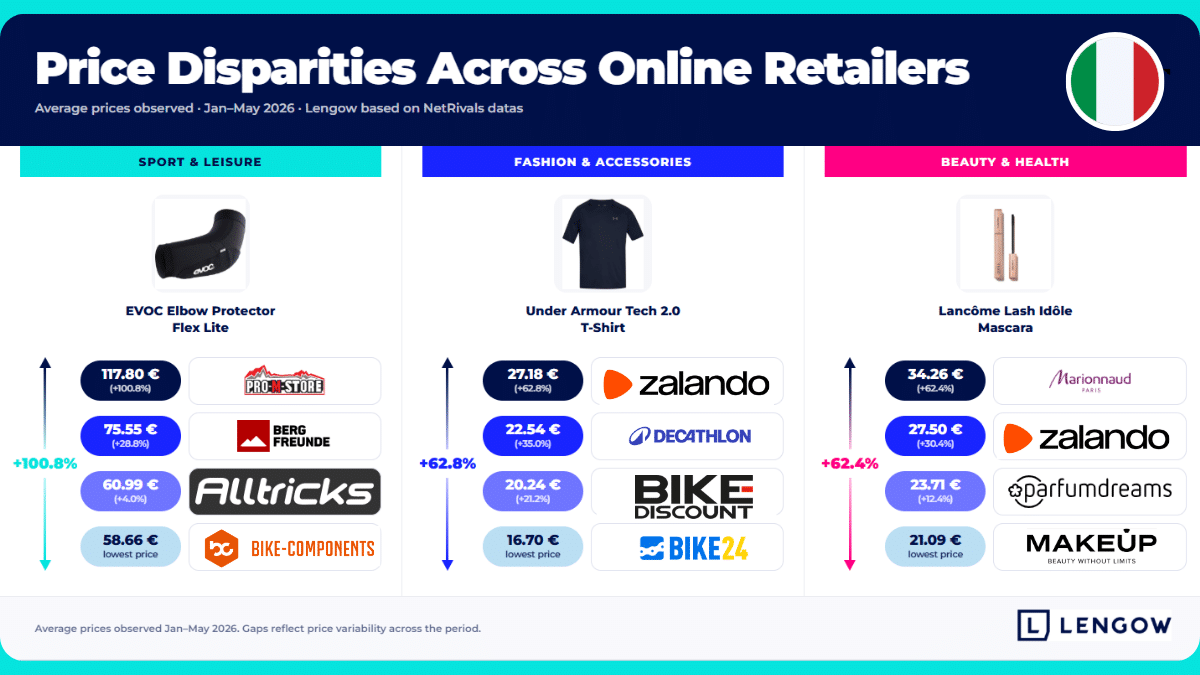
The pattern holds across categories. Beauty and fragrance products show similarly wide ranges: L’Oréal Professionnel’s Serie Expert Silver shampoo varied by 87% between Amazon.de and Douglas in Germany. The Rabanne Fame Intense Eau de Parfum was available for 86.40 euros at Primor in France and 162.05 euros at Marionnaud, a difference of nearly 88%. The Lancôme Lash Idôle mascara sold for 21.09 euros on Makeup.it in Italy and 34.26 euros at Marionnaud.it, a 62% gap.
Why price dispersion is a brand problem, not just a consumer inconvenience
When a shopper encounters a 130% price gap for the same product, their first reaction is rarely to buy at the higher price. It is to question whether the more expensive retailer is legitimate, whether the cheaper one is selling a counterfeit, or whether the brand itself has lost control of its distribution.
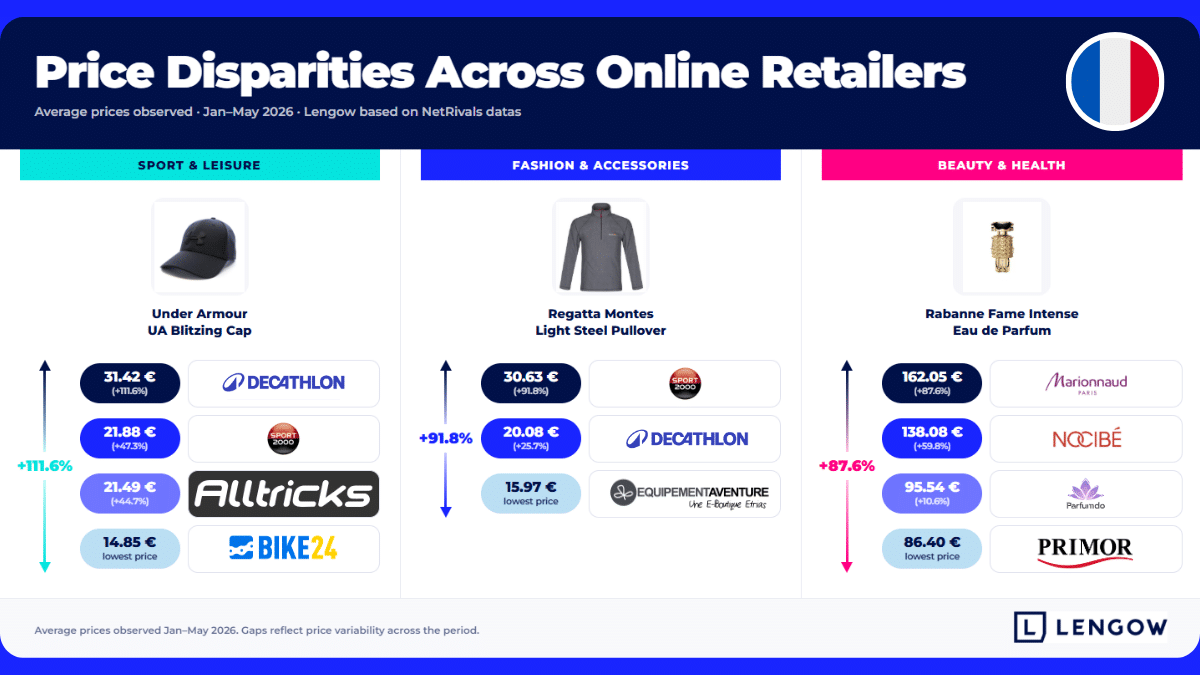
For marketplace-first categories like sport and outdoor equipment, the effect is amplified. A consumer comparing prices across Decathlon, Alltricks, Bike24 and Bergfreunde for cycling gear will see meaningful price differences on identical SKUs and will rationally gravitate toward the lower end. The higher-priced retailers are not just losing individual sales; they are training buyers to search harder before committing, which increases acquisition costs across the board.
The marketplace dynamic has not simplified since 2022
Four years ago, we wrote about the common belief that price disparities on marketplaces were a temporary issue, something that would gradually disappear as platforms matured and brands strengthened their distribution agreements. The 2026 data suggests the opposite has happened.
The number of active online retailers per product has increased, not decreased. Specialty retailers in cycling, outdoor sports, petcare and beauty have proliferated, each pricing independently based on their own margin structures and promotional calendars. Aggregator platforms have made comparison shopping frictionless. And brands that sell through multiple channels simultaneously have found it harder, not easier, to enforce consistent pricing across them.
The result is that price dispersion is now structural. It is not caused by rogue sellers or temporary misalignment. It is the natural output of a fragmented retail landscape where every distributor optimizes for their own unit economics.
What this means for retailers operating in these markets
The data points to a few practical realities for retailers and brands active across European markets.
First, pricing by country matters more than ever. The same product can have very different competitive dynamics in Germany, France, Spain and Italy, even when sold through the same platforms. The price gaps observed in the Spanish petcare market, for instance, are considerably wider than those in the Italian beauty market, reflecting differences in retailer concentration and consumer price sensitivity. A single European pricing strategy will systematically misalign in at least one market.
Second, the lowest price in a category sets the reference point, regardless of where it appears. When a consumer can find a product for 59.50 euros on Amazon Spain, the 140-euro price at JD Sports does not read as premium positioning. It reads as a pricing failure. This is a structural shift from the pre-marketplace era when price anchoring was easier to control.
Third, monitoring competitor prices is no longer sufficient on its own. Brands need visibility into how their products are priced across the full retailer ecosystem, including third-party sellers on generalist platforms, specialty e-tailers and cross-border retailers shipping into a given market. A price observed in one channel shapes consumer expectations in every other channel.
The case for active price intelligence in 2026
The scale of price dispersion documented here is not something a brand or retailer can address reactively. By the time a consumer has seen a 135% price gap on a product you distribute, the damage to their price perception of that product is already done
What the data argues for is a continuous, automated view of how every product in a catalog is priced across the full landscape of online retailers. Not a monthly report. Not a quarterly audit. A real-time or near-real-time feed of price positions, indexed by country, retailer and category, that allows commercial and marketing teams to act before gaps become entrenched.
NetRivals, Lengow’s price intelligence solution, is built precisely for this. It tracks prices continuously across thousands of retailer pages, flags significant deviations as they emerge and gives brands and retailers the market visibility they need to make pricing decisions based on facts rather than assumptions. The data used throughout this article was collected through that same infrastructure.
To show what this looks like in practice, we have produced two detailed price radar studies going deeper into the market dynamics observed in France and Spain specifically, with category-level breakdowns, retailer rankings and actionable benchmarks. If you operate in either market and want a clearer picture of where the real pricing pressure is coming from, both studies are available to download below.
The price gaps documented across Germany, Spain, France and Italy in the first half of 2026 are not surprising if you have the data to see them. The question is whether you see them before your consumers do.
For a deeper look at these trends, our Price Radar studies on France and Spain analyse how brands and products moved on Amazon between January and May 2026.
Data source: NetRivals price tracking, January-May 2026. Prices reflect observed average selling prices across public retailer pages in Germany, Spain, France and Italy.
Your e-commerce library
Clarins x NetMonitor Success Story
Learn moreSuccess on Marketplaces
Learn moreCompetitive Intelligence
Learn moreSign up for our newsletter
By submitting this form you authorize Lengow to process your data for the purpose of sending you Lengow newsletters . You have the right to access, rectify and delete this data, to oppose its processing, to limit its use, to render it portable and to define the guidelines relating to its fate in the event of death. You can exercise these rights at any time by writing to dpo@lengow.com

Trending Posts
Marketplaces
The Top 10 Marketplaces in Europe (2026)
The e-commerce scene is a vibrant mix of marketplaces in Europe. These aren't just websites; they're bustling hubs where millions…
02/01/26
8'
Marketing channels
ChatGPT Ads and advertising on GenAI Search Engines: what you need to know
Advertising on generative AI-based search engines (GenAI) marks a new era in digital marketing. After two decades dominated by traditional…
18/01/26
8'
Marketplaces
The French Marketplace Landscape: What Brands Need to Know
France has quietly become Europe's marketplace laboratory. Lengow's exclusive ranking reveals why traditional retailers, not tech giants, dominate the game.…
08/01/26
6'
E-commerce Trends
Google’s Universal Commerce Protocol: The End of E-Commerce as We Know It?
On January 11, 2026, at the NRF Retail's Big Show in New York, Google unveiled the Universal Commerce Protocol (UCP),…
16/01/26
6'
Marketing channels
What the World Is Unboxing on TikTok and Instagram (Haul & Unboxing Index 2025)
Opening a package on camera has become much more than simple entertainment. In 2026, "haul" and "unboxing" videos serve as…
20/01/26
7'