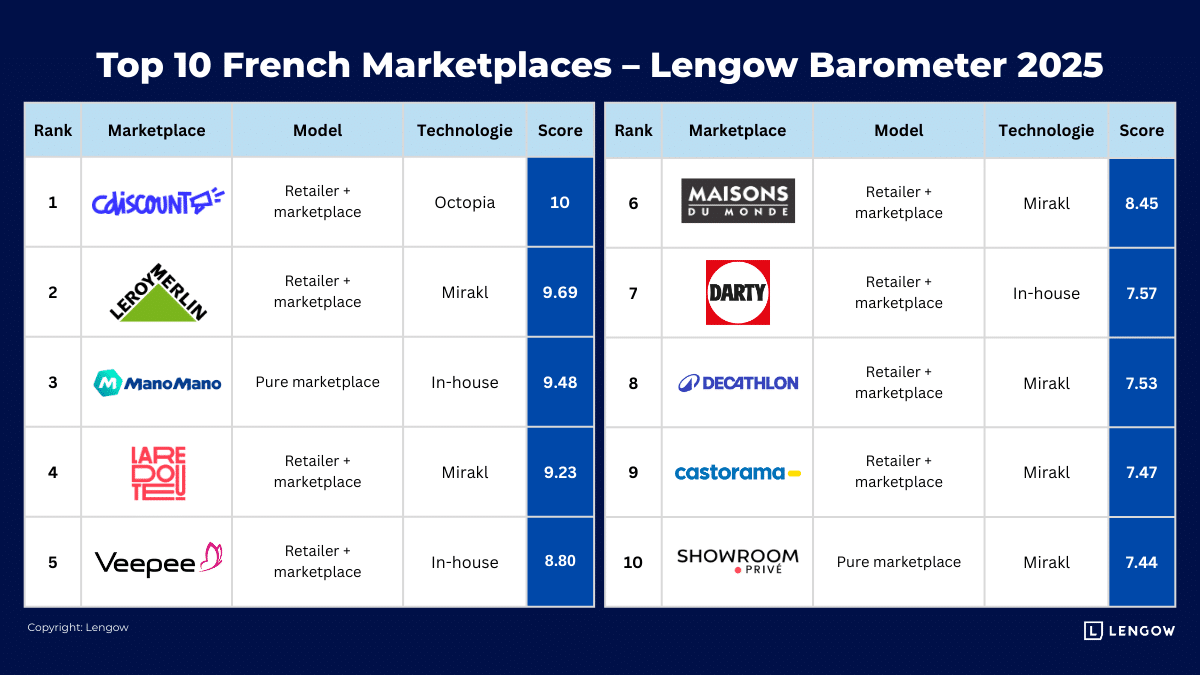

The Top 10: a retailer-led revolution
| Rank | Marketplace | Technology | Business model |
|---|---|---|---|
| 1 | Cdiscount | Octopia | Retailer + marketplace** |
| 2 | Leroy Merlin | Mirakl | Retailer + marketplace |
| 3 | ManoMano | In-house | Pure marketplace |
| 4 | LaRedoute | Mirakl | Retailer + marketplace |
| 5 | Veepee | In-house | Retailer + marketplace |
| 6 | Maisons du Monde | Mirakl | Retailer + marketplace |
| 7 | Darty | In-house | Retailer + marketplace |
| 8 | Decathlon | Mirakl | Retailer + marketplace |
| 9 | Castorama | Mirakl | Retailer + marketplace |
| 10 | Showroomprivé | Mirakl | Pure marketplace |
* This ranking intentionally focuses on French marketplaces. Non-French platforms operating in France (e.g., Amazon, Temu, AliExpress, Zalando, Rakuten) are excluded.
** Cdiscount: historically a hybrid model (retailer + marketplace), but increasingly “marketplace-first” in practice.
Notice something unusual? Most of these names aren't tech startups or pure-play e-commerce giants.
They're retailers. Established brands with physical stores, deep category expertise, and decades of customer relationships.
Why France is different
While Germany, the UK, and other European markets saw Amazon establish near-monopolistic dominance, France took a different path. Traditional retailers didn't wait to be disrupted. They disrupted themselves. Starting in the early 2010s, French retailers made a strategic bet:
open up their platforms to third-party sellers. Transform from merchants into marketplace operators. The move was bold, and it paid off. Today, hardware stores like
Leroy Merlin and
Castorama run thriving marketplaces. So do fashion retailers like
La Redoute, home goods players like
Maisons du Monde, and sporting goods chains like
Decathlon. They leveraged their brand equity, their logistics infrastructure, and most importantly, their customer trust to build successful two-sided platforms.
According to recent research from RetailX,
21% of marketplaces in the European EU1000 ranking are headquartered in France. That's more than any other European country, and even more than the United States (19%) or China (7%) in that same ranking. France doesn't necessarily lead Europe in total marketplace GMV,
but it absolutely leads in marketplace adoption. The model has become standard operating procedure for French retail, not an experimental side project.
What this means for international sellers
If you're a brand or seller looking to expand in France, this landscape creates both opportunities and challenges.
- The opportunity: French marketplaces offer category-specific audiences with high purchase intent. Leroy Merlin shoppers are looking for home improvement products. Decathlon customers want sports gear. The targeting is built in.
- The challenge: You can't treat French marketplaces like Amazon. Each has its own onboarding process, technical requirements, and vendor expectations. The rules of engagement vary significantly from one platform to another.
- The strategy: Be selective. You don't need to be on all ten marketplaces. You need to be on the right ones for your category, with a localized approach that respects how French consumers shop.
Built on serious technology
These aren't amateur operations. The French marketplace ecosystem runs on sophisticated infrastructure.
Several top platforms use specialized marketplace technology from providers like Mirakl (powering Leroy Merlin, La Redoute, Maisons du Monde, Castorama, and Decathlon) or Octopia (powering Cdiscount). Others like ManoMano or Veepee have invested in proprietary technology stacks.
This technological maturity means these platforms can handle complex catalog management, sophisticated fulfillment options, and demanding vendor integration requirements. They're enterprise-grade operations.
Looking ahead: lessons for Europe
The French model offers important lessons for the rest of Europe. Retailers can successfully operate marketplaces. Local champions can compete with global platforms. And early adoption of the marketplace model creates defensible competitive advantages. For international brands eyeing European expansion,
France represents both a unique market and a potential blueprint. Understanding how and why French marketplaces evolved differently isn't just useful for selling in France. It's useful for understanding where European e-commerce might be heading next. This ranking is Lengow's first
annual benchmark of the French marketplace landscape. We're building it from real transaction data, not marketing claims. As the ecosystem continues to evolve, we'll keep tracking which platforms truly matter for merchants trying to grow in France. Because in the end, marketplace success isn't about being everywhere.
It's about being in the right places, with the right strategy, backed by real data.
Methodology: This ranking is based on aggregated, anonymized data from a sample of 600 merchants using Lengow from January 1 to December 31, 2025. The ranking combines three key indicators: sales volume (GMV), number of orders, and number of active sellers. Only French-headquartered marketplaces are included to highlight the specific characteristics of the French ecosystem.

Adrian Gmelch
Adrian Gmelch is Director of Content at Lengow, where he leads content strategy while staying firmly hands-on: reading the research, and tracking the trends that matter before they go mainstream.
Table of content
Is your catalogue ready for AI Shopping?
Discover what AI assistants look for, how products get selected and what you can do now to stay visible in the new shopping journey.