



ChatGPT Ads: first results are in
09/07/26
7'
One number sets the scene. According to data from Adobe Analytics published this week, shoppers who reached retail sites via an AI chatbot during the four days of Prime Day 2026 in the US were 40% more likely to complete a purchase than those coming from search, email or social media. A first in the event’s history.
And Amazon, of all companies, bought sponsored placements in ChatGPT to promote this Prime Day. The same Amazon that has been blocking ChatGPT’s crawlers for months, that sued Perplexity for shopping on behalf of its users without authorization, and whose share of agentic traffic remains the lowest in the industry, around 0.4% according to J.P. Morgan. The e-commerce giant is playing both sides at once: it pays to be seen, and refuses to be read.
OpenAI shelved the built-in checkout dream and went all in on ads
The timing isn’t a coincidence. You have to go back to March to understand why OpenAI needed a win like Amazon’s. In September 2025, ChatGPT launched Instant Checkout, the promise of completing a payment without leaving the conversation, with Shopify, Etsy and Walmart as launch partners. Five months later, the results were grim. It was Walmart, in particular, that put out the number that stung: the conversion rate for payments made inside ChatGPT ran at roughly a third of what the same visitor delivered when sent to walmart.com.
OpenAI pulled the plug in early March 2026, rebranding the retreat from built-in checkout as a simple “shift to Apps.” The official statement described a “smoother” buying experience. In practice, the conversation stays in ChatGPT, the transaction goes back to the merchant’s own site, exactly the model of a standard search engine earning a commission per click rather than a cut of the sale.
From there, everything moves in the same direction: ads. The ad pilot launched on February 9, 2026. The self-serve Ads Manager, with click-based bidding, followed on May 5. Automated product feeds arrived on June 2. Advertising is no longer a side feature at OpenAI. After giving up on monetizing the transaction directly, the company turned it into ChatGPT’s main economic engine. Amazon becomes the first major account to validate, under real conditions, the model OpenAI ended up betting everything on.
Amazon buys the click, never the transaction
The mechanism is worth spelling out, because it says a lot about the strategy behind it. Amazon didn’t join OpenAI’s product feed system, the one that lets a structured catalog generate placements automatically based on conversational intent. It simply bought brand visibility: every sponsored click redirects to Amazon.com, never to a payment completed inside the conversation. Amazon keeps control of the transaction, the customer data, and the relationship.
Juozas KaziukėnasAmazon and other retailers don’t want to be aggregated by ChatGPT but they will gladly buy ads on ChatGPT to bring users to their storefronts.
Target is playing a different game. Testing with its ad arm Roundel since February 9, the retailer claims a 40% increase in ChatGPT-driven traffic to its site every month, and in the same move has rolled out a dedicated app inside ChatGPT alongside a partnership with Google on the Universal Commerce Protocol. No blocking on one side and buying on the other: here, organic, agentic and paid all move together. The number measures traffic that predates the ad buys, not ad performance, but the logic runs in the exact opposite direction from Amazon’s.
ChatGPT Ads: who’s already in (overview)
| Brand | Market | Status | Approach |
|---|---|---|---|
| Amazon | US | Paradox | Buys Prime Day ads, blocks crawlers from indexing its catalog. |
| Target (Roundel) | US | Live | Organic, agentic and paid at once, since February 9, 2026. |
| Walmart | US | Repositioning | Instant Checkout dropped (3x lower conversion), pivoted to the product feed. |
| Etsy | US | Legacy | Instant Checkout launch partner, September 2025. |
| Williams-Sonoma | US | Active pilot | Test announced alongside Target, February 2026. |
| Chewy, Sephora, Lowe’s, Wayfair | US | Active pilot | Named by Sensor Tower among the 44% of retail impressions, March 2026. |
| Zalando | UK | Live | Launch partner for the first European market, June 6, 2026. |
| Tesco | UK | Live | One of the first retailers live directly in the UK. |
| Hilton | UK | Active pilot | Travel sector, piloting via agency Dentsu. |
| Hiscox | UK | Active pilot | Insurance sector, piloting via agency Dentsu. |
Non-exhaustive sample, as of July 9, 2026. Sources: official brand communications, OpenAI, Digiday, Marketing Dive, Sensor Tower, Dentsu, Campaign.
The ad format is evolving in real time, right in front of us
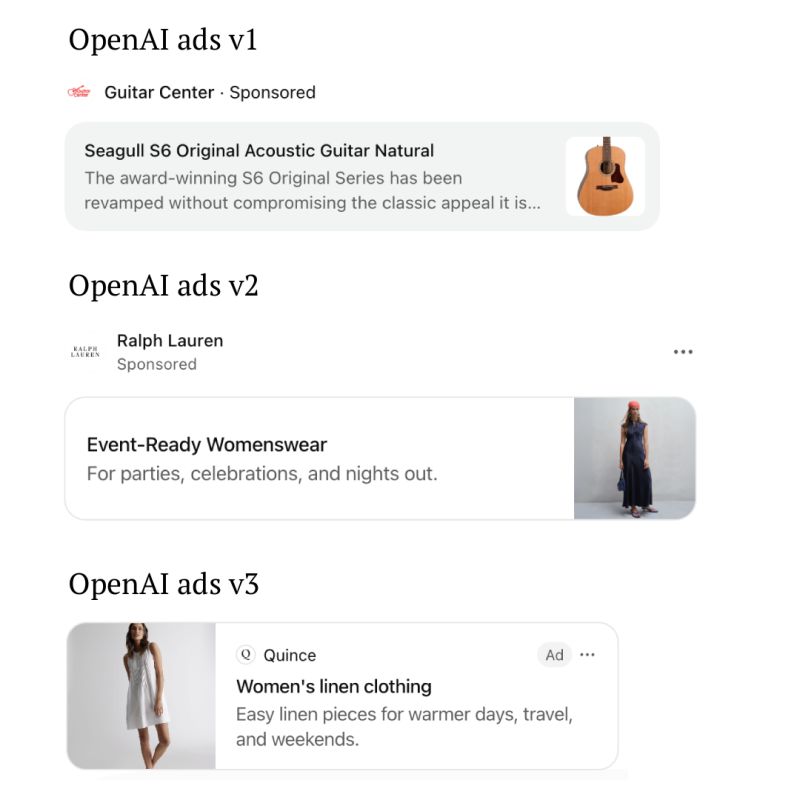
What stands out, beyond the Amazon case, is how fast the format itself is changing. In a LinkedIn post tracking the story closely, Kaziukėnas has already documented three generations of ads in the space of a few months: a first version as a plain text-and-image banner (Guitar Center), a second that widens the image and tightens the horizontal footprint to prepare for showing several ads side by side (Ralph Lauren), and a third where the format starts to resemble an actual product card, complete with an “Ad” label and an options menu (Quince). He also notes that a dedicated shopping module is in the works, while pointing out that OpenAI is still leaning on formats close to standard banners. In his view, Google remains ahead on ad integration genuinely built for AI.
This fast pace tracks the official timeline. OpenAI started testing ads in ChatGPT on February 9, 2026, for US users on the Free and Go plans. On May 5, the platform opened self-serve buying through its Ads Manager, adding click-based bidding on top of the existing CPM, along with a measurement pixel and a Conversions API. Less than a month later, on June 2, product feed management moved into a dedicated section of the Ads Manager, confirmed publicly: advertisers can now connect a structured catalog, up to one million SKUs per advertiser, with a 100-product sample required before the feed opens in full. Same format already sent to Google Shopping, no rebuild needed.
What this means for a brand selling online
Go further
On June 6, 2026, ChatGPT Ads crossed the Atlantic and landed in the UK, the first European market OpenAI has opened, with Dentsu as launch partner and Zalando among the very first brands live, alongside Tesco, Hilton and Hiscox. The $60 CPM listed in the US has settled around $30 in this first European market, and access is still handled case by case by OpenAI’s sales teams, with no self-serve counter like in the US. For a European e-commerce brand, the question that follows is no longer a textbook hypothetical.
Amazon’s behavior is a signal, not a model to copy. Most brands have neither the negotiating leverage nor the strategic interest to block ChatGPT while buying ads on it. For them, the question raised by these first months of ChatGPT Ads is more direct: is the product feed already powering Google Shopping ready to power this new channel too, organic and paid at once. The answer, for 80% of merchants according to the figures cited above, is not yet.
The gap between “I’m visible to AI agents” and “I can actually talk to them” opened up a year ago on organic ground. It has just opened a second time, on paid ground, with ad budget on the line. Brands that already invested in structuring their catalog for Google Shopping have covered a good part of the distance. Others are discovering, with ChatGPT Ads, that a data problem they could put off has become a cash flow problem.
Your e-commerce library
Sign up for our newsletter
By submitting this form you authorize Lengow to process your data for the purpose of sending you Lengow newsletters . You have the right to access, rectify and delete this data, to oppose its processing, to limit its use, to render it portable and to define the guidelines relating to its fate in the event of death. You can exercise these rights at any time by writing to dpo@lengow.com

Trending Posts
Marketplaces
The Top 10 Marketplaces in Europe (2026)
The e-commerce scene is a vibrant mix of marketplaces in Europe. These aren't just websites; they're bustling hubs where millions…
02/01/26
8'
Marketing channels
ChatGPT Ads and advertising on GenAI Search Engines: what you need to know
Advertising on generative AI-based search engines (GenAI) marks a new era in digital marketing. After two decades dominated by traditional…
18/01/26
8'
Marketplaces
The French Marketplace Landscape: What Brands Need to Know
France has quietly become Europe's marketplace laboratory. Lengow's exclusive ranking reveals why traditional retailers, not tech giants, dominate the game.…
08/01/26
6'
E-commerce Trends
Google’s Universal Commerce Protocol: The End of E-Commerce as We Know It?
On January 11, 2026, at the NRF Retail's Big Show in New York, Google unveiled the Universal Commerce Protocol (UCP),…
16/01/26
6'
Marketing channels
What the World Is Unboxing on TikTok and Instagram (Haul & Unboxing Index 2025)
Opening a package on camera has become much more than simple entertainment. In 2026, "haul" and "unboxing" videos serve as…
20/01/26
7'