




Marketplaces in Iberia (2026): the complete map
07/05/26
9'
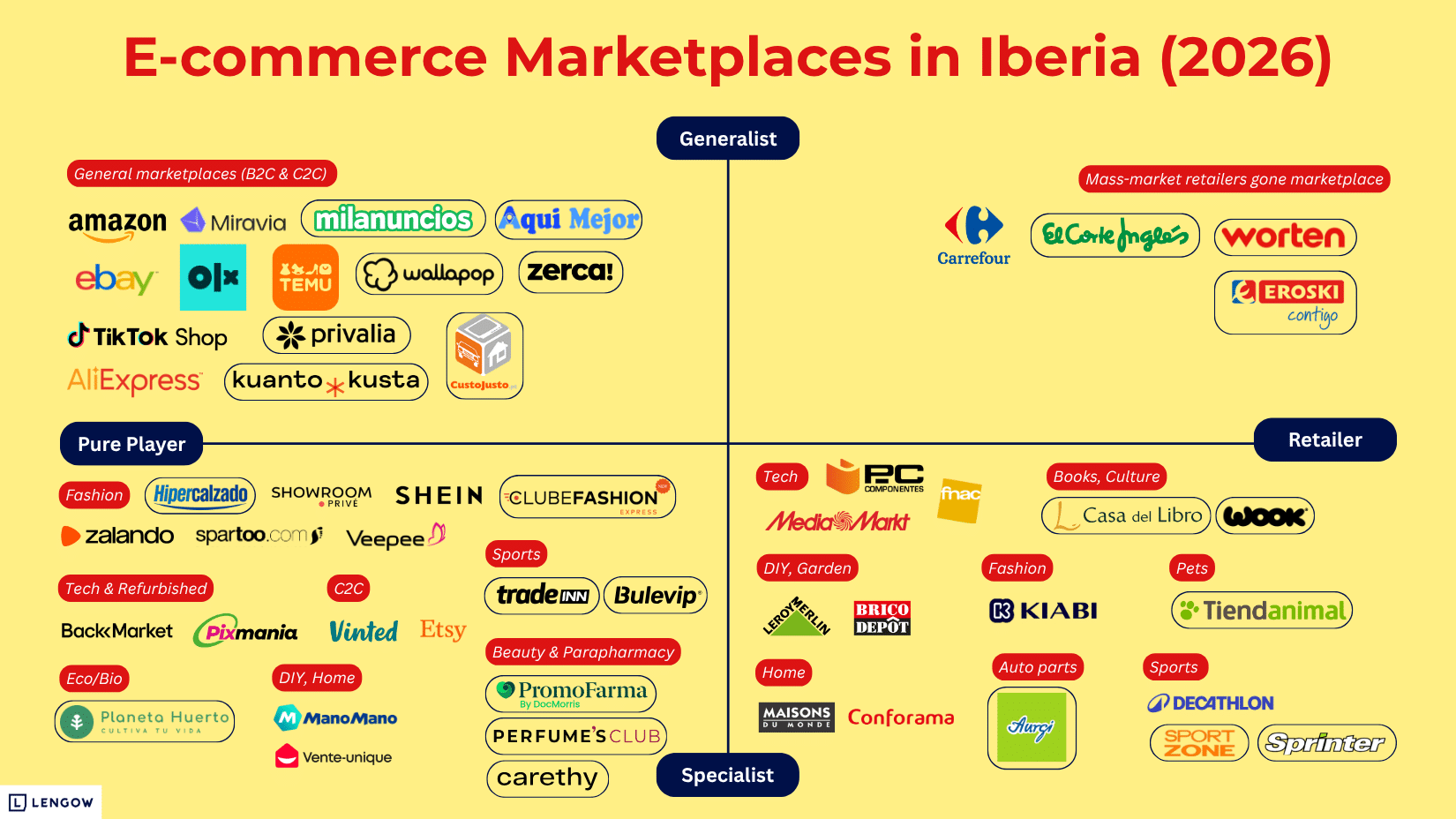
If you’re building an e-commerce strategy for Spain or Portugal, two distinct markets with their own dynamics, yet closely connected enough to be analysed together, the standard playbook is likely to mislead you. The Iberian market is not France, with its 55+ domestic platforms. Nor is it Germany, structured around Amazon. It is a rapidly transforming market, with a unique combination of highly present global players, retail chains converted into platforms, and a handful of local pure players that have built genuine category authority. That is why we created this map of Iberian marketplaces.
Reading note: on the map, the framed players are of Iberian, Spanish or Portuguese origin. This visual choice makes it possible to identify at a glance what the market has produced itself, as opposed to the international platforms that have established themselves there.
The two axes used to map marketplaces
The vertical axis ranges from “generalist” at the top (multi-category catalogue, broad audience) to “specialist” at the bottom (single vertical, expert audience). The horizontal axis ranges from “pure player” on the left (born as a marketplace, with no physical retail background) to “retailer” on the right (brick-and-mortar retailers that have opened their platforms to third-party sellers).
These axes were not chosen arbitrarily. They answer the two most structurally important questions about any marketplace: what it sells, and where it comes from. In Iberia, the answers reveal a landscape with a characteristic that few European markets share: a massive presence of Asian platforms at the heart of the generalist quadrant.
Top left: dominated by global giants, with a few local surprises
This is the most crowded quadrant on the Iberian map, and the one where it diverges most sharply from the French market. Alongside Amazon and eBay, present across all European markets, three Asian players have secured a considerable position: AliExpress, Temu and, more recently, TikTok Shop. Spain is one of the European markets where AliExpress has the strongest penetration, a cultural and commercial reality that marketplace strategies must integrate, not ignore.
Miravia is the clearest signal within this quadrant. Launched in Spain in 2022 by Alibaba Group, it represents the explicit bet of a global giant on the idea that this market lacks a high-quality, structuring generalist player. Alibaba did not choose France, Germany or Italy for this initiative. It chose Spain precisely because the landscape is different there, and potentially more open to capture.
AquiMejor is an interesting signal in this quadrant: a Spanish-born generalist marketplace covering fashion, footwear, sport and accessories, explicitly positioning itself as a domestic alternative to the foreign giants. Its about page makes a point of stating that it pays its taxes in Spain, where other international platforms do not. A still-modest player in terms of volumes, but one that illustrates the market’s appetite for a credible local generalist.
Worth noting: Hipercalzado and AquiMejor share the same operating group, based in Granada, two distinct verticals with the same Iberian DNA.
The generalist C2C segment is structured around two strong Iberian players: Wallapop (founded in Barcelona in 2013, the undisputed second-hand leader in Spain) and Milanuncios (classified ads, with a very large audience in Spain). Added to these is OLX on the Portuguese side, and Kuantokusta, a Portuguese price comparison site that has become a benchmark platform for the most price-conscious buyers in the Portuguese-speaking market. Custojusto completes the Portuguese C2C landscape alongside OLX. A classifieds platform for private sellers, it covers a broad spectrum, real estate, vehicles, electronics, fashion, and has established itself as one of the reference spaces for second-hand transactions in Portugal, a vertical that accounts for significant real-world volume in the Lusophone market.
Privalia deserves a mention in this quadrant: founded in Barcelona in 2006, it pioneered private sales in Spain before being integrated into the Veepee Group in 2018. Its trajectory illustrates a recurring pattern in this market: pure players that break through ultimately tend to be absorbed by larger groups, limiting the development of a dense independent ecosystem.
Top right: generalist retailers transitioning to the marketplace model
This quadrant aligns with what can be observed across Europe, but in Iberia it takes on a particular character.
El Corte Inglés holds a unique position. Founded in Madrid in 1940, and now one of the most powerful retail chains in Southern Europe, it represents in Spain what Galeries Lafayette represents in France, but with a far broader category coverage. Its marketplace reflects this ambition of comprehensive coverage. Its transition to the marketplace model is emblematic of the transformation taking place among the most established Iberian retailers.
Worten is the leading generalist player in Portugal, with a strong footprint in consumer electronics and household appliances, but a catalogue that now extends far beyond those categories. Its positioning is less that of a tech specialist and more that of a large general retailer for which electronics remains the main entry point. Carrefour España completes this quadrant by bringing the logic of large-scale general retail into the marketplace model, a movement visible across Europe, but one that takes on particular significance in markets where physical retail remains highly structuring.
Bottom left: specialist pure players dominated by foreign players
This quadrant best reveals what Iberia has built itself. And the conclusion is twofold: a few notable successes, but a far lower density than markets such as France.
In fashion: Zalando (European, with a strong presence in Iberia), Spartoo, Veepee, Showroom Privé and Shein. Shein deserves particular attention: its penetration in Spain is among the highest in Europe, driven by a young and highly mobile-first demographic. Its positioning within this quadrant reflects a hybrid model between marketplace and digital fast fashion.
In sport: TradeInn and Bulevip are two genuinely Iberian players, often absent from pan-European analyses, yet they have built real authority within their niches. TradeInn is a Catalan group launched in 1997, initially specialising in diving, which gradually expanded its offer to 14 sports disciplines before launching its marketplace in 2021. With €378 million in revenue and more than 360 million visitors per year across 190 countries, TradeInn operates one of the most international sports marketplaces in the Iberian market, a major advantage for merchants looking to export their catalogue beyond the peninsula. Bulevip focuses on food supplements and sports nutrition. These two players illustrate what the Iberian market can achieve when it develops true vertical depth.
In tech and refurbished goods: Back Market and Pixmania are present in the Iberian market, but both are foreign-origin players. Iberia has not yet produced its own domestic equivalent in this category.
In specialised C2C: Vinted and Etsy complete the quadrant with their respective positions, second-hand fashion for Vinted, crafts and unique creations for Etsy. Both have an active Iberian audience.
In DIY and home: ManoMano and Vente-unique. ManoMano has made Spain one of its priority markets after France, with sustained growth driven by the country’s demographic structure (high homeownership rates and an established DIY culture).
In para-pharmacy: PromoFarma (by DocMorris) and Carethy. These two players are a notable Iberian specificity, the online para-pharmacy and health vertical is far more structured in Spain than in France, partly due to favourable regulation and a strong self-medication culture. PromoFarma was founded in Barcelona before being acquired by DocMorris, while Carethy is a Spanish beauty and health marketplace. Both are essential players to include in any distribution strategy within this category.
Bottom right: specialist retailers, the most revealing quadrant
This is where the map becomes truly insightful, and where the Iberian Peninsula reveals its most interesting specificities for merchants.
Tech and electronics form a vertical structured around three complementary players. PC Componentes is the most instructive case in this entire quadrant. Founded in 2003 in Murcia, this marketplace specialising in computer components, consumer electronics and home appliances is now one of the most visited tech platforms in Spain. It has built a category authority that neither Amazon nor Media Markt have managed to take away in its field, with an average basket value between €240 and €260, making it the leader in its segment on the Iberian market. Media Markt ES/PT and Fnac ES/PT complete this trio, with well-established physical and digital presences in both countries.
Books and culture: Casa del Libro in Spain and Wook in Portugal. Two players that do not appear on any other European marketplace map, and that is precisely what makes them useful for understanding the Iberian market. Casa del Libro is Spain’s leading online bookseller, with a marketplace open to third-party sellers. Wook is its Portuguese equivalent, historically linked to the Porto Editora group. For any player in books, education or culture, these two platforms are essential.
DIY and gardening: Leroy Merlin ES/PT and Brico Dépôt ES/PT. Leroy Merlin Spain launched its marketplace via Mirakl and now offers millions of third-party references alongside its own catalogue. The DIY vertical is, as in France, one of the most advanced in the shift towards the marketplace model in Iberia.
Home and furniture: Maisons du Monde ES/PT and Conforama ES. Two key names in decoration and furniture, whose marketplaces allow them to extend their offer far beyond their own catalogues.
Fashion: Kiabi ES/PT stands out as the only fashion retailer to have built a true marketplace in the region. Its presence in Iberia is significant, driven by a competitive pricing strategy that resonates particularly strongly in these markets. In footwear, Hipercalzado rounds out the picture of Iberian specialist retailers. Founded in 2007 in Granada and converted into a marketplace in 2017, it has established itself as Spain’s go-to online destination for footwear, from trainers to winter boots, for men, women and children, with hundreds of brands listed. It represents a structured footwear vertical that few other European markets have managed to produce in the form of an independent marketplace.
Sport: Decathlon ES/PT, Sprinter and Sport Zone PT. Decathlon deserves particular attention in this market: Spain is one of its historic countries of operation, with one of the densest physical presences in Europe and a digital platform generating significant volumes. The profile of the Iberian Decathlon shopper, a regular sports practitioner focused on value for money, is one of the most qualified in the region for sports brands. Sprinter is a Spanish multi-brand sports retailer present across the peninsula, whose marketplace enables sports brands to reach an already qualified audience of practitioners. Sport Zone is its Portuguese equivalent.
Two categories that are truly specific to Iberia deserve separate mention. Automotive with Aurgi: a Spanish retailer specialising in car accessories and maintenance, whose marketplace gives access to a highly engaged customer base of vehicle owners. And pets with Tiendanimal: the leading platform dedicated to pets in Spain, with a loyal and recurring audience. The Spanish pet market is one of the most dynamic in Southern Europe, giving Tiendanimal structural growth potential that merchants in this category would be wrong to overlook.
What the map means for your strategy
Clarity: Iberian marketplaces are category-specific by design. A buyer on Leroy Merlin is actively looking for DIY products. A Decathlon customer wants sports equipment. A PC Componentes visitor is in tech-buying mode. A Tiendanimal user owns a pet and has a recurring budget. Purchase intent is built into the platform, you are not competing for attention within a generic feed.
Complexity: you cannot manage these platforms the way you manage Amazon. Each has its own onboarding requirements, content standards, commission structures and customer service expectations. Some platforms, particularly those originating from traditional retail, recommend or require customer support adapted to the local language, which implies a specific organisation for merchants selling from abroad.
The Iberian duality : Spain and Portugal share geography and commercial history, but they are two markets with their own dominant players, pricing dynamics and consumer behaviours. This distinction is critical in certain verticals (culture, food, sport…) and less decisive in others, such as tech or international fashion.
The Asian presence: AliExpress, Temu and Shein are not peripheral players in Iberia, they are at the heart of the market, with market shares that influence pricing and consumer expectations. Any Iberian marketplace strategy must integrate this reality.
Strategy: be selective. The right two or three marketplaces for your category will outperform a scattered presence across ten platforms. Map your vertical within this quadrant. Identify where your category is concentrated. Build depth before seeking breadth.
A market that rewards understanding
The Iberian Peninsula is not France. It has fewer niche specialist pure players, but a strong ecosystem of retailers converted into platforms, a structurally important Asian presence, and a handful of key local players (PC Componentes, Wallapop, TradeInn, PromoFarma, Tiendanimal) that have built defensive positions within their respective categories.
What defines this market is its duality: on one side, a strong concentration around global players (Amazon, AliExpress, Temu, Shein) that capture a significant share of volumes; on the other, a network of category-focused platforms where purchase intent is high, and where merchants who understand the local rules have a genuine structural advantage over those applying a generic pan-European playbook.
Your e-commerce library
Sign up for our newsletter
By submitting this form you authorize Lengow to process your data for the purpose of sending you Lengow newsletters . You have the right to access, rectify and delete this data, to oppose its processing, to limit its use, to render it portable and to define the guidelines relating to its fate in the event of death. You can exercise these rights at any time by writing to dpo@lengow.com

Trending Posts
Marketplaces
The Top 10 Marketplaces in Europe (2026)
The e-commerce scene is a vibrant mix of marketplaces in Europe. These aren't just websites; they're bustling hubs where millions…
02/01/26
8'
Marketing channels
ChatGPT Ads and advertising on GenAI Search Engines: what you need to know
Advertising on generative AI-based search engines (GenAI) marks a new era in digital marketing. After two decades dominated by traditional…
18/01/26
8'
Marketplaces
The French Marketplace Landscape: What Brands Need to Know
France has quietly become Europe's marketplace laboratory. Lengow's exclusive ranking reveals why traditional retailers, not tech giants, dominate the game.…
08/01/26
6'
E-commerce Trends
Google’s Universal Commerce Protocol: The End of E-Commerce as We Know It?
On January 11, 2026, at the NRF Retail's Big Show in New York, Google unveiled the Universal Commerce Protocol (UCP),…
16/01/26
6'
Marketing channels
What the World Is Unboxing on TikTok and Instagram (Haul & Unboxing Index 2025)
Opening a package on camera has become much more than simple entertainment. In 2026, "haul" and "unboxing" videos serve as…
20/01/26
7'