
Marketplaces in Germany (2026): the complete map
19/05/26
8'
Germany is the largest e-commerce market in continental Europe and also its most concentrated. Despite Amazon’s clear dominance, German specialist retailers have built a substantial marketplace cluster over the past five years. The country’s German-born pure-play marketplaces have held their ground against international pressure. And the mass-market grocery and hypermarket sector – the engine of marketplace conversion in France – has stayed almost entirely outside the model.
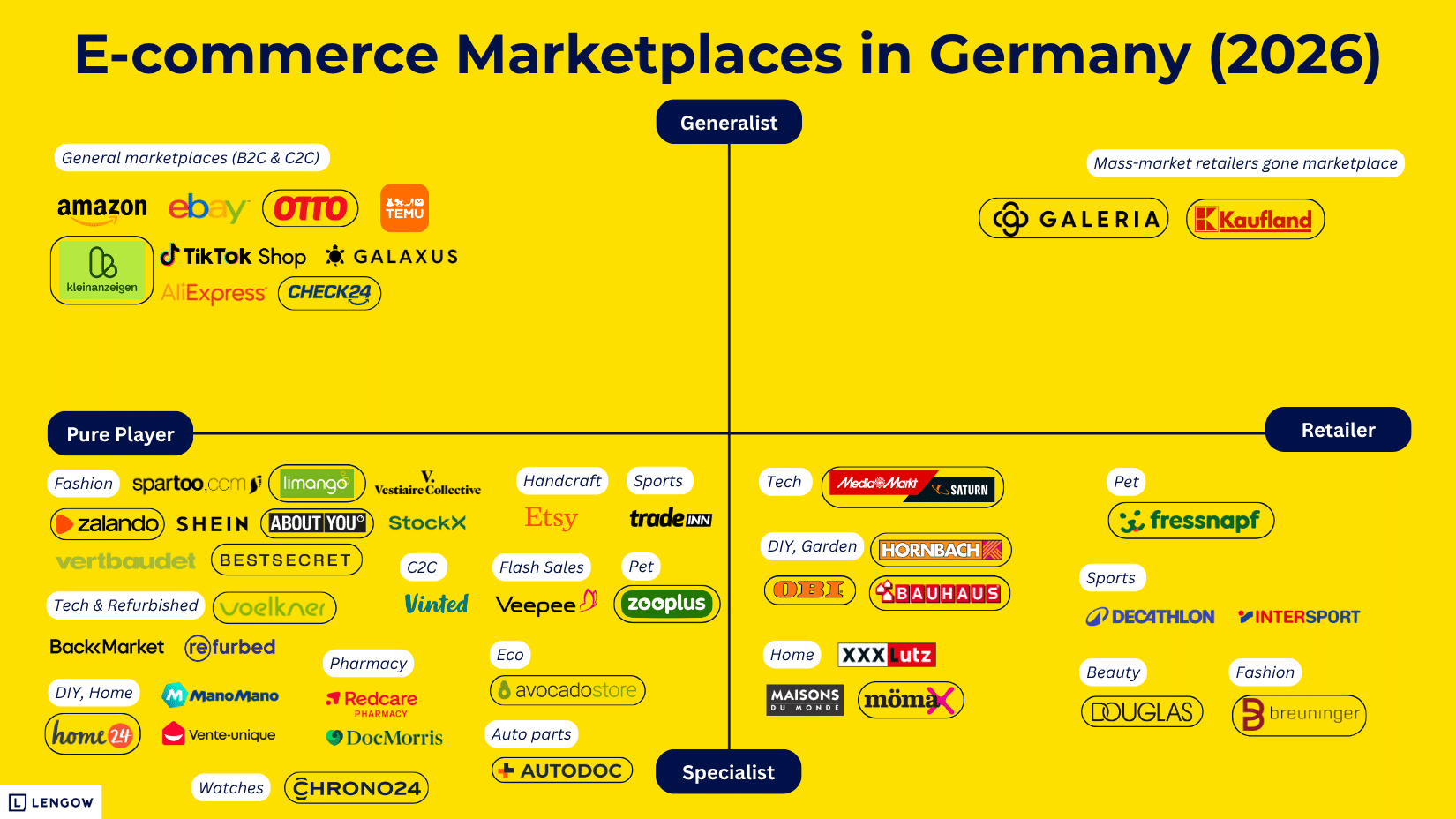
The map below covers marketplaces open to third-party sellers operating in Germany in 2026, organized along two axes: generalist versus specialist, and pure player versus retailer.
Amazon, and a tier behind it
Amazon‘s position in Germany has no European equivalent. The platform accounts for roughly 63% of German online retail according to HDE figures (the marketplace only stands at 46%). Sellers benefit from category coverage that is hard to match elsewhere, and FBA remains the default delivery infrastructure for cross-border merchants entering the country.
Behind Amazon, the tier of major generalists is led by eBay.de, which remains the long-tail and refurbished anchor of the German market, and by OTTO.de, the most important German-born generalist marketplace. OTTO reported around €7 billion in GMV for fiscal year 2024/25, with 12.2 million active customers and approximately 6,200 partners on its marketplace platform. The Hamburg group has progressively opened the platform to EU sellers and continues to grow third-party share each year, while maintaining a curated onboarding process that contrasts sharply with Amazon’s open model.
Kaufland.de, run by the Schwarz Group, has emerged as the most active pan-European generalist marketplace below the top three. The platform inherited Real.de’s marketplace business in 2020 and has since expanded its cross-border offering to several European markets.
International challengers have rapidly built positions of their own. Temu reached approximately $2.6 billion in GMV in Germany by 2024, making it the fourth-largest marketplace in the country. AliExpress has strengthened its position. Shein continues to expand beyond fast fashion into home and beauty. TikTok Shop launched in Germany in April 2025 and is gaining traction in fashion and lifestyle.
The platform with the broadest reach in Germany is not strictly a commerce marketplace but functions as one for a large share of the population: Kleinanzeigen. The general-goods classifieds platform – formerly eBay Kleinanzeigen, rebranded in May 2023 after Adevinta’s acquisition completed – records around 700 million monthly visits and 36 million monthly users, with more than 55 million ads live at any time. The platform remains predominantly C2C, with around 1% of sellers operating as commercial traders through its Kleinanzeigen PRO offering. Even at that ratio, it sits among the most-visited retail platforms in Germany alongside Amazon and eBay.
A German-born pure-play heritage
What stands out on the German map is the persistence of the country’s home-grown pure players. Zalando, founded in Berlin in 2008, remains the dominant European fashion marketplace with 52.4 million active customers across the continent. In January 2025, the group completed its acquisition of About You (the Hamburg-based fashion platform) bringing both brands under the same group, though About You continues to operate independently with a distinct positioning toward younger, mobile-first audiences.
Otto Group’s marketplace ambitions extend well beyond OTTO.de. Limango, founded in 2007 and now part of the group, operates a curated marketplace focused on families and young parents with around two million unique users per month. The combined Otto Group footprint – OTTO, Limango, About You-adjacent ventures – represents the most coherent counterweight to Amazon in Germany.
The pure-player segment includes other German-born platforms with sustained scale. BestSecret, the Munich-area invite-only fashion club, operates a curated members-only platform for premium and luxury off-price fashion that has attracted significant partner interest. Avocadostore, based in Hamburg, has built Germany’s largest dedicated eco-fashion and sustainable lifestyle marketplace, with more than 70,000 products from over 1,000 brands.
In home and living, Home24 (founded in Berlin and now owned by Austrian XXXLutz) operates a curated Mirakl-based marketplace that complements its private-label assortment. Zooplus, the Munich pet-supplies pure player that ranks among Europe’s largest, launched its third-party marketplace in November 2025 via Mirakl. Autodoc, the Berlin-based auto parts retailer, launched its marketplace in Germany and Austria in August 2025; by the end of the year it had attracted around 440 sellers and 1.2 million live offers.
The mass-market gap
The most distinctive feature of the German map is what is missing from the top-right quadrant. Across all of Germany’s mass-market retailers – Edeka, Rewe, Aldi, Lidl, Netto, Penny, etc. – only two operate marketplaces open to third-party sellers: Kaufland (already counted as a pure-play-led generalist), and Galeria, the department store chain that returned to profitability in fiscal 2025 after years of restructuring.
This is unusual in the European context. In France, country’s major mass-market retailers (Carrefour, Auchan, E.Leclerc, Intermarché, etc.) run third-party marketplaces, mostly powered by Mirakl. Germany’s mass-market retailers have made a different choice. Aldi and Lidl have built their reputations on tight 1P assortment control and are not diluting it. Edeka and Rewe operate decentralized cooperative structures that make a single national marketplace organizationally difficult. Tchibo, often associated with marketplace experimentation, was confirmed at 100% first-party in 2025 by ECDB data.
This is the single most consequential structural fact about the German marketplace map. Selling broad consumer assortments in Germany without going through Amazon, eBay, OTTO, or Kaufland is harder than in any other major European market, because the retailer-led alternative tier – large supermarket and hypermarket marketplaces – does not exist.
Where Germany built a marketplace cluster: specialist retailers
The opposite is true at the specialist end. Germany has built one of Europe’s most substantial clusters of specialist retailer marketplaces, particularly in categories where logistics for bulky or complex goods rewards trusted retail brands.
In DIY and home improvement, the marketplace conversion is now structural. OBI runs a Mirakl marketplace covering Germany and Austria. Hornbach operates a Mirakl-based marketplace; first-party still dominates the GMV mix, but the third-party share is growing each year. Bauhaus joined the category most recently, launching its marketplace in January 2026, making it the latest major DIY entrant to convert.
Consumer electronics is dominated by MediaMarktSaturn. The Ceconomy group’s marketplace draws around 65 million monthly visitors across MediaMarkt and Saturn brands and runs an explicit Become-a-seller program.
Beauty is anchored by Douglas, the Düsseldorf prestige-beauty chain, which operates one of the best-known Mirakl marketplaces in Europe. Decathlon, while French-owned, is one of the largest sports retailers in Germany and operates a third-party marketplace there. Pet retailer Fressnapf runs a marketplace with 6% third-party GMV in 2025 – still first-party-dominant, but a confirmed marketplace.
Furniture is the deepest specialist retailer category by number of marketplace platforms. XXXLutz, the Austrian group that has aggressively expanded into Germany – most recently with its 2024 acquisition of the Porta Group and its 140 German, Czech, and Slovak stores – operates a marketplace launched in August 2023. Its discount sister brand Mömax runs on the same infrastructure. Maisons du Monde, French-origin, opened its marketplace to the German market in 2020 and now sees roughly 35% of its online sales flowing through the marketplace model.
Premium fashion completes the cluster. Breuninger, the Stuttgart department store chain founded in 1881, runs Germany’s number-two premium fashion marketplace behind Zalando – with €1.17 billion in online revenue in 2025 and a clear focus on curated luxury and contemporary brands.
Specialist pure players and category challengers
The pure-player side of the specialist quadrant adds further depth.
In refurbished electronics, Refurbed – Austrian-founded and now market leader in Germany – holds a slight edge over Back Market. Both operate at scale and represent the two anchors of the German refurbished category. Voelkner, the B2C arm of the Conrad Group, runs a marketplace for electronics and household products with around 470,000 monthly active users.
In fashion, Spartoo (French, footwear-focused), Vertbaudet (French, children’s) and Veepee (French, flash sales) all operate marketplace channels in Germany. Veepee’s “Brandsplace” – a brands-only marketplace layered onto its core flash-sale business – launched in Germany in 2023 alongside Benelux, and third-party already represented 24% of the group’s GMV by 2024.
In home, Vente-Unique, the French furniture pure player listed on Euronext Growth, opened its marketplace in 2022 and operates in Germany. In sports, TradeInn – the Spanish multi-store group including Tradeinn, Bikeinn, Snowinn and others – has built a growing German customer base. In DIY, ManoMano remains active in Germany, though its market share has reportedly declined in recent years.
The C2C and handcraft segment is anchored by three foreign-origin platforms: Vinted (Lithuanian, second-hand fashion, structurally dominant in Germany), Etsy (US, handmade) and Kleinanzeigen on the generalist side. Galaxus, the Swiss generalist owned by Migros and the leading marketplace in Switzerland, launched its German marketplace operation in 2023 and has continued to expand its category coverage.
CHECK24, the Munich-based price-comparison portal, is the only German price-comparison platform with an integrated and still-operating third-party marketplace (for fashion since 2019 and home & living since 2017). Idealo Direktkauf, the previous German equivalent, was discontinued at the end of 2022.
Two German pharmacy marketplaces, both now foreign-headquartered
The pharmacy category on the German map has an unusual structure. Redcare Pharmacy (the rebrand of Shop Apotheke) was founded in Cologne in 2001 and is now headquartered in the Netherlands. DocMorris, the country’s other major online pharmacy marketplace, was founded in Aachen in 2000 and is now headquartered in Switzerland following its parent company’s renaming from Zur Rose Group to DocMorris AG. Both operate active third-party marketplaces – Redcare runs a curated Mirakl platform, DocMorris a dedicated partner program with more than 1,500 partner pharmacies and sellers across Europe – and together they form the structural anchors of the German online pharmacy market.
The German-born, foreign-HQ pattern is worth noting because it appears elsewhere on the map too. Home24’s parent is now Austrian XXXLutz. The pattern reflects the fact that German marketplace-grade pure players have proved attractive acquisition targets for foreign retail groups.
What the German map tells us
Three things stand out when the map is read as a whole.
- The first is Amazon’s depth of dominance. At 63% of German online retail, the platform has a position that no European peer matches. Any cross-border seller’s German strategy begins with Amazon, regardless of which secondary marketplaces are added.
- The second is the missing tier of mass-market retailer marketplaces. Germany’s marketplace landscape lacks the alternative tier of supermarket and hypermarket platforms that anchors the French map. For sellers, this means broad consumer assortments have fewer credible non-Amazon routes to the German shopper than in France or even Iberia.
- The third is the depth of specialist retailer conversion. Where Germany has built marketplace muscle is in specialist retail: DIY, electronics, beauty, pet, sports, furniture, premium fashion. The specialist cluster is one of the largest in Europe, and the conversion wave is still in progress, with Bauhaus, Zooplus and Autodoc joining in 2025–2026 alone.
For brands and retailers considering Germany, the implication is concrete. Beyond the unavoidable Amazon and eBay starting point, the highest-leverage marketplace opportunities sit in specialist retailer conversion: a small number of category-specific platforms with strong brand equity, professional buyer audiences and shared technical infrastructure that simplifies multi-platform expansion.
The German marketplace map of 2026 looks less like a one-platform market than the topline numbers suggest. It looks like a marketplace economy with one dominant generalist, a deep specialist retailer cluster and a structurally absent middle.
Your e-commerce library
Clarins x NetMonitor Success Story
Learn moreSuccess on Marketplaces
Learn moreCompetitive Intelligence
Learn moreSign up for our newsletter
By submitting this form you authorize Lengow to process your data for the purpose of sending you Lengow newsletters . You have the right to access, rectify and delete this data, to oppose its processing, to limit its use, to render it portable and to define the guidelines relating to its fate in the event of death. You can exercise these rights at any time by writing to dpo@lengow.com

Trending Posts
Marketplaces
The Top 10 Marketplaces in Europe (2026)
The e-commerce scene is a vibrant mix of marketplaces in Europe. These aren't just websites; they're bustling hubs where millions…
02/01/26
8'
Marketing channels
ChatGPT Ads and advertising on GenAI Search Engines: what you need to know
Advertising on generative AI-based search engines (GenAI) marks a new era in digital marketing. After two decades dominated by traditional…
18/01/26
8'
Marketplaces
The French Marketplace Landscape: What Brands Need to Know
France has quietly become Europe's marketplace laboratory. Lengow's exclusive ranking reveals why traditional retailers, not tech giants, dominate the game.…
08/01/26
6'
E-commerce Trends
Google’s Universal Commerce Protocol: The End of E-Commerce as We Know It?
On January 11, 2026, at the NRF Retail's Big Show in New York, Google unveiled the Universal Commerce Protocol (UCP),…
16/01/26
6'
Marketing channels
What the World Is Unboxing on TikTok and Instagram (Haul & Unboxing Index 2025)
Opening a package on camera has become much more than simple entertainment. In 2026, "haul" and "unboxing" videos serve as…
20/01/26
7'