

Italian e-commerce marketplaces (2026): the complete map
15/05/26
8'
If you’re building an e-commerce strategy for the Italian market, or planning your entry into it, it is crucial to map all online marketplaces beforehand. Italy is the fourth-largest e-commerce market in Europe, with strong consumer demand and a well established retail culture. But the marketplace ecosystem behind that demand is structured differently from anything else on the continent. It’s the third European market Lengow has mapped this year, after France and Iberia, and it’s, maybe, the most surprising of the three.
That’s why we built this map of Italian marketplaces.
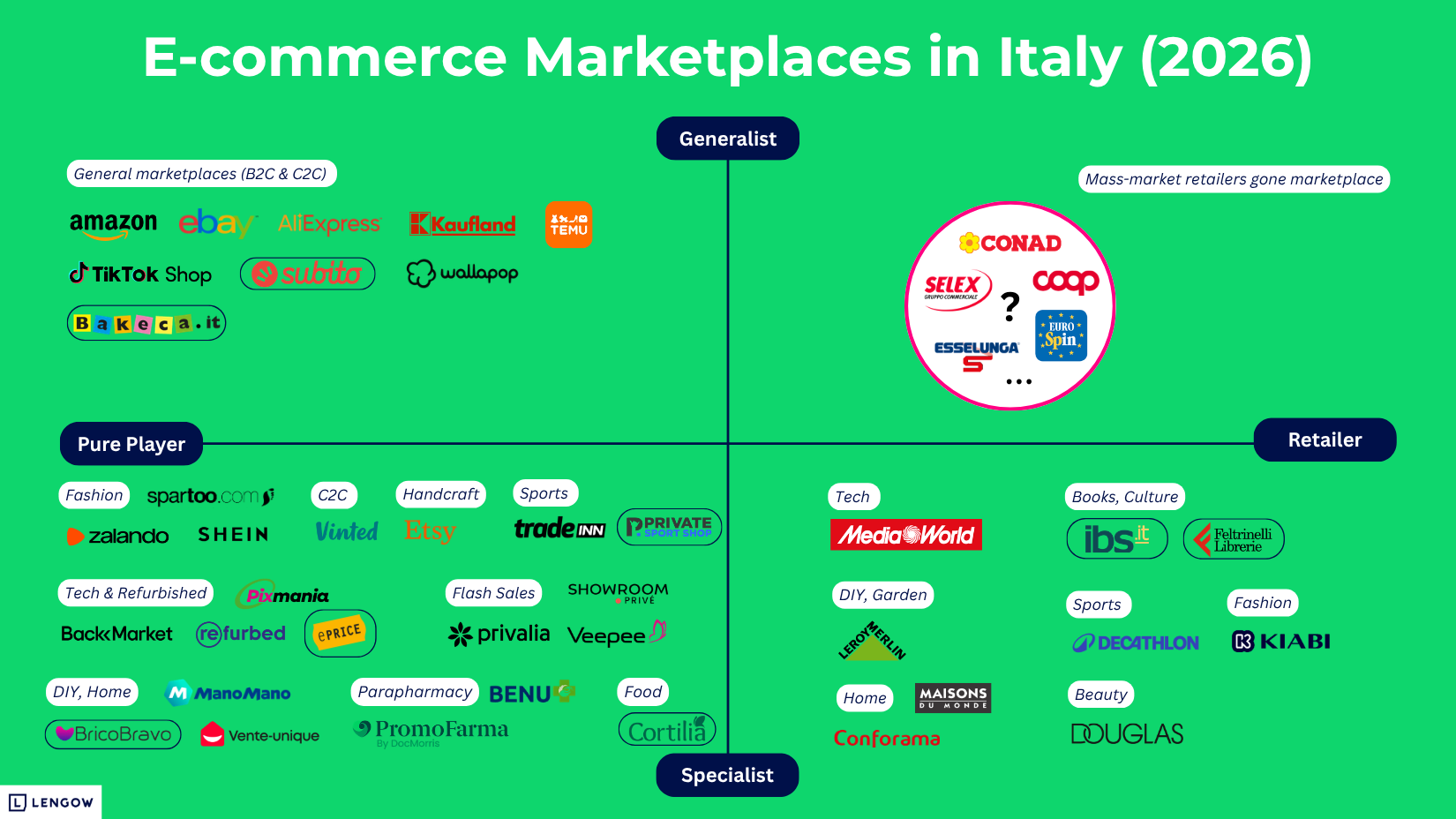
Reading note: on the map, the framed players are of Italian origin. This visual choice makes it easy to distinguish what the local market has produced from the international platforms that operate there.
The two axes to map marketplaces
The vertical axis runs from Generalist at the top (broad, multi-category catalogue) to Specialist at the bottom (single vertical, expert audience). The horizontal axis runs from Pure Player on the left (born as a e-commerce or marketplace, no physical retail history) to Retailer on the right (brick-and-mortar chains that opened their platforms to third-party sellers).
These axes cut to the two most structurally important questions about any marketplace: what it sells, and where it came from. And in Italy, the answers reveal a market built around imported generalists, a small group of vertical specialists, and a striking absence in one specific corner of the map.
Top-left: where Italian e-commerce happens
The generalist quadrant on the Italian map is where the country’s real shopping behaviour concentrates.
Amazon, eBay, AliExpress, Temu, etc. dominate the global side. As in Iberia, the Asian platforms are not peripheral here. Temu’s penetration in Italy has grown sharply since 2023, AliExpress remains a reference for price-sensitive buyers, and TikTok Shop’s gradual European rollout is reaching Italian consumers through the same demographic pattern observed elsewhere: young, mobile-first, social-commerce-driven. Kaufland completes the foreign generalist line-up, extending its multi-category offer from Germany.
The Italian C2C cluster is one of the strongest in Europe. Subito, founded in 2007 and now operated by Adevinta Italia, is the historical leader: cars, electronics, fashion, real estate, jobs – a true multi-category classifieds platform with deep penetration in every Italian region. Alongside it sits Bakeca.it, founded in Turin in 2002, smaller but Italian-owned and rooted in local commerce. Wallapop, the Spanish second-hand app, launched in Italy in September 2021 and has crossed six million Italian users, with transactions up 124% year-on-year in 2024. Vinted complements the picture on the fashion-specific C2C side.
Italian consumers have adopted second-hand and peer-to-peer commerce at a scale that places this segment among the most active in Europe, with no equivalent dynamic on the retailer side.
Top-right: the most striking absence on the map
This is where Italy diverges most sharply from France.
In France, mass-market retail converted to marketplace at scale. Carrefour, E.Leclerc, Auchan, Intermarché – all running Mirakl-powered platforms open to third-party sellers. In Italy, the same conversion has not happened.
Conad (Italy’s largest grocery distributor, around 15% market share), Selex (around 14.7%), Coop Italia, Esselunga and Eurospin (the country’s largest hard-discount chain, founded in Verona in 1993, with more than 1,200 stores across Italy, Slovenia, Croatia and Malta) all operate active e-commerce sites. None of them runs a marketplace open to third-party sellers. Unieuro, the country’s leading consumer electronics chain, acquired by Fnac Darty in 2024, announced a marketplace as part of its 2025-2030 strategic plan. The platform has not yet launched.
The implication is concrete. The marketplace conversion path that defines French retail, and that gave France eight retailer-marketplaces in its top ten, has not been reproduced in Italy. Whether this stems from structural caution, regulatory complexity, the cooperative nature of several leading retailers (Conad, Coop, Selex are all cooperative structures), or simply a different competitive logic, the result is visible on the map: the top-right quadrant is essentially empty.
Bottom-left: the specialist pure players
This quadrant is where Italian e-commerce becomes more interesting, but also where the international footprint remains heavy.
Fashion is led by foreign players: Zalando (Germany), Spartoo (France) and SHEIN (China). Italy’s most internationally visible fashion marketplace experiment, YOOX, founded in Bologna in 2000 by Federico Marchetti and listed on Borsa Italiana in 2009, closed its three-year-old third-party seller programme on 10 February 2025 as parent company YNAP unwound under LuxExperience (the new name of Mytheresa after the April 2025 acquisition). YOOX continues to operate as a 1P off-price retailer, but its marketplace chapter is closed. That closure removes from the map what would otherwise have been Italy’s flagship domestic fashion marketplace.
Tech and refurbished goods: Back Market (France) and Refurbed (Austria, present in Italy as one of twelve European markets) operate as the two leading refurbished electronics marketplaces, alongside Pixmania. ePrice, founded in Milan in 2000, is the Italian historical reference in tech, with a marketplace component developed progressively over the past decade.
Sports: TradeInn, the Catalan group that has built one of the most international sports marketplaces in Europe, ships as well across Italy. Private Sport Shop, the French sports flash-sales platform now part of Sportscape Group, operates a localised Italian site with a strong member base.
Flash sales: Veepee, Privalia (acquired by Veepee in 2016) and Showroom Privé all operate in Italy. Their multi-category flash sales model anchors fashion-and-lifestyle commerce for Italian consumers attracted by branded products at reduced prices.
DIY and home: ManoMano has built a presence in Italy alongside Vente-unique (home and furniture). BricoBravo, the Italian DIY pure player with roots in a Milanese ferramenta founded in 1959, completes this cluster as the local representative.
Other verticals: Etsy for handmade and vintage. PromoFarma by DocMorris in parapharmacy, originally Spanish, now part of the DocMorris group. Cortilia, the Italian online grocery platform founded in Milan in 2011, operates a curated marketplace model for local food and farm producers, one of the rare Italian-origin specialist platforms in food.
Bottom-right: where international retailers dominate
Italy’s specialist retailer quadrant is structured around international players, with a smaller share of domestic anchors than in France for example.
Tech: MediaWorld, the Italian brand of the MediaMarktSaturn group (the same group that operates Media Markt in Spain and Germany), launched its marketplace via Mirakl in July 2024, backed by a €100 million investment in digital transformation. It now operates as Italy’s leading consumer electronics retailer-marketplace.
Books and culture: this is the strongest Italian-origin cluster in the entire quadrant. IBS.it (Internet Bookshop Italia), founded in 1998 as the country’s pioneering online bookstore, runs a marketplace covering books, music, film and stationery. Feltrinelli Librerie, the historic Milanese bookseller founded in 1957 by Giangiacomo Feltrinelli, complements IBS.it with its own digital marketplace covering books and cultural products. Together they form the most distinctive Italian-origin pair on the map.
DIY and garden: Leroy Merlin Italia (Adeo Group, France) operates one of the largest retailer-marketplaces in the Italian DIY space, with thousands of third-party references added to its own catalogue. As in Iberia, the DIY vertical is one of the most advanced in marketplace conversion across Italian retail.
Sports: Decathlon Italia runs the country’s reference sports retailer-marketplace, supported by one of the densest physical-store networks in Italy and a digital platform that has progressively opened to third-party brands.
Fashion: Kiabi, the French family-fashion retailer present in Italy since 1996 with 40 stores across twelve regions, anchors the fashion retailer position.
Home: Maisons du Monde Italia and Conforama Italia (now under Bricofer ownership in Italy since 2024) cover the furniture and home decoration vertical.
Beauty: Douglas, the German group, operates a marketplace across its Southern European footprint, including Italy where it counts around 500 stores acquired through the Limoni and La Gardenia chains.
What this map reveals about Italy
A few patterns stand out when you look at the full picture.
Italy’s marketplace ecosystem is heavily imported
Of the visible brands on the map, the large majority are of non-Italian origin. The Italian-framed players – Subito, Bakeca.it, BricoBravo, ePrice, IBS.it, Feltrinelli, Cortilia – concentrate in specific verticals (C2C, books, DIY, food) where local cultural attachment and category specificity give them defensive positioning.
The retailer-marketplace conversion that defines France has not happened
Italian mass-market retailers run e-commerce. None has yet opened to third-party sellers at scale. The visual effect on the map is unmistakable: the top-right quadrant is empty, with a big questionmark.
Italy lost its flagship marketplace
YOOX, the country’s most internationally visible marketplace experiment, was shut down in February 2025 after three years of operation. That closure removes from the Italian map what would have been its most globally recognised domestic platform, and underscores how difficult marketplace scale has been to build and sustain in this market.
B2B marketplaces are emerging where B2C marketplaces have not
Outside the scope of this map (which focuses on B2C and C2C), Italy has seen meaningful B2B marketplace launches in recent years: METRO Italia’s Mercato Online (2022), Conrad Italia (2023) and RETIF Italia (2025), among others. The energy that French and Iberian retailers channelled into consumer-facing marketplaces appears, in Italy, to be flowing partly into business procurement instead.
What this means if you’re selling in Italy
Clarity: Italian marketplaces are concentrated in specific categories. A buyer on IBS.it is looking for books. A Leroy Merlin Italia visitor wants DIY supplies. A Decathlon Italia shopper is in sports-purchase mode. A Cortilia user wants curated local food. Purchase intent is built into each platform, you are not competing for attention in a generic feed.
Complexity: the thin retailer-marketplace layer means brands selling in Italy have fewer “open” platforms to plug into than in France or Iberia. Selection matters more. The wrong platforms cost more time than the right ones save.
The international layer: Amazon, eBay, AliExpress, Temu, Zalando are structural platforms in Italy. Any Italian marketplace strategy starts there, then layers domestic specialists where category fit justifies it.
Strategy: be selective and be category-led. Italy rewards depth in the verticals where consumer demand and platform infrastructure coincide, books, sports, DIY, beauty, refurbished tech, second-hand commerce, food. Across those verticals, a small set of well-chosen platforms can deliver disproportionate reach.
Your e-commerce library
Clarins x NetMonitor Success Story
Learn moreSuccess on Marketplaces
Learn moreCompetitive Intelligence
Learn moreSign up for our newsletter
By submitting this form you authorize Lengow to process your data for the purpose of sending you Lengow newsletters . You have the right to access, rectify and delete this data, to oppose its processing, to limit its use, to render it portable and to define the guidelines relating to its fate in the event of death. You can exercise these rights at any time by writing to dpo@lengow.com

Trending Posts
Marketplaces
The Top 10 Marketplaces in Europe (2026)
The e-commerce scene is a vibrant mix of marketplaces in Europe. These aren't just websites; they're bustling hubs where millions…
02/01/26
8'
Marketing channels
ChatGPT Ads and advertising on GenAI Search Engines: what you need to know
Advertising on generative AI-based search engines (GenAI) marks a new era in digital marketing. After two decades dominated by traditional…
18/01/26
8'
Marketplaces
The French Marketplace Landscape: What Brands Need to Know
France has quietly become Europe's marketplace laboratory. Lengow's exclusive ranking reveals why traditional retailers, not tech giants, dominate the game.…
08/01/26
6'
E-commerce Trends
Google’s Universal Commerce Protocol: The End of E-Commerce as We Know It?
On January 11, 2026, at the NRF Retail's Big Show in New York, Google unveiled the Universal Commerce Protocol (UCP),…
16/01/26
6'
Marketing channels
What the World Is Unboxing on TikTok and Instagram (Haul & Unboxing Index 2025)
Opening a package on camera has become much more than simple entertainment. In 2026, "haul" and "unboxing" videos serve as…
20/01/26
7'