



Live commerce in Europe: one channel is carrying the market
27/05/26
6'
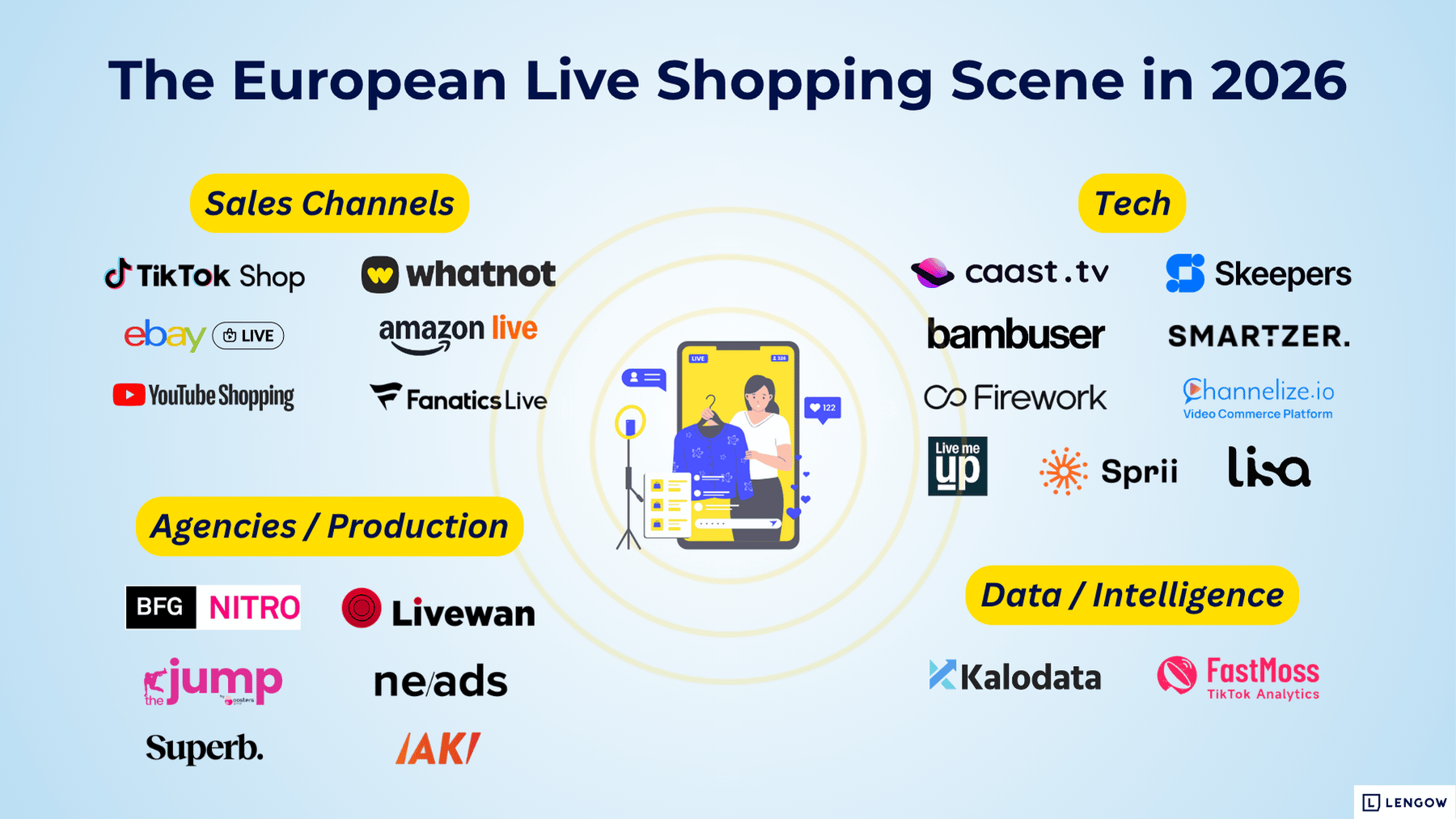
We mapped the players selling through live video in Europe. The map tilts hard toward TikTok Shop. That tilt isn’t a gap in our research. On the contrary, it’s the most honest thing the map says about the market.
For a few years the verdict on live shopping in the West was that it had flopped. Half of that is right. After the Covid spike, the format went quiet, and “interesting, but it never really took off” became the default reaction in most e-commerce conversations.
What that verdict missed is that the format never stopped working. Retailers kept running lives on their own sites, quietly and with real craft. Carrefour streamed wine-fair sessions and a first oenology class that pulled 9,000 to 15,000 viewers across three one-hour shows, with around 3,000 people watching at once, and reported several tens of thousands of euros in sales once replays were counted. Key retail players such as Fnac-Darty, Boulanger, Cdiscount, Leroy Merlin, Sephora and Clarins all ran their own programmes. But the revenue was rather modest.
That gap, real audiences but small numbers, is the whole story. A live on your own website caps your reach at the people who already came to your site. Strong production and a good CRM don’t move that ceiling. You’re asking customers to show up at a set time to watch you sell, while competing with the entire internet for their evening. It doesn’t scale, and it was never going to.
The supply side contracted instead of booming
The companies built to power a live shopping boom mostly consolidated. Spockee, the French pioneer, was absorbed into Skeepers. Klarna ran live and virtual shopping for a while, then sold the underlying Hero technology to Bambuser and shut its own service down. iAdvize, which had bought the live shopping startup Aploze in 2021, moved its entire product to generative AI and quietly dropped live. Voggt, Europe’s leader in live card and collectible auctions, was acquired by Fanatics Live. Bambuser, the Stockholm enabler, ended up as the consolidator of the European tech layer rather than one player among many.
One clarification on Meta, since it always comes up. It killed live shopping on Facebook and Instagram in 2022 and 2023 and hasn’t brought it back. Its 2026 return to social commerce runs through creator-affiliate tagging in Reels, with checkout still happening off-platform. That’s adjacent to live shopping, not the same thing.
So the picture by early 2026 is a format that works, an owned-site model that found its ceiling, and a tech layer that shrank to a handful of survivors.
What actually scaled
One channel broke the pattern, and it’s TikTok Shop. It’s live across several European markets, with live shopping built into the app and hundreds of selling sessions a day. The mechanism is what makes the difference. TikTok didn’t build a storefront and ask people to come browse it. It built a creator-affiliate engine where large numbers of creators recommend products mid-video and earn a commission on every sale. In Germany, where TikTok Shop reportedly cleared around €700 million in its first year and now ranks among the country’s top 15 e-commerce players, industry estimates put roughly 87% of top-store revenue on creator-made videos. TikTok then raised its seller commission from 5% to 9% across most European markets in January 2026, which reads as confidence rather than retreat.
The second model that works is the marketplace and community format. Whatnot reported more than $8 billion in live GMV in 2025, more than double the year before, and now operates in the UK, France, Germany, the Netherlands, Belgium and Austria. eBay Live launched in the UK in February 2025 and in Germany at the end of that year. Fanatics Live, built on the Voggt acquisition, is scaling card and collectible auctions across the continent. None of these is a brand running a show on its own homepage. They’re commerce-native destinations where the audience and the checkout already sit in the same place.
TikTok Shop as the only driver?
The most useful signal on our map is in the layers most people skim past.
The channel layer is very mixed: TikTok Shop, Amazon Live, YouTube Shopping, Whatnot, eBay Live and Fanatics Live. The tech layer is mixed too, and notably not bound to TikTok at all, since Bambuser, Caast.tv, Skeepers, Smartzer, Sprii, Channelize, Firework and Live Me Up mostly serve owned-site and multichannel video for brands.
The agencies and the data tools point somewhere narrower. The specialist agencies, BFG Nitro in Germany, Neads and Livewan in France, Superb in the UK, The Jump in Spain, are overwhelmingly set up to run TikTok Shop lives. The data layer is starker still: Kalodata and FastMoss are pure TikTok Shop analytics, and there’s no credible third-party equivalent for Whatnot, eBay Live or Amazon Live, where you’re left with whatever the platforms choose to publish.
When both the services money and the intelligence money pool around a single channel, that’s where the selling is actually happening. A services economy forms around revenue. The concentration in those two layers is the clearest evidence on the map that, for now, TikTok Shop is the driver and most of the rest is either feeding it or waiting.
Where this leaves brands
The format works. That part is settled, clearly in Asia and increasingly through TikTok Shop in Europe. What’s unsettled is whether anything beyond TikTok Shop reaches real scale here. The owned-site route has hit its ceiling and will stay a retention tactic rather than a growth channel. The marketplaces, Whatnot first among them, are the second pole worth watching, and the likeliest place for a surprise in a vertical such as vintage fashion, wine or collectibles.
For a brand deciding where its live commerce budget goes in 2026, the map gives a blunt answer. Distribution comes first, and right now distribution means TikTok Shop, with the community marketplaces as the hedge worth testing early.
Whichever channel a brand backs, the first job is the same: get an accurate product catalogue into it, with prices, stock, attributes and images mapped to that channel’s rules. That’s a feed problem before it’s a content problem, and it’s where Lengow sits. Lengow connects a brand’s catalogue to the channels on this map and to the on-site enablers behind live, with active feeds on TikTok Shop (Darty, etc.), on Caast.tv and Skeepers.
The speed shows. When TikTok Shop opened in France, Darty went live in 40 days rather than the usual four to six months for a new channel, with Lengow pulling its catalogue and pushing separate offer and product feeds into the platform. Multiple sellers running through Lengow have averaged a €64.40 basket on TikTok Shop in its first year.
Your e-commerce library
Clarins x NetMonitor Success Story
Learn moreSuccess on Marketplaces
Learn moreCompetitive Intelligence
Learn moreSign up for our newsletter
By submitting this form you authorize Lengow to process your data for the purpose of sending you Lengow newsletters . You have the right to access, rectify and delete this data, to oppose its processing, to limit its use, to render it portable and to define the guidelines relating to its fate in the event of death. You can exercise these rights at any time by writing to dpo@lengow.com

Trending Posts
Marketplaces
The Top 10 Marketplaces in Europe (2026)
The e-commerce scene is a vibrant mix of marketplaces in Europe. These aren't just websites; they're bustling hubs where millions…
02/01/26
8'
Marketing channels
ChatGPT Ads and advertising on GenAI Search Engines: what you need to know
Advertising on generative AI-based search engines (GenAI) marks a new era in digital marketing. After two decades dominated by traditional…
18/01/26
8'
Marketplaces
The French Marketplace Landscape: What Brands Need to Know
France has quietly become Europe's marketplace laboratory. Lengow's exclusive ranking reveals why traditional retailers, not tech giants, dominate the game.…
08/01/26
6'
E-commerce Trends
Google’s Universal Commerce Protocol: The End of E-Commerce as We Know It?
On January 11, 2026, at the NRF Retail's Big Show in New York, Google unveiled the Universal Commerce Protocol (UCP),…
16/01/26
6'
Marketing channels
What the World Is Unboxing on TikTok and Instagram (Haul & Unboxing Index 2025)
Opening a package on camera has become much more than simple entertainment. In 2026, "haul" and "unboxing" videos serve as…
20/01/26
7'