.png?width=48&height=48&name=Adrian%20(1).png)
Contents
E-commerce Multichannel Marketing: The Questions You Should Ask Yourself
Key Steps To Follow For Your Marketing Strategy
What Are the Acquisition Channels To Consider?
Social Commerce: Key For Every E-commerce Marketing Strategy
Make Sure Your Marketing Strategy Is Data-Driven
Example: Data-Driven Google Marketing Campaigns
Marketing Automation: A No-Brainer
Examples of Successful Multichannel Marketing Strategies
Multichannel Marketing Strategy FAQs
E-commerce Multichannel Marketing: The Questions You Should Ask Yourself
Before developing a marketing strategy, it is important to ask yourself a few key questions. While this may not always be easy, taking the time to reflect on these questions will help you refine your strategy and create a more effective campaign:- Who is your target audience and how can you tailor your messaging and approach to their specific needs and interests?
- What is your marketing campaign goal (e.g., increase brand awareness, generate leads, drive traffic and sales)?
- What is your budget and which acquisition channels are feasible for your business?
- How will you reach your audience (e.g., through product ads, email marketing, affiliation, etc.)?
- What is your unique value proposition and how can it differentiate your business and make a strong impression on potential customers?
- How can I reach new customers?
- How can I test new marketing acquisition channels?
- How can I provide an optimized customer experience across all channels?
- How can I improve my key performance indicators (KPIs) while managing acquisition costs and limited budgets?
Key Steps To Follow for Your Marketing Strategy
Once you have answered the questions above, it is time to begin implementing your strategy to drive more traffic to your e-commerce website and increase your sales. Some key steps to follow include:- Identify your buyer personas: Understanding who your customers are and which channels they are most likely to use will help you effectively reach and engage them. This may involve conducting market research and analyzing customer data.
- Develop a clear marketing message: Your message should be consistent across all channels and should clearly communicate the value and benefits of your products or services.
- Select the right channels: Once you know your target audience and have developed a clear marketing message, choose the channels that are most likely to reach and engage them. This could include social media, search engines, and retargeting.
- Create a content plan: Such a plan will help you promote your products and services on multiple channels. Include details on the type of content, sharing schedule and responsibilities.
- Measure and optimize: Regularly measure and analyze the performance of your multichannel marketing strategy to see what's working and what's not. This will allow you to make adjustments and optimize your strategy for better results.
What Are the Acquisition Channels To Consider?
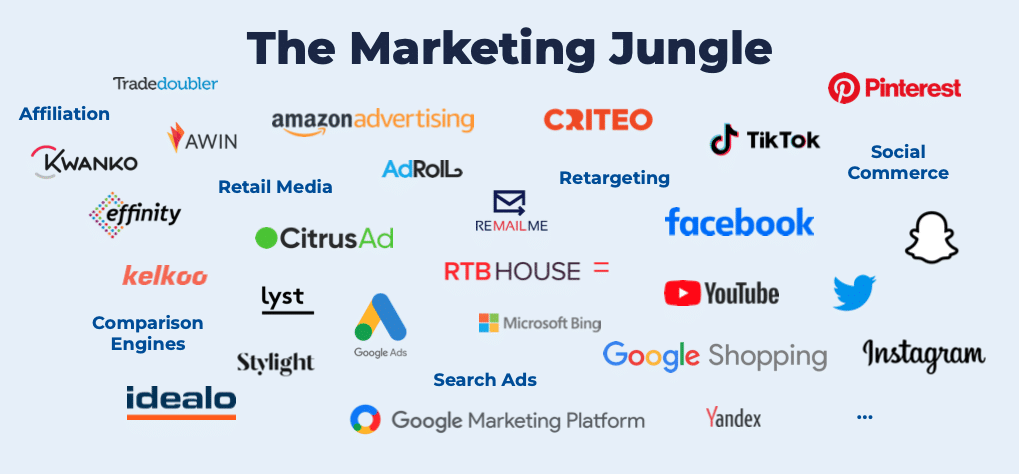
To generate traffic to your e-commerce site, there are several acquisition marketing channels to consider. The most important are listed below.
Social media marketing
involves using platforms like
Facebook, TikTok, Snapchat, Pinterest, and Instagram
to promote your business and connect with potential customers. Effective product ads in various formats can make a big difference, consider also
native shopping solutions
(the entire shopping process – discovery, reinforcement, add to basket and payment – takes place on the social media platform, without leaving it for another site). To improve your website's visibility in search engine results,
search engine marketing strategies include optimizing your site through search engine optimization (SEO) and using
pay-per-click (PPC) or search engine advertising (SEA) to increase its ranking for specific keywords.
Google (Google Ads) is the most widely used search engine, but it's important to also consider
Bing (Microsoft) and
Yandex.
Affiliate marketing
involves partnering with other businesses or individuals to promote your products or services, and paying them a commission for each sale they generate. Some of the best-known
affiliate marketing platforms
include
ShareASale, Awin, Amazon Associates, Shopify, and eBay Partners
.
Retargeting
is a form of online advertising that allows businesses to show ads to users who have previously visited their website. This can be an effective way to increase brand awareness and drive conversions because it allows businesses to show ads to users who have already shown some interest in their products or services. Some of the biggest players in the retargeting space include
Criteo, Facebook, and RTB House
. If the brand or company you work for also has
a presence on marketplaces like
Amazon and sells directly there, then it can also be very important to include
retail media in their marketing strategy.
Social Commerce: Key for Every Multichannel Marketing Strategy
To increase online sales, it is important to focus on where consumers spend the most time online, which is on social media. In the UK, 77.9% of the population is active on social media (53 million users). In Germany, the percentage is even higher, at 78.7%, (66 million users), and in France, 76% of the population uses social media (47 million users). This shows the significant potential for marketers to reach and engage with consumers through social media platforms. Generation Z in particular spends a lot of time on social media. By 2025, the share of e-commerce done through social commerce is expected to reach 17%. In 2021 alone, 64% of social media users made a purchase through social commerce, representing a total of 2 billion buyers. This shows again the vast potential of this market. Social media platforms offer a range of e-commerce features that can help marketers boost online sales. Some of the most notable examples include:- Dynamic product ads on Facebook and Snapchat, which allow brands and retailers to operate a catalog directly within the social network's advertising system, similar to how Google Shopping works.
- Facebook Collection ads, which streamline the journey from product discovery to payment.
- Instagram Shopping Ads, which use product tags to make paid publications more engaging and interactive. Users can click on the tags to go directly to the product page on the seller's site.
- "Links" stickers for Instagram Stories, which allow subscribers to access a brand's website or other digital media with a single click. These stickers replace the popular "Swipe up" feature.
- Different advertising formats offered by TikTok, such as In-Feed Ads, TopView Ads, or Brand Takeover Ads.
- Live Shopping, which allows users to buy products through a call-to-action (CTA) during a live video, often presented by an influencer. This feature is particularly suitable for the beauty e-commerce industry.
Make Sure Your Marketing Strategy Is Data-Driven
For e-commerce marketing it is crucial to rely on data you can easily turn into actions. It will help you drive better decision-making, maintain control over your advertising activity and optimise the costs. By combining advertising data, such as clicks and impressions, with business data, such as margin and turnover, you can enhance your advertising efforts. For example, you can use data such as stock levels, seasonality, and margin rates from your business to inform decisions about your product catalog. This can be done using an e-commerce intelligence platform like Lengow. You will be able to effectively execute your marketing channels strategy. Another concrete example: If you plan promotions, first review your product catalog and use data from recent months or past promotions to identify which products to push in your marketing strategy. Consider sales and stock levels to avoid disappointing shoppers. Use an Analytics tool to analyse your product performance and buying behavior, such as the number of sales and views, and the conversion rate. After that, you can segment your catalogue and create rules based on the Analytics data. For example, you could reduce the prices of products that are not selling well, or to increase the visibility of your best-selling products on the best working channels.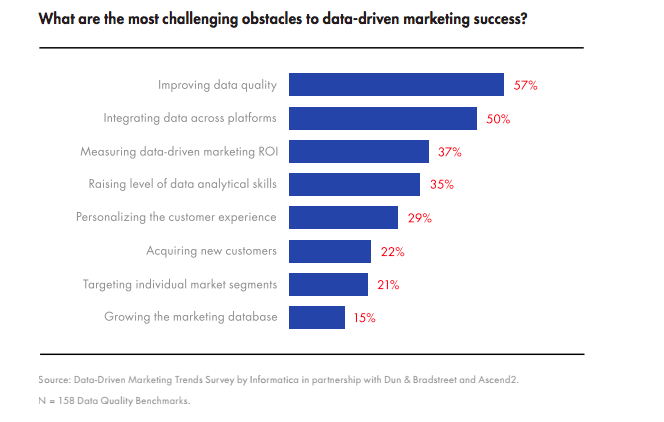
Example: Data-Driven Google Marketing Campaigns
As Google being the most important channel for marketing activities (49% of users utilize it to discover new products and services), let’s have a closer look at it to see which data-driven strategy you could use in this case. Three examples: Run A/B tests on Google Shopping Ads : Converting and driving profit is a major goal for a Google Shopping Ad. Running A/B tests is a solid method of improving your ads. By using A/B tests, you get to see the side-by-side comparison between an ad as-it-stands as well as with new adjustments made. Use the data collected to make the best decision on which ad is the winner. Base your ads strategies on reliable data : Integrate your own data, such as stocks, seasonality performance, competitive pricing, and margins. Add relevant figures and statistics as ‘additional sources’ to your marketing platform in your Google feed. This will allow you to create a complete product catalogue that matches your specific business needs. Afetr that you can segment your Google product catalogues to get ahead of the data, simplifying the process of analysis and evaluation. Set up an accurate price strategy to generate profit : With a Google Price Tracker you can find out which products you sell more expensive, cheaper or equal to the market average. In a similar vein, you will be able to determine whether or not you have the best pricing by using a Google Shopping Repricer, which will allow you to define alternative price strategies for each segmented group. Always remember: base pricing decisions on relevant data.Marketing Automation: A No-Brainer
Marketing automation changes a marketers life. Repetitive, time-consuming marketing tasks are automated. For example, Lengow's marketing automation platform allows businesses to set up and automate their marketing campaigns, such as email marketing or retargeting. By using email list validation software, business can ensure that their email campaigns are sent to valid, engaged recipients, reducing bounce rates and improving overall campaign performance. This can help businesses save time and resources, and ensure that their marketing messages are delivered to the right customers at the right time. Some key elements a marketing automation platform should provide:- Additional sources: Build a single, optimised product catalogue by rapidly enhancing your product feed with hot (price, stock, margin) and cold (rich-media content, picture) data from any source.
- Optimisation rules: Use optimisation rules to easily improve the quality of your titles, attributes, and descriptions, and therefore reduce manual workload.
- Custom Labels: Use custom labels to split your catalogue into segments, based on performance, promotions or seasonality. Run A/B tests on ads, spend more money on items with a high added value, or delete the less effective products.
- Duplication of configurations: You should be able to instantly copy all the existing settings set up on a channel (categories, attributes, etc.) with an “automatic settings import” feature. Like this, you don’t have to carry out unnecessary configurations, and you have a brand new, ready-to-use feed in a matter of minutes for a new channel.
- My Custom Channel: Use this to create a personalized structure for any marketing channel in complete autonomy and speed up the distribution of your products.
Examples of Successful Multichannel Marketing Strategies
If you're curious about what successful e-commerce multichannel marketing strategies might look like, here are a few examples to inspire and pique your interest:- L’OREAL LUXE: The company uses personalised and localised feeds across nine markets for eleven catalogues per brand which are distributed across four different platforms (Google Shopping, Pinterest, Facebook, and Instagram). Thanks to Lengow, L’ORÉAL LUXE has boosted AOV by 20% and +80% turnover on Google Shopping.
- Nespresso: Partners with Lengow since 2015, the global brand distributes its products on numerous marketing channels, such as Meta, Google, and Pinterest, in +35 countries using automatic rules, inventory and promotions management and automatic updates.
- Zadig & Voltaire: With Lengow, the French fashion label was able to get started on retargeting and affiliate platforms and create Dynamic Ads on Google and mainly Facebook. It currently distributes its products in 8 countries and has multiplied its investments by 9 on Google Shopping since 2017.
Upgrade Your Multichannel Marketing Strategy!
Multichannel Marketing Strategy FAQs
.png?width=64&height=64&name=Adrian%20(1).png)
Adrian Gmelch
Adrian Gmelch is Director of Content at Lengow, where he leads content strategy while staying firmly hands-on: reading the research, and tracking the trends that matter before they go mainstream.
.png)